
Mouth — a step-by-step lesson for grown-up and child
This lesson opens the busiest doorway on the face. The mouth takes in dinner, sends out words, shows the whole world a smile and hums along to every song — and your child has been running it, uncredited, since day one.
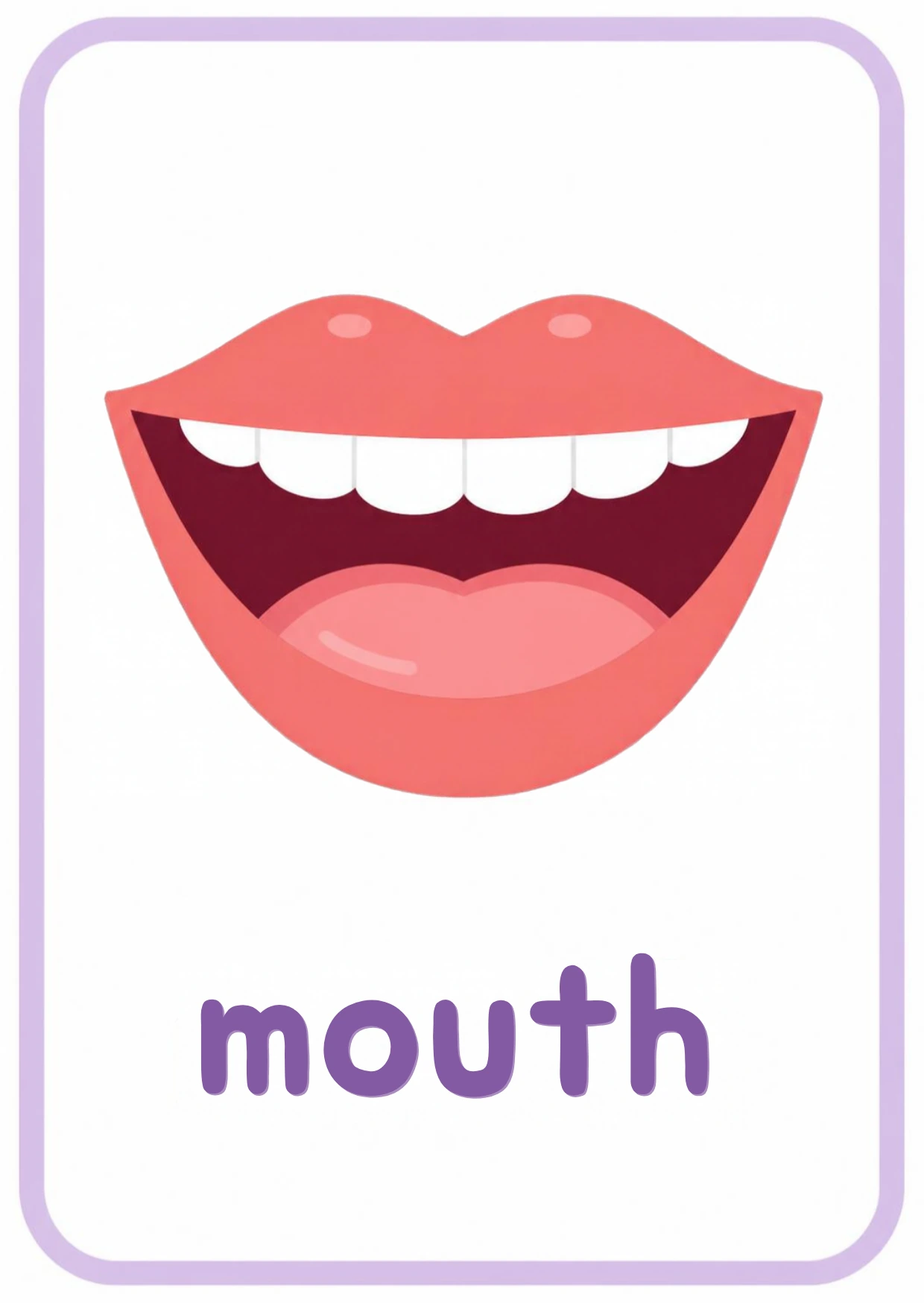
What is this?
The mouth is the opening below the nose, framed by lips. Food and drink go in, words and laughs and songs come out, and inside it works a team: teeth for chewing, tongue for tasting and moving, and a smile showing to everyone.
What does it mean?
The mouth is the body’s front door for two of its biggest jobs: fuel and language. Every word your child says travels out of this one doorway, shaped by lips and tongue; every bite that becomes energy travels in through it. It is also the sense-organ neighbour where taste happens — the tongue lives here.
What does the child need to know?
Your child needs to know: the mouth eats, drinks, talks, smiles and hums, the lips frame it and the teeth and tongue work inside it, it opens wide for the dentist and says aaah — and only food and drink belong inside it, nothing else, not ever.
Why this matters
Naming the mouth gives your child a word for the place where eating meets talking meets feelings — the spot that hurts at the dentist, tingles at the toothbrush and aches when a wobbly tooth arrives. Body maps with the mouth on them handle all of those moments better.
What it teaches
Body-part vocabulary, oral-motor awareness (mouth shapes as controls), the food-and-words double duty, self-care links to tooth-brushing, and the safety rule that keeps non-food objects out.
Words to learn
mouthlipsteethtonguesmilechew
Say this to your child
“"This is your mouth — what a busy doorway! Food goes in, words come out, smiles show and songs hum. Inside: teeth chewing, tongue tasting, lips framing it all. Open wide — aaah! And remember the guest list: food and drink only. Everything else stays out of the mouth."”
Step by step
- Show the card: what body part is peeking out from behind this big open smile? Let the grin give it away, then name its jobs: it eats, it talks, it smiles.
- Make a mouth-shape show together: small ooh mouth, wide aah mouth, big smile, tiny hmm. Ask which shape the card is showing.
- Name the workmates: lips on the outside, teeth for chewing, tongue for tasting and moving food. Say aaah and find all three in a mirror.
- Talk through the door: put a hand gently on your lips while saying a word and feel the buzz. Every word your child says comes out of this doorway.
- Set the membership rule: mouths admit food, drink, words and toothbrushes — nothing else. Pebbles, crayons and toy parts stay out; the mouth has a guest list.
Look closer at the picture
Look at the picture together: is the mouth open or closed? Can you see a smile? What word sits beside it? Are any teeth showing?
Ask your child
"What are all the jobs your mouth does?" "What is inside your mouth that chews? That tastes?" "What shape is your mouth making right now?" "What belongs in a mouth — and what never does?"
What your child can say or do
Your child may perform the whole mouth-shape alphabet on request, report that the tongue lives inside and the teeth are its neighbours, or guard a pebble from a younger sibling with the guest-list rule quoted word for word.
Out in the real world
Mouths work everywhere: chewing dinner, blowing bubbles, whistling at the kettle, saying sorry, singing in the car. The dentist visit is the field trip — the wide-open aaah is exactly the mouth shape this lesson practised.
Try it together
Mouth-shape charades: you make a mouth shape — ooh, aah, wide smile, small circle — and your child guesses what goes with it: blowing a candle, saying aaah at the doctor, smiling at a friend, drinking through a straw. Swap roles. Every round is oral-motor practice disguised as a guessing game.
Understanding check
Ask: "Name three jobs your mouth does. What chews inside it? What goes in a mouth?" The list, the teeth and the food-only rule — that is the lesson landed.
Parent tips
Connect the mouth lesson to tooth-brushing night — same doorway, same teeth, same tongue — and the routine gains a body-map reason. If mouthing of objects still happens at three, the guest-list rule said cheerfully, and often, does more than any confiscation.
Staying safe
Only food and drink go in the mouth — pebbles, batteries, button coins and toy parts are mouth hazards, not snacks, and small objects stay away from little siblings. Biting is for food: friends, pets and furniture are all outside the guest list.
This lesson pairs with the Mouth flashcard in the library — print it, show it, keep it on the fridge. Back to Body Parts & Five Senses Flashcards.