
Head — a step-by-step lesson for grown-up and child
This lesson starts at the very top. The head is the body part your child has known longest — it shook no before any words arrived — and naming it properly opens the whole map of the face and the five senses living on it.
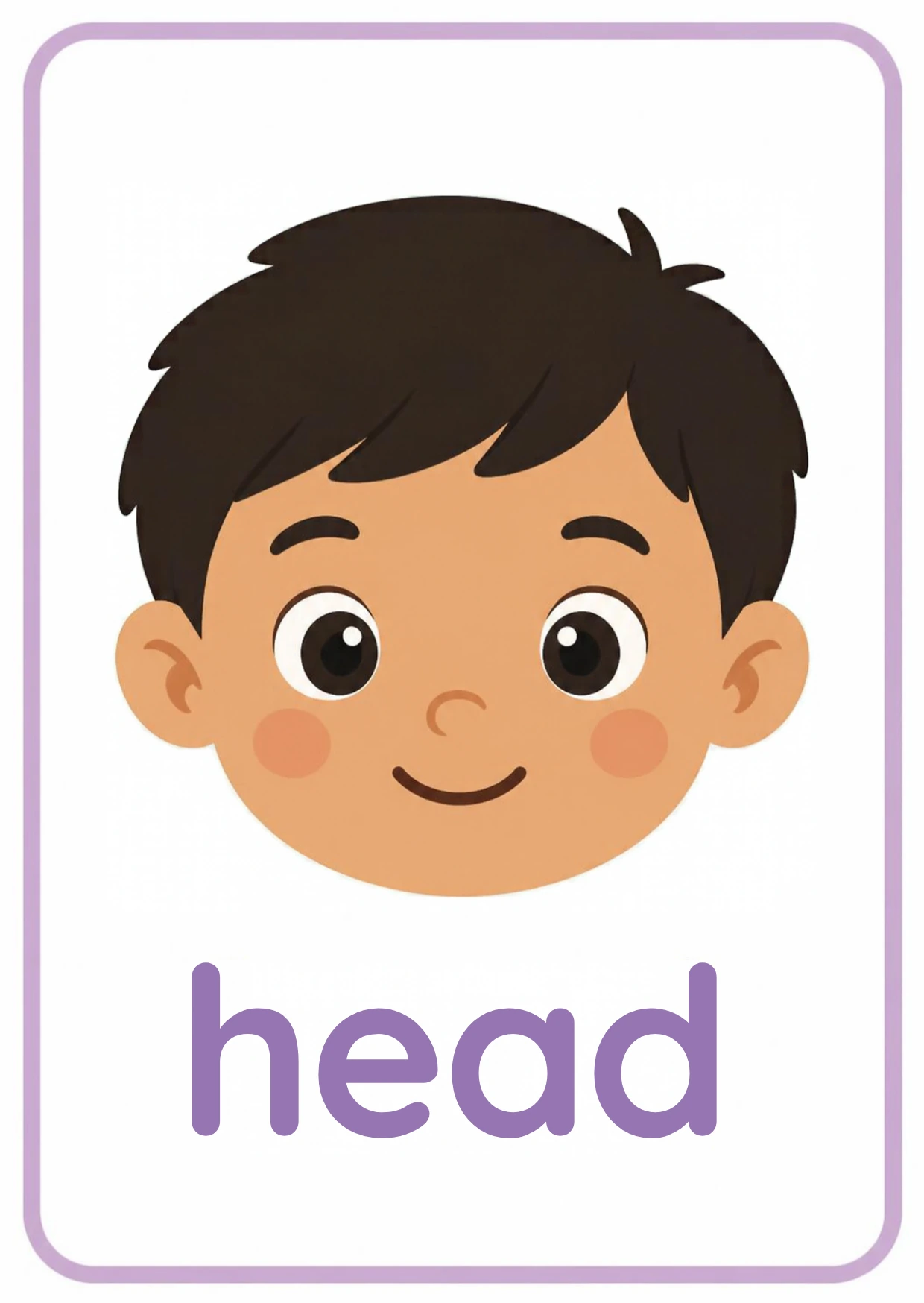
What is this?
The head is the top part of the body: a round home for the face, the brain inside and all the sense organs — eyes, ears, nose and mouth. Everything your child uses to see, hear, smell, taste and talk is gathered in this one place.
What does it mean?
The head sits on top for a reason: it is the body’s lookout tower. High up, the eyes see further, the ears catch more, and the brain inside gets first news of everything. Your child’s head also does the showing — nodding yes, shaking no, tilting to listen — before any words are needed.
What does the child need to know?
Your child needs to know: the head is the body part on top, it holds the face and the brain, hats and hoods and hairbrushes all live on it, and it moves in useful ways — nodding for yes, shaking for no, tilting when something is interesting.
Why this matters
Body-part naming is the first map a child ever learns, and the head is its capital. A child who can name the head and everything on it can follow directions, describe aches and feelings, and take part in the games — heads up, head down — that preschool runs all day.
What it teaches
Body-part vocabulary and body schema (the internal map of self), imitation and motor control in the nod-and-shake games, the five-sense organs as a set, and self-identity — my head, my face, my smile.
Words to learn
headfacebrainnodshaketop
Say this to your child
“"This is your head — the very top of you! Your head holds your face, your eyes, your ears, your nose and your mouth, and your brain works inside it all day. Nod your head: yes! Shake your head: no! Your head talks before your mouth does."”
Step by step
- Show the card and ask what body part this is — the smiling boy’s face with dark hair makes the answer easy. Then point to the word: head.
- Find your child’s head with both hands: round on top, face at the front, hair up top. Name each neighbour — eyes, ears, nose, mouth — as you touch near it.
- Play the head-moves game: nod your head yes, shake your head no, tilt it slowly side to side like you are listening. Your child copies each one.
- Name what lives on the head: a hat goes here, a hood goes here, the hairbrush visits every morning. Head as a place, not just a part.
- Finish with the lookout tower idea: the head sits on top so the eyes can see far and the ears can hear wide. Ask your child to look left, look right, from their tower.
Look closer at the picture
Look at the picture together: whose face is this — a smiling boy’s? What color is his hair? Which word sits under his face? What is your own head doing right now?
Ask your child
"What is the top part of your body called?" "What does your head carry — name them all!" "How does your head say yes? And no?" "What do we put on our heads when it is cold?"
What your child can say or do
Your child may nod and shake through every question for a day, name the whole face-country map — eyes here, ears here, nose here — or report proudly that the brain lives inside and it is thinking right now.
Out in the real world
Heads are named all day long: heads up at crossing the street, brush your hair, hat on for the cold, chin up at the doctor’s. Every one of those daily phrases lands better on a child who knows exactly which part the word means.
Try it together
Follow-my-head: you move only your head — nod, shake, tilt, look up, peek down — and your child copies like a mirror. Swap roles. Add slow-motion mode and robot mode. It is imitation, motor control and connection in one seated game.
Understanding check
Ask: "What is this body part? What does your head carry? Show me yes and no with your head." The name, the list and the nod — that is the lesson landed.
Parent tips
Touch is what makes body maps stick — name each part while your hand is on it, not from across the room. And let the head be silly sometimes: a head that can tilt like a curious bird or droop like a sleepy puppy is a head fully explored.
This lesson pairs with the Head flashcard in the library — print it, show it, keep it on the fridge. Back to Body Parts & Five Senses Flashcards.