
Hear — a step-by-step lesson for grown-up and child
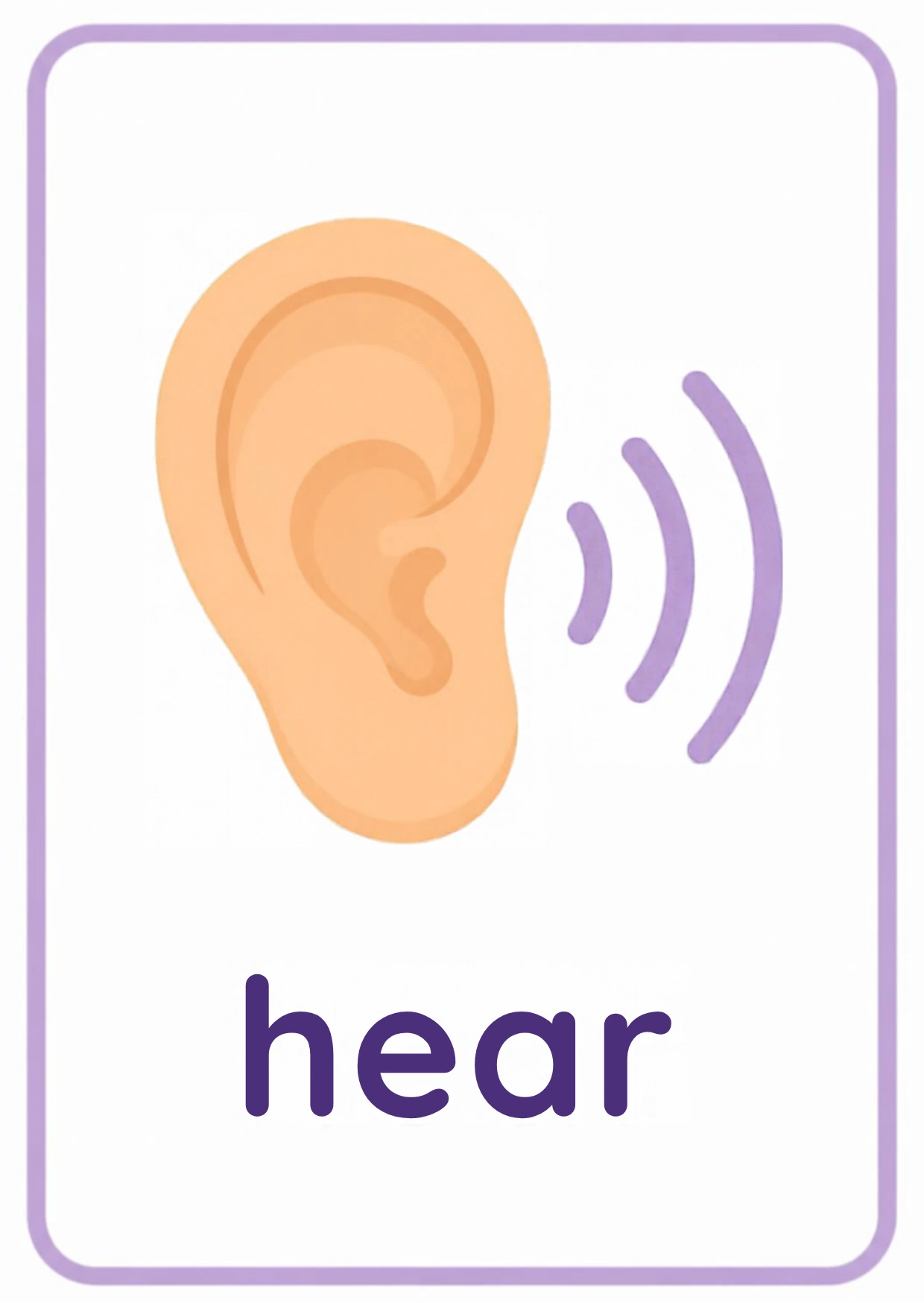
This lesson tunes the five-senses collection to sound. Hearing is the sense that never closes — working in the dark, through walls, while asleep — and this card draws it beautifully: sound waves rippling out of the picture, straight for an ear.
What is this?
Hear is what your ears do: catch sounds — voices, dogs, rain, music — and send them to the brain to be understood. It is the second of the five senses, and the only one that never switches off for sleep.
What does it mean?
Sound travels in invisible waves through the air — the card draws them as ripples — and the ear collects them. Hearing works from every direction at once, even through doors and in the dark, which makes it the body’s early-warning system: the sense that tells you something is happening before you can see what.
What does the child need to know?
Your child needs to know: we hear with our ears, hearing is the second of the five senses, sounds can be loud or soft, near or far, and ears are delicate — very loud noise right up close hurts them, so volume stays kind and ears get quiet when they need it.
Why this matters
Hearing is half of language: every word your child learns arrives through this sense first. The listening games build the attention that stories, music and classroom instructions run on — and a trained ear is also a safety ear, catching the warning shout before the eye finds the danger.
What it teaches
Auditory attention and discrimination, the five-senses framework (hearing as one of five), volume awareness and self-regulation, sound vocabulary (loud, soft, high, low, near, far), and stillness as the price of listening well.
Words to learn
hearearssoundloudsoftwaves
Say this to your child
“"Hear! Your ears catch sounds in invisible waves — listen: the clock, the bird, my voice. Hearing is one of your five senses, and it never sleeps — your ears work even in the dark! But they are delicate, so sounds stay kind and gentle around them. What can you hear right now, this very second?"”
Step by step
- Show the card and ask what the ripples around the ear might be. Explain: sound travels in waves — invisible, but real — and the ear catches them. That is hearing.
- Name the five-senses family again: seeing, hearing, smelling, tasting, touching. Hearing is number two — and it works even with eyes shut.
- Prove it: everyone shuts their eyes for five slow seconds and listens. What arrived? Name every sound that came in — the fridge, a car, a voice down the hall.
- Play near-and-far: make a sound close to your child’s ear, then the same sound from across the room. Same sound, different size — that is how ears measure distance.
- Set the volume rule: ears like sounds at talking level. Shouting straight into an ear, or music at full blast, is too much — quiet is not boring, quiet is ear care.
Look closer at the picture
Look at the picture together: what do you see coming from the ear — the purple waves? What word sits with the picture? Is the ear alone or with a face?
Ask your child
"What do we hear with?" "Which sense keeps working while you sleep?" "What sounds can you hear right now?" "What sounds are too loud for ears — and what do we do about it?"
What your child can say or do
Your child may freeze mid-play, finger raised, to announce a sound nobody else noticed, ask what made every noise in the house, or turn the music down unprompted with the volume rule quoted — hearing, owned and defended.
Out in the real world
Hearing fills every part of the day: the kettle, the doorbell, the story at bedtime, the warning call at the road. Give the ears their catches — your ears heard the post arrive — and the invisible sense becomes visible to its owner.
Try it together
The listening minute: sit still together, eyes open or shut, and raise one finger for every new sound heard in one quiet minute. Compare lists afterwards — two ears, two different reports. The stillness is the training; the comparison is the fun.
Understanding check
Ask: "What do we hear with? How many senses? What do sound waves look like on our card?" The ears, the five and the ripples — that is the lesson landed.
Parent tips
The listening minute works in waiting rooms, queues and cars — anywhere stillness is welcome anyway. And model your own listening: when a sound arrives, stop, name it, look for it together. Children learn what attention looks like by watching yours.
Staying safe
Little ears are delicate: keep music and screens at talking volume, no shouting directly into anyone’s ear, and step away from very loud noise — speakers, engines, fireworks — or cover ears when it cannot be avoided. Ringing ears are ears asking for quiet.
This lesson pairs with the Hear flashcard in the library — print it, show it, keep it on the fridge. Back to Body Parts & Five Senses Flashcards.