
See — a step-by-step lesson for grown-up and child
This lesson opens the five-senses collection with the busiest one. Seeing is how your child takes in most of the world — and this card proves it beautifully: a butterfly has landed right where the eyes can find it.
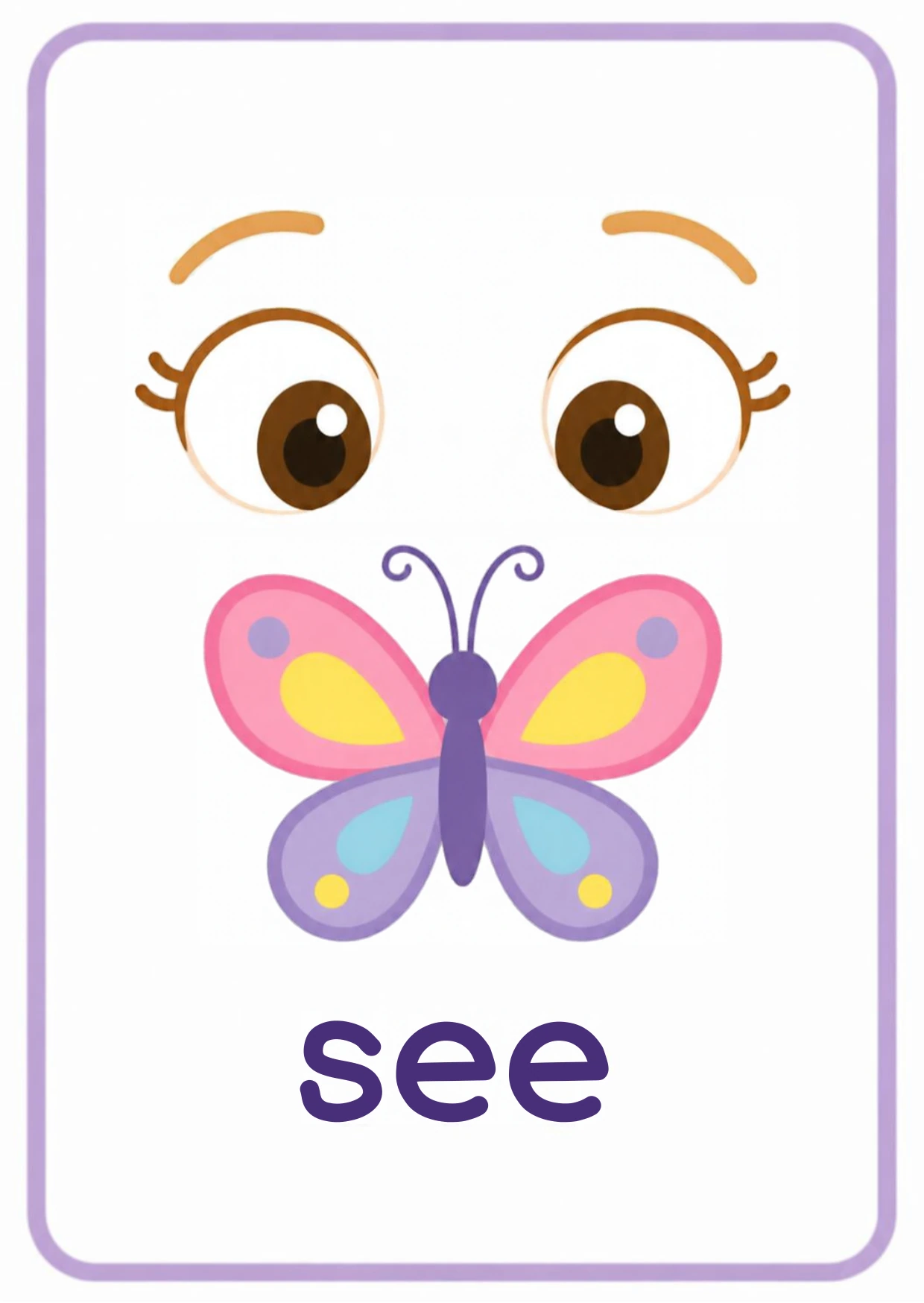
What is this?
See is what your eyes do: catch light and turn it into pictures inside your head. It is one of the body’s five senses — the five ways to learn about the world — and it is the one working hardest for your child, from the moment the day starts.
What does it mean?
Your body has five ways to learn: eyes see, ears hear, nose smells, tongue tastes, skin touches. Seeing is the loudest of the five — most of what a preschooler knows arrived through the eyes. And seeing is a skill, not just a fact: looking closely, like the picture’s butterfly-watcher, is seeing done on purpose.
What does the child need to know?
Your child needs to know: we see with our eyes, seeing is one of five senses, looking closely is something you can practise — slow down, really look — and eyes need protection: never a look at the sun, bright days get hats and shade.
Why this matters
Naming see gives your child the owner’s manual for their busiest sense. It turns look at this into a game they can play alone — spotting, noticing, comparing — and it anchors the five-senses map that every later science lesson, from light to rainbows, will stand on.
What it teaches
Visual attention and observation, the five-senses framework (seeing as one of five), descriptive vocabulary for what the eyes find, sun-safety habits, and the quiet pride of spotting things others miss.
Words to learn
seeeyeslookspotbutterflyobserve
Say this to your child
“"See! Your eyes are one of your five senses — five ways your body learns about the world. The butterfly on this card landed right where the eyes could find it. Let us play: I see something red… can you spot it? Looking closely is seeing done like a scientist."”
Step by step
- Show the card and ask what the eyes are doing — and what has come to visit them. A butterfly, landing near! That is seeing at work: the eyes found it.
- Name the five-senses family: eyes see, ears hear, nose smells, tongue tastes, skin touches. Seeing is the first of five ways to learn.
- Play colour spy: I see something red… something round… something tiny. The finder must point before shouting the answer — looking before leaping.
- Practise looking closely: pick one small thing — a leaf, a button, a toy — and study it for ten slow seconds. What did the eyes catch that a quick look missed?
- Set the sun rule with care: the sun is too bright for eyes, ever. Bright days get hats, shade and sunglasses — the eyes do the seeing, the hat does the guarding.
Look closer at the picture
Look at the picture together: what has landed near the eyes — a butterfly? Is it close or far away? What word sits with the picture? What color can you spot in it?
Ask your child
"What do we see with?" "How many senses does your body have — can you name them?" "What did your eyes spot today that nobody else noticed?" "Why do we never look at the sun?"
What your child can say or do
Your child may announce the five senses as a memorised team, spot the tiniest ladybug on the walk and demand witnesses, or hold up the sun rule to a grandparent — seeing, named, practised and defended.
Out in the real world
Seeing is the sense that works everywhere: reading signs, spotting the bus, choosing the best apple, finding a friend in the park. Give the eyes their credit out loud — your eyes found it — and the sense becomes a skill your child knows they own.
Try it together
Spot-the-change: arrange five toys on a tray, let your child look away, secretly remove or swap one, and ask what changed. Three rounds, then swap roles. It is observation training with a mystery plot — and remembering what was there is the hard, valuable part.
Understanding check
Ask: "What do we see with? How many senses are there? Show me looking closely." The eyes, the five and a slow deliberate stare — that is the lesson landed.
Parent tips
Keep the colour spy game in the car, the queue and the bath — it is the most portable sense game there is. And when your child spots something first, let them be the spy-caller next round: the finder becomes the teacher, and the sense gets sharpened twice.
Staying safe
The sun rule is absolute: looking straight at the sun — even for a second, even on a hazy day — can damage eyes for life. Hats, shade and sunglasses are the eye’s equipment for bright days, and adults follow the same rule out loud so the copying goes both ways.
This lesson pairs with the See flashcard in the library — print it, show it, keep it on the fridge. Back to Body Parts & Five Senses Flashcards.