
Banana — a step-by-step lesson for grown-up and child
The banana is the fruit a three-year-old can open all by themselves, which makes it a milestone wearing a snack. This lesson teaches the word at the card, the growing — tall plants in warm countries, not trees — and hands over the peel, the proudest job in the fruit bowl.
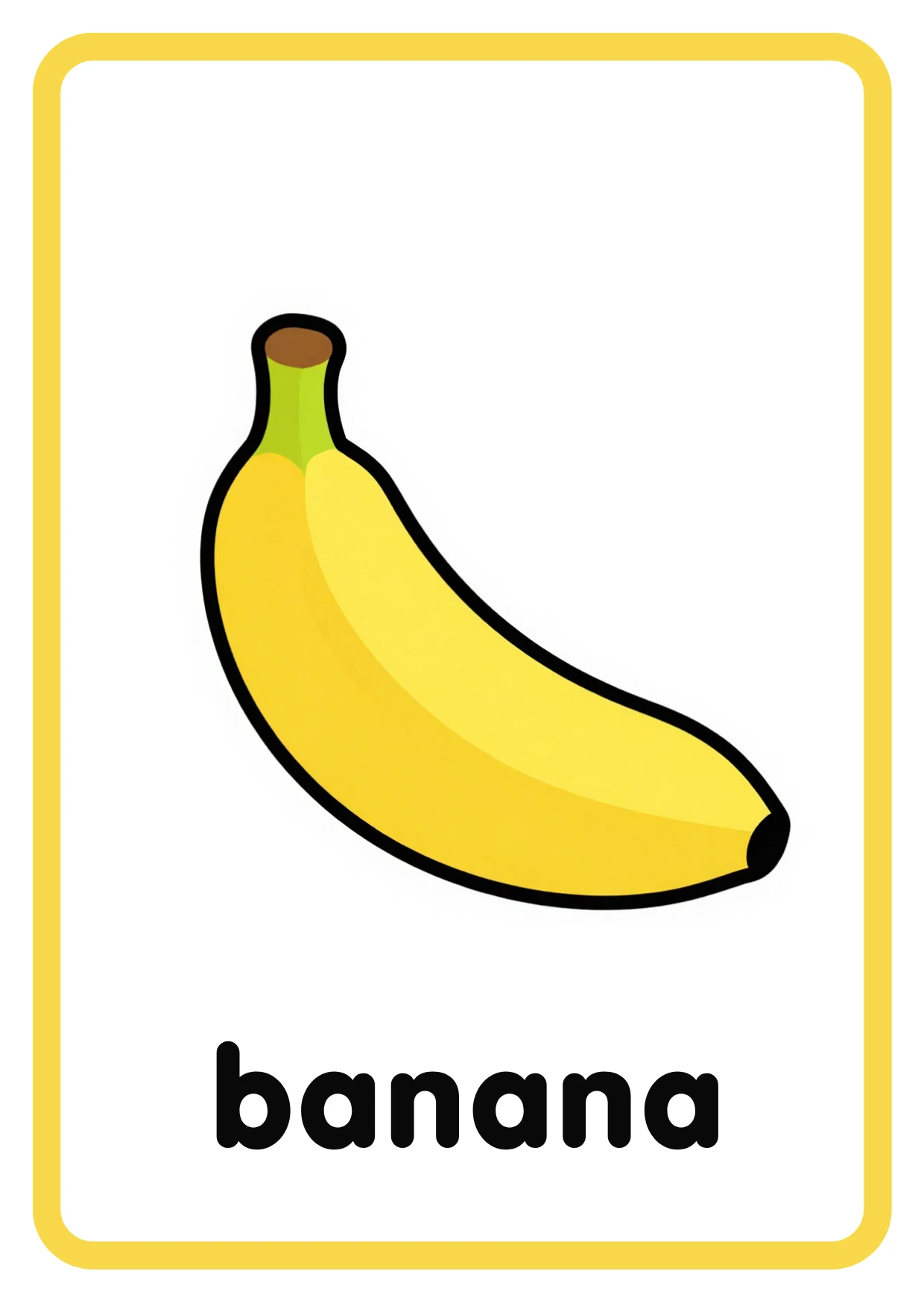
What is this?
A banana is a long, curved, yellow fruit that grows in bunches on tall plants in warm countries. The card shows one yellow banana with the word underneath. Inside the peel it is soft and sweet; outside it turns from green to yellow to spotty as it ripens — spots mean sweeter.
What does it mean?
Peeling is problem-solving: pinch the top, pull the strip down, repeat. A child who works a banana open is doing fine-motor engineering with an edible result, and the word banana rides on every step — said at the pinch, said at the pull, said with a full mouth at the end.
What does the child need to know?
Your child needs the word at the card, the where-it-grows story — big plants, warm places, bunches — and one full peel done by their own hands while you supervise only the eating. The ripeness game is a bonus: green means wait, yellow means go, spots mean sweetest of all.
Why this matters
Self-service foods build independence at exactly the age it is cheapest to build: a banana needs no knife, no grown-up strength and no waiting. The word attaches to capability — “I can open it myself” — and capability is the hook that keeps vocabulary coming back.
What it teaches
Fine motor control in the peel, sequencing (pinch, pull, open, eat), ripeness observation, tropical-plant knowledge (big plants, not trees), and the independence that makes snack time self-managing.
Words to learn
bananayellowpeelsoftsweetcurve
Say this to your child
““Banana! Ba-na-na — three claps for three parts. Where does it grow? On tall, tall plants, hanging in bunches in the sunshine. Now the best bit: you peel it. Pinch the top... pull the strip... open! Yellow all the way through. You opened it yourself!””
Step by step
- Show the card and say banana slowly — three parts, three claps: ba-na-na. Clap it again together.
- Ask where it grows and tell the story: tall green plants in warm countries, bananas hanging in whole bunches like crowds of friends.
- Hand over the fruit and the job: your child pinches the top and peels the strip down — help only if the pinch fails twice.
- Say the word at every stage: banana in the hand, banana in the peel, banana in the smile.
- Finish with the spots game: find the spottiest banana in the bowl and guess whether it is the sweetest — then taste the evidence.
Look closer at the picture
Study the card together: it shows a yellow banana, bent like a smile, with the word banana underneath. Ask your child which way the curve bends, what color it is, and whether the real bananas at home bend the same way.
Ask your child
“Do bananas grow on trees or on big plants?” “What color is a banana before it is ready?” “What do the spots mean?” “Who can peel one — you or me?”
What your child can say or do
Your child might clap out ba-na-na at random meals, inspect every banana in the shop for spots, or peel one with exaggerated ceremony for a visiting teddy — the word has landed when the routine travels to an audience.
Out in the real world
Bananas arrive weekly and get opened daily: breakfast, snacks, the shopping bag. Each peel is another rehearsal of the word and another rep for the fingers that do it — vocabulary and fine motor, sharing one snack.
Try it together
Peel-it-like-a-pro practice: two bananas, and your child opens both — pinch the top, pull the strip down, one strip at a time — while you supervise the eating. Save the peels for a teddy-bear picnic afterwards, where the word gets performed to an audience of one very polite bear.
Understanding check
Ask: “What grows on tall plants in warm places? Clap the word. Who peels it?” The claps, the plants and a proudly opened fruit — that is the lesson landed.
Parent tips
If your child calls every yellow food banana, spread the evidence: a lemon, a pepper, the banana itself — same color, different shapes. Sorting by shape after sorting by color is the next chapter, and the fruit bowl teaches it for free.
Staying safe
A grown-up takes over if the peel fights back, and the fruit gets a quick rinse before peeling — hands touch the outside, then the inside. Watch for over-enthusiastic bites: a banana is soft, but a full mouth still needs sitting down and slowing up.
This lesson pairs with the Banana flashcard in the library — print it, show it, keep it on the fridge. Back to Fruits & Vegetables Flashcards.