
Pumpkin — a step-by-step lesson for grown-up and child
The pumpkin closes the vegetable class at maximum volume: the biggest card, the biggest vegetable, and a season — autumn — that seems to exist partly in its honor. This lesson teaches the word at the card, the ground-growing story it shares with the watermelon, and the seed hunt that turns the giant into a counting game.
What is this?
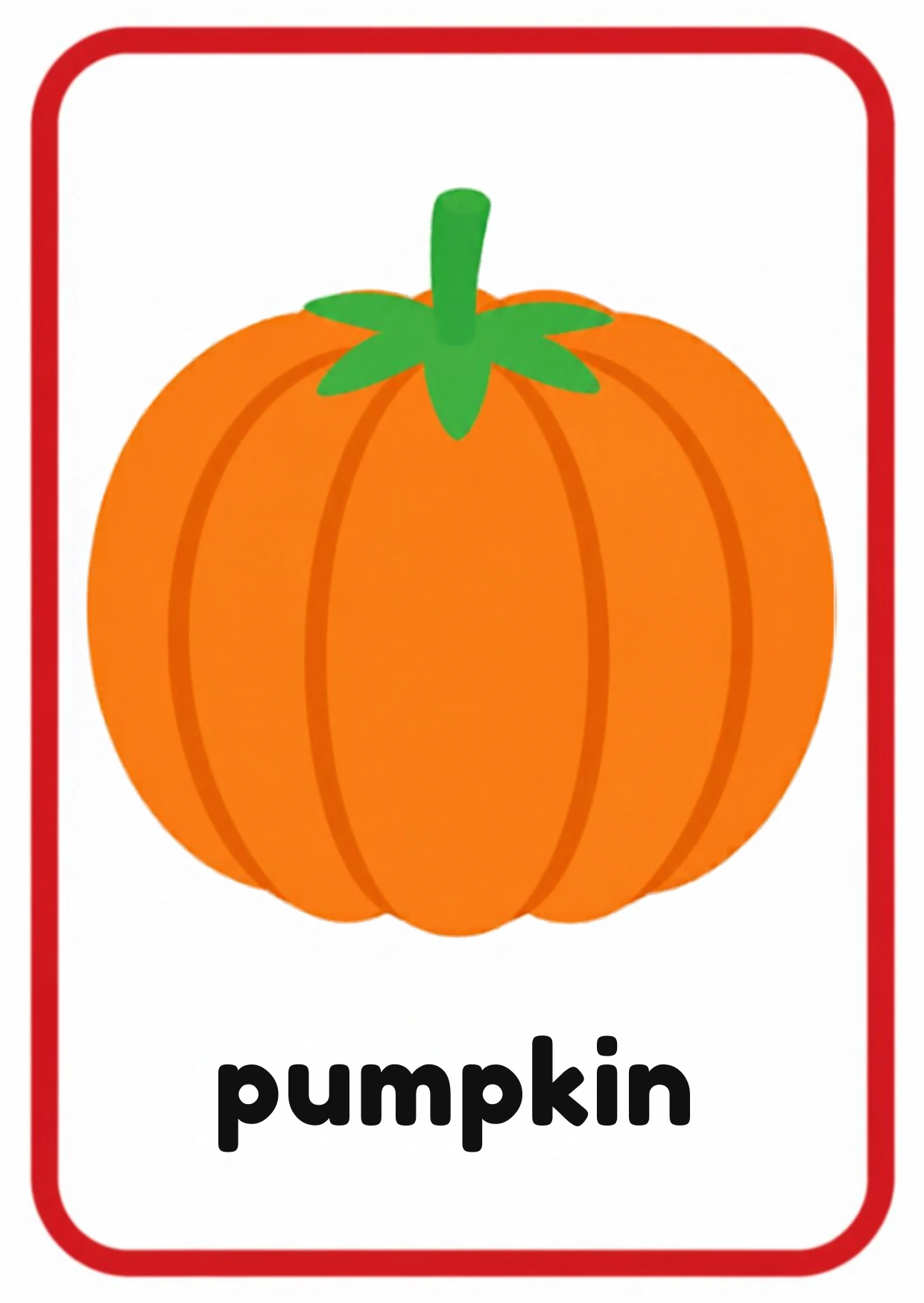
A pumpkin is a huge, round, orange vegetable that grows on the ground on sprawling vines, resting on the soil like the watermelon. The card shows a big orange pumpkin with a sturdy stem. Outside it is ribbed and hard; inside it is hollow, stringy and full of hundreds of seeds in a soft yellow nest.
What does it mean?
Scale is the lesson: the pumpkin is the biggest thing in the fruit-and-vegetable world your child handles, and lifting attempts teach weight vocabulary — heavy, heavier, too heavy — with immediate physical feedback. A word that can be tried against your own muscles is a word the body helps remember.
What does the child need to know?
Your child needs the word at the card, the ground-growing story — it lounges on a vine like its cousin the watermelon — and the pat-and-lift test: pat the drum like a drum, hard and hollow, then attempt a lift with adult spotting. The seed hunt completes it: a grown-up opens the top, your child scoops, washes and counts the seeds — hundreds, honestly.
Why this matters
The pumpkin connects the class to the year’s calendar: autumn, harvest, the season of orange doorsteps. A child who knows pumpkins grow on the ground — not on shelves, not in shop freezers — owns the behind-the-scenes of their own holidays, which is the kind of knowledge children treasure and retell.
What it teaches
Weight vocabulary tried physically, size comparison (bigger than a melon, bigger than a dog?), seed scooping fine motor, vine-growing knowledge shared with the watermelon, and the seasonal calendar knowledge that autumn brings its own vegetable.
Words to learn
pumpkinorangebigseedsribsstem
Say this to your child
““Pumpkin! PUM-kin — the biggest vegetable we know! It grows on the ground on a long vine, resting like the watermelon. Pat it — can you hear the hollow drum? Now try to lift it... HEAVY! And inside: hundreds of seeds, hiding in a yellow nest. Scoop them, wash them, count them — the biggest vegetable is also a counting game!””
Step by step
- Show the card and say pumpkin in two beats — PUM-kin — a big round word for a big round vegetable, said with arms drawn wide.
- Tell the growing story: pumpkins grow on the ground on sprawling vines, like the watermelon — resting on the soil, getting bigger all summer.
- The pat-and-lift test: pat a real pumpkin like a drum — hard, hollow, echo-y — then attempt a two-hand lift with a grown-up spotting. Report the weight: heavy? Very heavy?
- The seed hunt: a grown-up cuts the top, and your child scoops the stringy nest — then washes the seeds in the colander and counts as far as counting will go. Hundreds!
- Close with the season round-up: what else arrives with pumpkins? Leaves, harvest, colder mornings — the year’s biggest vegetable comes with its own season attached.
Look closer at the picture
Look at the card together: it shows a big orange pumpkin with a stem and the word pumpkin underneath. Ask your child whether the pumpkin is bigger or smaller than the apple card, what the ribs on its sides look like, and what the stem is doing.
Ask your child
“Where does a pumpkin grow — up high or on the ground?” “Who is its sprawling cousin?” “What hides inside the hollow?” “Is it heavier than your football?”
What your child can say or do
Your child might drum on every pumpkin at the shop, report the seed-count in the hundreds with total accuracy, or point out that Halloween pumpkins are “just big vegetables with faces” — a seasonal icon decoded is a vocabulary lesson with decorations.
Out in the real world
Pumpkins own the autumn: doorsteps, shop displays, the farm visit, the pie. Every sighting repeats the word, and the ground-vine fact keeps coming up — nobody ever guesses it, and everyone remembers it once told.
Try it together
The seed excavation: a grown-up cuts the lid, your child scoops the inside with both hands — slimy! — and the seeds get washed in the colander, patted dry and counted in rows. Roast a handful if you like: the pumpkin pays off its counting game in snacks, and the counting gets louder every autumn.
Understanding check
Ask: “Where does a pumpkin grow? What hides inside it? Is it heavy or very heavy?” The ground, the hundreds of seeds, and a muscle-tested answer — that is the lesson landed.
Parent tips
If the seed count collapses into silliness — it will — let it: “more than a hundred, less than a million” is a genuine mathematical answer, and the laughing while saying it is the sound of a lesson working.
Staying safe
The opening is strictly a grown-up job — thick skin, big knife, stubborn stem. Your child owns the scooping, the washing and the counting, hands washed after; raw pumpkin flesh is for exploring, and the cooked or roasted versions are the ones that get eaten.
This lesson pairs with the Pumpkin flashcard in the library — print it, show it, keep it on the fridge. Back to Fruits & Vegetables Flashcards.