
Ten Butterflies — a step-by-step lesson for grown-up and child
This lesson reaches the summit: ten. Two rows of five butterflies, two hands of five fingers, one enormous celebration. Your child counts the whole set, meets their own two hands as the number they carry everywhere, and finishes the counting journey that started with one apple.
What is this?
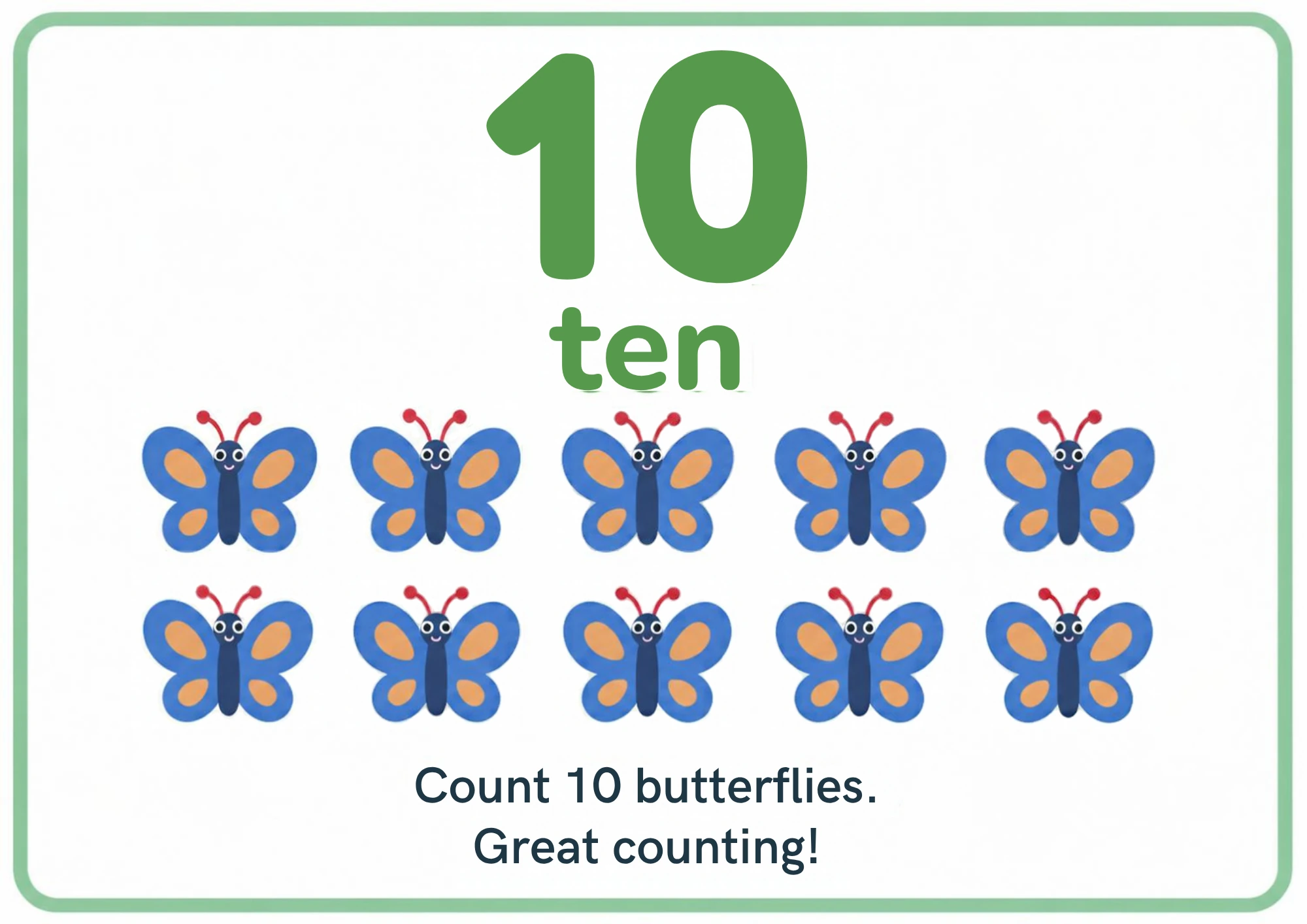
Ten is nine and one more — and five and five, and a whole pair of hands. On the card: ten blue butterflies fluttering in a pair of rows, the word ten and a big green numeral 10 — the grand finale of the counting cards.
What does it mean?
Ten is the number children own twice: once on the card, once on their fingers. Matching butterflies to fingers one-to-one is the deepest work this card does — the count and the body agreeing, ten and ten, a whole system clicking together.
What does the child need to know?
Your child needs: ten comes after nine, each butterfly gets one touch, and ten matches both hands together. And the kindly secret: stopping at five on a tired day is a complete lesson, not an early finish.
Why this matters
Ten is the base of the whole number system — every bigger number is built from tens. A child who has counted ten slowly, matched it to ten fingers and celebrated reaching it has shaken hands with the structure of all future maths.
What it teaches
Two-digit recognition (the 1 and the 0 teaming up), ten-as-five-and-five, finger matching at full scale, celebration and pride — finishing a long journey is its own developmental event.
Words to learn
tenbutterflieshandsfingersallcelebrate
Say this to your child
“"Ten butterflies! Two rows of five — let’s count them all: one, two, three, four, five — and five more: six, seven, eight, nine, ten! Now your hands — one wiggle for every number we say. Ten butterflies, ten fingers! You counted the whole way. Hooray for ten!"”
Step by step
- Show the card and ask how many butterflies arrived for the finale — then count them together, one row of five, then the other.
- Match the count to hands: five butterflies, five fingers on one hand; five more, five on the other — ten and ten, agreeing beautifully.
- Wiggle the count: one finger wiggles for every number said, all the way to ten, ending in two hands flung open — ten!
- Build the full set: line up all the number cards from one to ten and count the whole parade — the journey from one apple to ten butterflies, walked end to end.
- Finish with the drumroll: knees slapped fast, hands up, TEN! — and if the day was long, a five-high-five and see you tomorrow, because five is a finish line too.
Look closer at the picture
Look at the card together: how many blue butterflies are fluttering on it? What two digits make the big green numeral — a 1 and a 0? Touch each butterfly once as you count to ten, then hold up both hands and count their ten fingers too.
Ask your child
"How many butterflies are on the card?" "How many fingers do you have — all together?" "What is five and five more?" "Which card comes after nine?" "Can you count our whole number line from one?" — the grand-finale questions.
What your child can say or do
Your child may march through the whole number line unprompted, count ten stairs, ten peas and ten sleepy yawns, and demand the drumroll nightly. Ten becomes the badge of honour it deserves to be — worn loudly, with both hands.
Out in the real world
Tens close every day: ten toes in the bath, ten biscuits in the packet minus a few, ten goodnight kisses — one per finger, counted slowly. The whole set lives on the fridge now, counted front to back on proud mornings.
Try it together
The full parade: lay all ten number cards out in order and walk the line, touching each card and naming it — one apple, two ducks, all the way to ten butterflies. Then shuffle three cards and let your child put the parade back in order. The walk is the review; the fixing is the mastery.
Understanding check
Ask for ten tomorrow at bathtime — ten toes: if the count lands clean with a wiggle per toe, the finish line was truly crossed. Then flip it: ask what comes after nine, and listen for the two-digit answer arriving proudly.
Parent tips
Match every long count to the hands — five and five is the skeleton of ten, and fingers are always in stock. End tired days at five with full honours: the set rewards returning counters far more than it rewards stubborn ones.
Staying safe
Paper cards live on the fridge or at table height, not underfoot. Bathtime toe-counting happens seated with a grown-up within arm’s reach — and the drumroll is knee-slapped, never table-banged, for the sake of the dinner below.
This lesson pairs with the Ten Butterflies flashcard in the library — print it, show it, keep it on the fridge. Back to Numbers 1–10.