
Nine Balloons — a step-by-step lesson for grown-up and child
This lesson climbs the last hill before ten: nine balloons, three rows of three, counted patiently from top to bottom. Your child discovers that big numbers are just little groups holding hands — and that resting mid-count is allowed.
What is this?
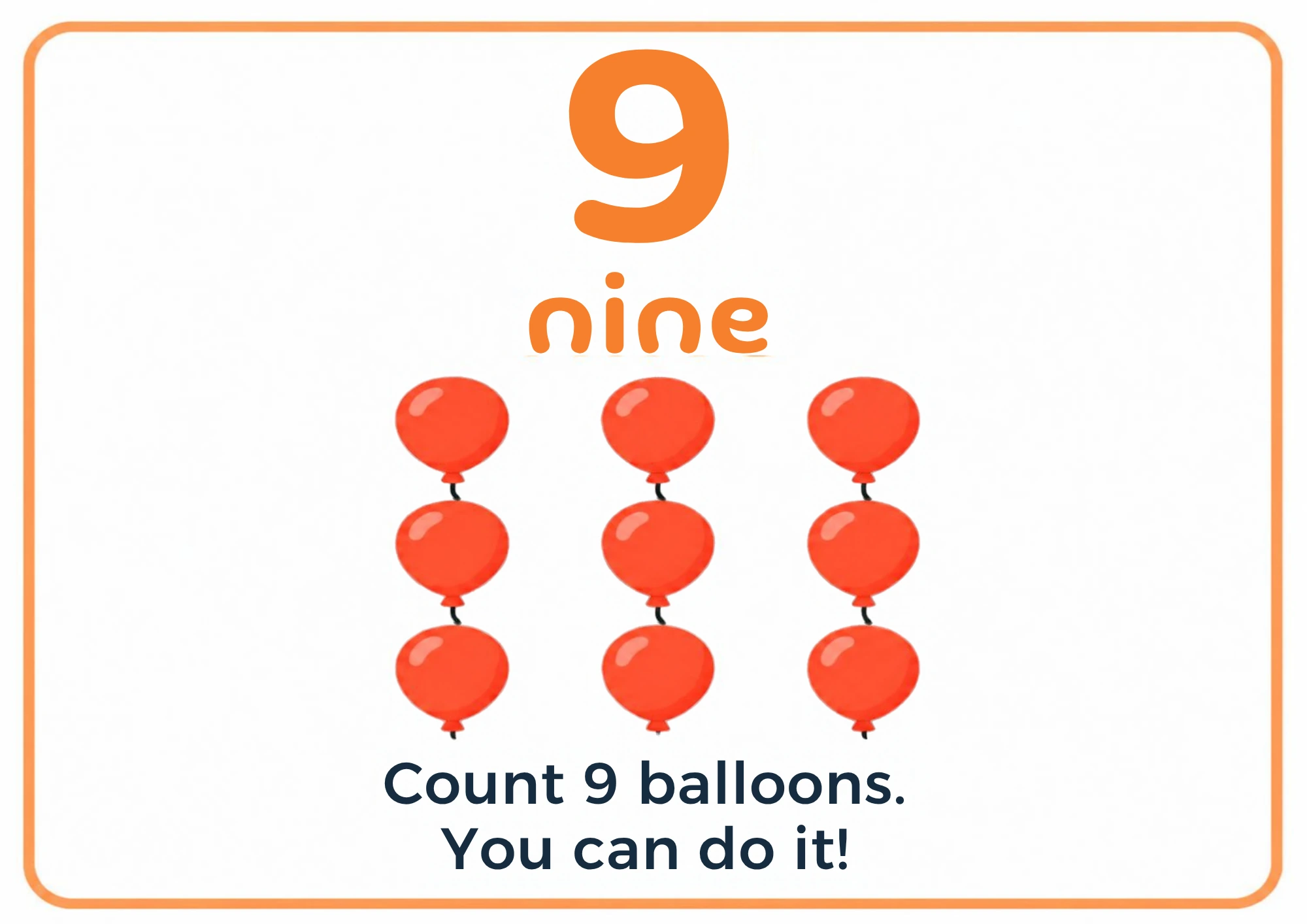
Nine is eight and one more — or three rows of three, which is how the card shows it. On the card: nine red balloons standing in tidy columns, the word nine and a big orange numeral 9.
What does it mean?
Nine is big enough to need a plan: count a row, rest, count the next. Children learn here that long counts are stamina events — and that the layout on the card is a friend, holding the count steady when memory wobbles.
What does the child need to know?
Your child needs: nine comes after eight, each balloon gets one touch, and three rows of three can be counted one after another. Drifting away mid-count is allowed and normal — the balloons will wait, and so will the lesson.
Why this matters
Counting nine teaches strategy, not just sequence: choose a route, follow the rows, keep your place. That self-organisation is the bridge to ten and beyond — and spotting three-threes inside nine is multiplication seen from a very great distance.
What it teaches
Long-count stamina, route planning across a grid, three-plus-three-plus-three composition, patience with self and numbers, and the focus that a tidy layout quietly trains.
Words to learn
nineballoonsrowsthreestacktotal
Say this to your child
“"Nine balloons! Look how they stand — three rows of three. Count them with me: one, two, three... four, five, six... seven, eight, nine! Three balloons, three balloons, three balloons — and altogether, nine! Can you pop them? One clap each!"”
Step by step
- Show the card and ask how many balloons floated onto it — then count them together, one row at a time, top to bottom.
- Count it again the stacked way: three balloons, then three more, then the last three — three little groups stacking into one big nine.
- Build nine: nine blocks in three rows of three, counted into place one tap per block — then tip one away and recount the drifting balloon.
- Rest mid-count on purpose: count a row, take a stretch, count the next. Long counts breathe — show your child that stopping is part of going on.
- Finish with nine pretend balloon-pops — one clap per balloon — and a big wow for the last: nine is a lot of balloons.
Look closer at the picture
Look at the card together: how many red balloons, and how many rows do they stand in? Touch each balloon once as you count to nine. Find the big numeral 9 and the word nine, floating up by the balloons.
Ask your child
"How many balloons are on the card?" "How many rows of three?" "What is three and three and three?" "Can you clap nine times without stopping?" "Is nine more than eight — by how much?" — answered with claps, rows and stamina.
What your child can say or do
Your child may count to nine with a wobble around six and a heroic recovery — or abandon ship at seven and return after a biscuit. Both days are successes: long counts are endurance sports, and endurance grows by coming back.
Out in the real world
Nines wait patiently in daily life: nine peas pushed around a plate, nine stairs to the half landing, nine sleeps until the weekend as measured by a small person. Big counts, real objects, slow pointing — nine rewards the effort.
Try it together
Balloon rows: tape three paper-column strips on the floor and let your child place three pom-poms on each, counting the threes, then the total. Nine placed, nine counted, nine clapped — a whole number line in one game.
Understanding check
Ask for the count on a nine-ish pile tomorrow — nine blocks, nine pegs: a routed, row-by-row count means the strategy landed. A scatter-count tangle means rebuild the rows first; the layout is the scaffold, so use it.
Parent tips
Teach the route, not just the numbers: top to bottom, left to right, finish a row before moving on. And let tired counters stop — the card waits, balloons wait, and returning tomorrow is how long counts are actually won.
Staying safe
Tape and paper rows stay flat on the floor, and pom-poms stay away from babies — the balloon game is table-or-floor with a grown-up in range. Real balloons are for grown-ups to blow up and tie, and popped bits go straight in the bin.
This lesson pairs with the Nine Balloons flashcard in the library — print it, show it, keep it on the fridge. Back to Numbers 1–10.