
Three Cats — a step-by-step lesson for grown-up and child
This lesson gives your child their first middle-sized number: three. Small enough to trust at a glance, big enough that pointing still matters — and the cats are close enough together that every touch lands somewhere new.
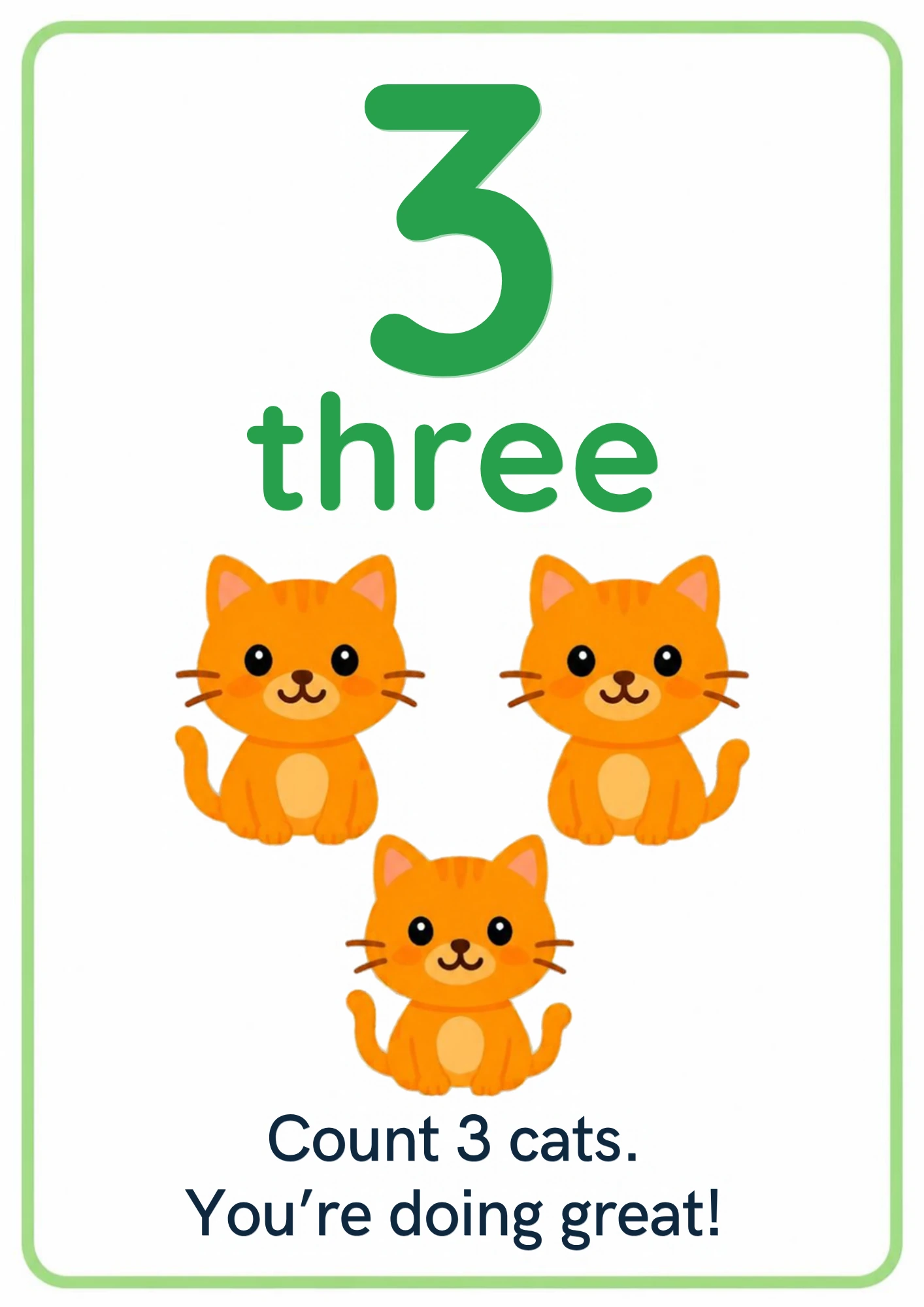
What is this?
Three is one, then one more, then one more again. On the card: a trio of orange cats, the word three and a big green numeral 3 — enough cats to count, few enough to check the answer with a single look.
What does it mean?
Three is where counting starts to feel like an amount rather than a word: a trio is visibly more than a pair. Children also meet their own age here — being three is a very fine thing to have in common with a number.
What does the child need to know?
Your child needs: three comes after two, each cat gets one touch and one number, and three stays three even when the cats trade places. Recounting after a mix-up is not failing — it is the actual skill.
Why this matters
Seeing three without counting and counting three by touch meet on this card, and the shuffle-and-recount game quietly teaches a deep truth: number belongs to the group, not the arrangement. That is conservation of number, met in play.
What it teaches
Counting accuracy at the edge of a glance, touch-to-word coordination, arranging and rearranging small groups, and the age-pride connection — I am three, and three is on the card.
Words to learn
threecatsmorecountgroupmiddle
Say this to your child
“"Three cats! Count them with me — one, two, three. Then touch each cat once as you go. Now let’s make a three of our own — three blocks in a row. Count them... shuffle them... count again! Three every time. Three is a proper amount!"”
Step by step
- Show the card and ask how many cats came to visit — then count them together, one touch per cat, in any order your child chooses.
- Count again the other way round and land on three twice — arriving at the same number twice is the most convincing maths there is.
- Build a three: line up three toys, count them, then rearrange — tower, row, circle — and count after every rebuild. Three survives them all.
- Play show-me-three: your child fetches three of something — three leaves, three pegs, three crackers — and you count the haul out loud together.
- Finish with the body: three jumps, three claps, three roars — a cat number deserves a cat sound at the end.
Look closer at the picture
Look at the card together: how many cats, and what colour are they? Touch each cat once as you count. Where is the big green numeral 3? Where is the word three? The cats and the numeral agree.
Ask your child
"How many cats?" "Can you touch each one once?" "Is three more than two — how do you know?" "Can you hop three times?" "How old are you — and what is on the card?" — answered with touches, hops and a very proud number.
What your child can say or do
Your child may count everything in threes for a week, announce their age with new authority — "I am THREE!" — and build threes out of crackers, cars and pebbles. Recounts that land somewhere new are normal and useful: say the count again slowly, together.
Out in the real world
Threes are everywhere once named: three wheels on a trike, three traffic lights, three fish fingers on the plate, three bears in the story. Count them as you meet them — each real three is the card rehearsed.
Try it together
Three-coin tea party: three cups, three spoons, three guests (any toys will attend). Your child sets each place — one spoon per cup, one per guest — which is one-to-one counting with a whole party riding on it.
Understanding check
Scatter three blocks differently tomorrow and ask for the count: a confident three means the number has detached from the layout — the deepest thing this card teaches.
Parent tips
Let your child choose the counting order; ownership speeds learning. If a recount lands on four, count again yourself at snail pace — no correction, just a model — and let the cats set the tempo.
Staying safe
Counting snacks get eaten sitting down, and small countables — coins, pegs, pebbles — stay away from babies and out of mouths. The tea-party guests should be too big to swallow; toys have a way of ending up tasted at this age.
This lesson pairs with the Three Cats flashcard in the library — print it, show it, keep it on the fridge. Back to Numbers 1–10.