
Long pencil — a step-by-step lesson for grown-up and child
This lesson stretches a comparing word sideways. Tall goes up, but long lies down and reaches — and the pencil tin on your shelf already holds a whole scale of long, from the brand-new crayon to the beloved stub.
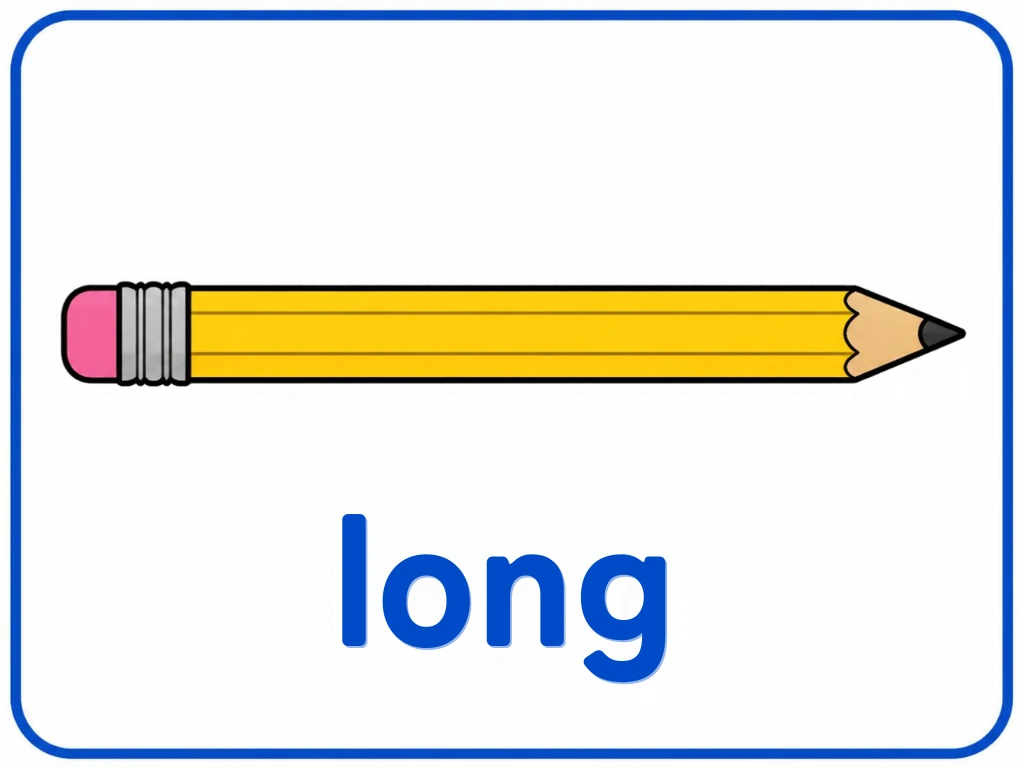
What is this?
Long means stretching out from one end to the other — reaching further than the thing beside it. The yellow pencil on the card stretches nearly the whole width of its picture. Long is not about height: a snake stretched on the ground is long, and so is a train, and so is one noodle lying on a plate.
What does it mean?
Long and short describe reach, not bigness. A pencil can be long and thin; a hippo is big but not long. Keeping those two ideas separate is genuinely useful for a three-year-old, and the pencil pair does it cleanly: both pencils are the same thickness — what changes is the stretch.
What does the child need to know?
Your child needs to know: long means one end to the other end with lots of space between, the opposite is short, and things can be lined up from longest to shortest — which is ordering, the quiet maths inside the game.
Why this matters
Ordering by length is early measurement with the numbers left out. A child who lines up crayons from longest to shortest is doing the thinking a ruler does — comparing, ordering, finding the extremes — years before any centimetres arrive.
What it teaches
Sideways spatial language (long, end to end), ordering and sequencing, comparison, fine-motor placing as the crayons get lined up just so, and the persistence of a game that can always be re-ordered.
Words to learn
longshortlongerendstretchline
Say this to your child
“"This pencil stretches all the way across the card — it is looong! Long means one end way over there and the other end way over here. Stretch your arms and show me long… now bring me something in this room that is longer than your foot!"”
Step by step
- Show the card and run your finger from one end of the yellow pencil to the other — long is a journey, so travel it.
- Hold the long pencil card beside the short pencil card and say both words in one breath: long pencil, short pencil. Let your child take over the saying.
- Play the arms version: hands together in front, then slide them apart — how looong? Long, longer, the longest your arms can reach.
- Line up three treasures — a crayon, a wooden spoon and a shoe — from longest to shortest. Shuffling the order again and again is half the fun and all of the maths.
- Let your child be the length judge: hold up two things and ask which is longer. Then swap and let them judge you — get one wrong on purpose and enjoy the correction.
Look closer at the picture
Look at the picture together: where does the pencil start and where does it end? What color is it? Does it reach across most of the card? What words sit with it?
Ask your child
"Which pencil is longer?" "Can you find something longer than your foot?" "Is a snake long or tall?" "Which crayon in the tin is the longest one of all?"
What your child can say or do
Your child might draw a loooong line across paper and narrate it, line up every crayon from longest to shortest without being asked, or slide their arms apart and announce "this looong!" — the word attaching itself to the body, exactly as planned.
Out in the real world
Long things hold the world together: the long table, the long scarf, the long road to grandma, the long queue at the shop. Name them as you wait in them — a long queue is a comparing word your child can stand inside.
Try it together
Measuring without rulers: how many hands long is the table? Place your child’s hand at one end, yours next to it, and count together — three hands, four hands. Any length becomes countable, and your child has just discovered why people invented measuring in the first place.
Understanding check
Ask: "Show me long with your arms. Which pencil is the long one? Line up these two — which is longer?" The stretch, the card and a confident point — that is the word landed.
Parent tips
Keep the line-up games short and frequent — ordering is addictive once it starts. And answer the tall-versus-long mix-up with patience: things that lie down are long, things that stand up are tall, and your child will sort them out through the games long before any rule makes sense.
This lesson pairs with the Long pencil flashcard in the library — print it, show it, keep it on the fridge. Back to Opposites & Comparing (Preschool).