
Open door — a step-by-step lesson for grown-up and child
This lesson takes the welcoming half of the door pair — the door standing wide — and teaches open as both a comparing word and a doing word. Your child’s hands have been opening things all day; now the word arrives to meet them.
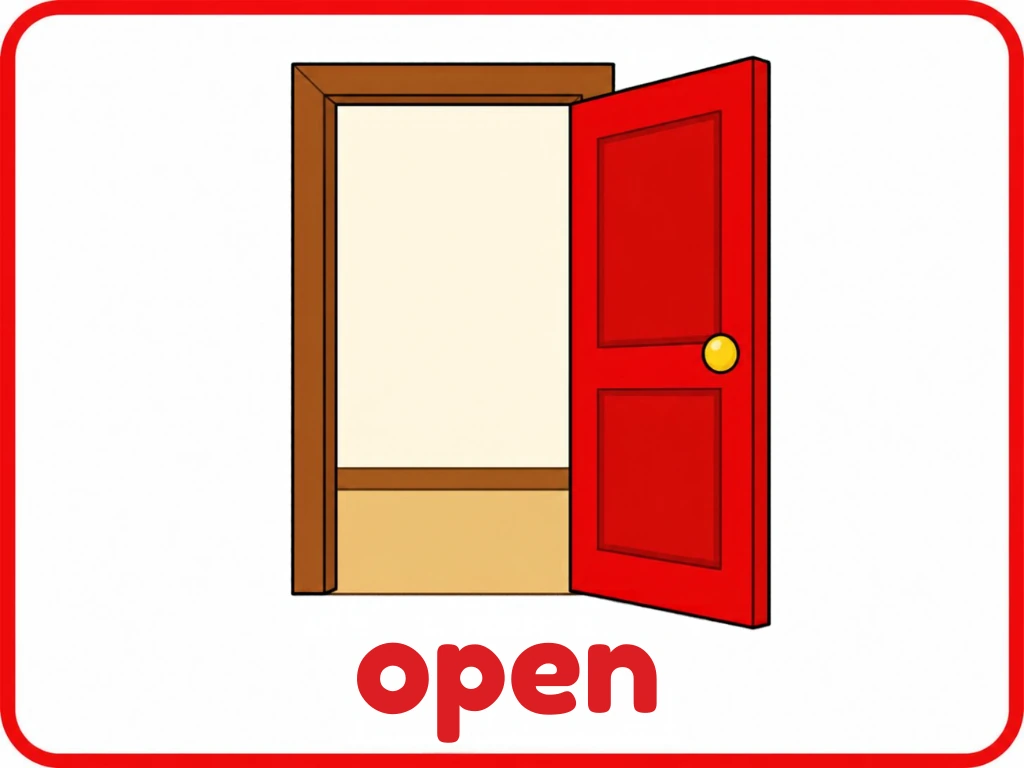
What is this?
Open means wide apart, with the way in showing. The door on the card stands wide open — you could walk straight through it. Open is a position word for doors and windows, and a doing word for everything else: books open, boxes open, eyes open, mouths open at every meal.
What does it mean?
Open is the word for the moment something becomes passable — the door lets people through, the book lets the story start, the box lets the present out. Children meet open dozens of times a day and love the moment; the card simply names it. Its partner, closed, is the same door at rest.
What does the child need to know?
Your child needs to know: open means the way in is showing, the opposite is closed, and doors open with pushes or pulls — some so heavy that grown-ups do the opening. The finger rule below is the serious part of this lesson: doors are strong and little fingers go where doors close.
Why this matters
Open and closed describe the state of half the household world — taps, curtains, cupboards, shops. A child who can name and manage openings gains real independence: opening their own lunchbox, their own book, their own coat buttons. The door is just the loudest example.
What it teaches
Position vocabulary (open, shut, wide), cause and effect as pushes and pulls move doors, turn-taking in the open-and-shut games, and careful hands — the finger-awareness that real doors quietly demand.
Words to learn
openshutwidedoorpushpull
Say this to your child
“"This door is open — standing wide, ready for visitors! Open means the way in is showing. Open your hands wide like a door… now shut them! Books open, boxes open, doors open — and what closes them again? Closed! The same door, resting."”
Step by step
- Show the card: the door is standing wide — what can come through it? Ask what would happen if it were shut instead.
- Say the pair with your hands: fingers spread wide for open, pressed together for shut. Open… shut… open… shut — the hands learn it first.
- Try the fastest door in the house: a book. Fling it wide — open! Fold it shut — closed! Then a box lid, then a cupboard.
- Visit the real door together — and let the grown-up work it. Push it wide: open! Swing it slow: shut! Your child calls the states; you move the wood.
- Walk the house and count the open things you find — the open curtains, the open window — naming each one as you go.
Look closer at the picture
Look at the picture together: is the door wide or only partly open? Which way does it swing — can you tell? What words sit with the door? Could somebody walk through it right now?
Ask your child
"Is the door open or closed?" "What kinds of things open besides doors?" "How do we open a heavy door safely?" "What is the opposite of open?"
What your child can say or do
Your child may spread both arms wide and announce "open door!", run the open-shut hands game unprompted, or report the household door states like a little guard: "front door closed, cupboard open!"
Out in the real world
Open is a town-wide word: the open shop, the open gate, the open window on the bus. Point out which doors you may walk through and which stay closed to visitors — the word quietly teaches public rules as well as positions.
Try it together
Open-and-shut everything: ten minutes of deliberately opening and closing whatever is safe — books, boxes, tins with lids, your hands, an umbrella. Narrate each state in one breath — open… shut — and finish with the hand-door game: fingers wide, fingers pressed, faster and faster.
Understanding check
Ask: "Show me open with your hands. Show me shut. Is this door open or closed?" The spread, the press and the right answer — that is the word landed.
Parent tips
The real door stays a grown-up job: heavy doors swing with more force than small arms expect, and the flashcard can do the dramatic slamming in imagination instead. Let your child call the states while you do the moving — the vocabulary is theirs to own even while the hinge is yours to manage.
Staying safe
Doors and little fingers need respect: keep fingers away from the edge and the hinge side where doors close, move doors slowly, and let a grown-up handle the heavy ones. If a baby sibling is crawling nearby, the door game happens in another room.
This lesson pairs with the Open door flashcard in the library — print it, show it, keep it on the fridge. Back to Opposites & Comparing (Preschool).