
Closed door — a step-by-step lesson for grown-up and child
This lesson closes the door pair properly. Closed is the door at rest — shut tight, keeping warmth or quiet or privacy inside — and it comes with the politest rule in the set: when a door is closed, we knock and wait.
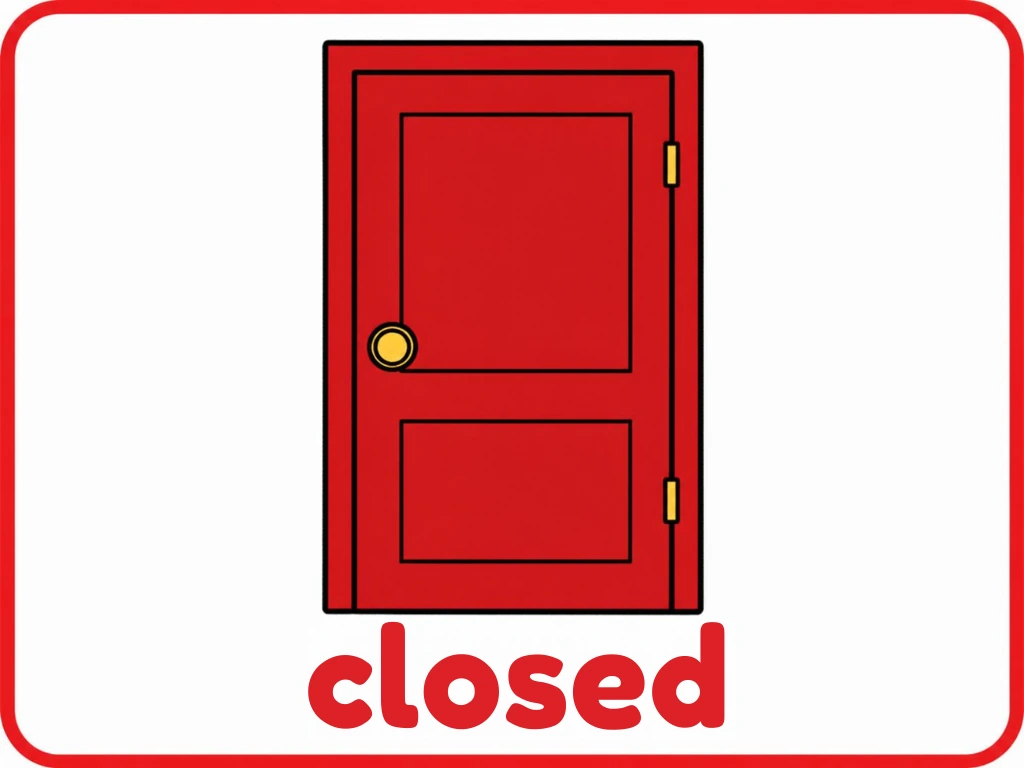
What is this?
Closed means shut all the way, with no gap showing. The door on the card is closed tight: nobody is walking through it right now. Closed is the resting position of doors, cupboards, boxes and books — the way things are when they are not open.
What does it mean?
Doors close for reasons, and each reason is a small life lesson: to keep warmth in, to keep noise out, to give someone privacy, to keep a pet in one room. A closed door is not an ending — it is the door doing a job. And it always answers to a knock and a handle.
What does the child need to know?
Your child needs to know: closed means shut all the way, the opposite is open, a closed door gets a knock first, and doors close with slow hands — never a slam. The knock-and-wait habit starts here, at three, and lasts a lifetime.
Why this matters
Knocking before entering is one of the earliest real courtesies a child can offer. It teaches waiting, respect for other people’s space and the impulse control of a paused hand — and the closed door gives the habit a clear, visible cue to attach to.
What it teaches
Position vocabulary, politeness rituals (knock, wait, listen), slow-and-gentle motor control — the anti-slam training — plus the social idea that some spaces belong to someone even when nobody is inside them.
Words to learn
closedopenknockwaitslowshut
Say this to your child
“"This door is closed — shut all the way, resting. When a door is closed, we knock: knock knock — may I come in? And we wait for the answer. Doors close slowly, with gentle hands, never with a bang. Open and closed, the same door, doing different jobs."”
Step by step
- Show the card: the door is shut tight. Ask what might be happening behind a closed door — quiet, privacy, a nap, a secret.
- Say the pair: open door, closed door — arms wide, then palms pressed. Let your child lead the switching.
- Practise the knock: knuckle gently on the table, the floor, a book cover — knock knock, may I come in? The rhythm makes it a game; the words make it a courtesy.
- Walk the house and find the closed things: the closed cupboard, the closed curtains, the closed washing machine. Each one is shut for a reason — guess the reason together.
- Play the slow-hands rule on a real door you choose together: open it slowly, close it slowly, no bang. Slow hands get the job every time.
Look closer at the picture
Look at the picture together: is there any gap under or around the door? Could anyone walk through it right now? What words sit with the door? How is this card different from the open door card?
Ask your child
"Is the door open or closed?" "What do we do before opening a closed door?" "Why do we close doors slowly?" "What is the opposite of closed?"
What your child can say or do
Your child may knock on every closed door in the house and wait theatrically for permission, close cupboard doors with exaggerated slow-motion hands, or answer your table-knock with a solemn "come in!" — the ritual running on its own now.
Out in the real world
Closed doors manage the whole day: the bathroom door closed for privacy, the bedroom door closed for a sleeping baby, the shop door closed on Mondays. Say why each one is shut — closed is a word that comes with a story attached.
Try it together
Knock-knock theatre: you sit behind a chair as the closed door, your child knocks — "knock knock, may I come in?" — and you answer in silly voices: "come in, we are having a tea party!" Swap seats so your child is the door too. The knocking, the asking and the waiting all get rehearsed, and the giggles are free.
Understanding check
Ask: "Show me closed. What do we do before opening a closed door? Fast hands or slow hands on doors?" The pressed palms, the knock and the word slow — that is the word landed.
Parent tips
Honour your child’s own closed doors — a blanket over a table is a house with a door, and knocking on it respects the same rule you are teaching. Children protect rules they see the grown-ups follow, so knock on theirs first.
Staying safe
Doors close with force: fingers stay far from the edges and hinges, doors move with slow hands, and slamming is a no for the door and the fingers both. A closed door might have someone behind it — knocking first is the polite rule and the safe one.
This lesson pairs with the Closed door flashcard in the library — print it, show it, keep it on the fridge. Back to Opposites & Comparing (Preschool).