
Small ball — a step-by-step lesson for grown-up and child
This lesson takes the losing side of the size contest — and makes it the fun one. Small things hide, fit in pockets and roll under sofas, which makes small the comparing word with the best games attached.
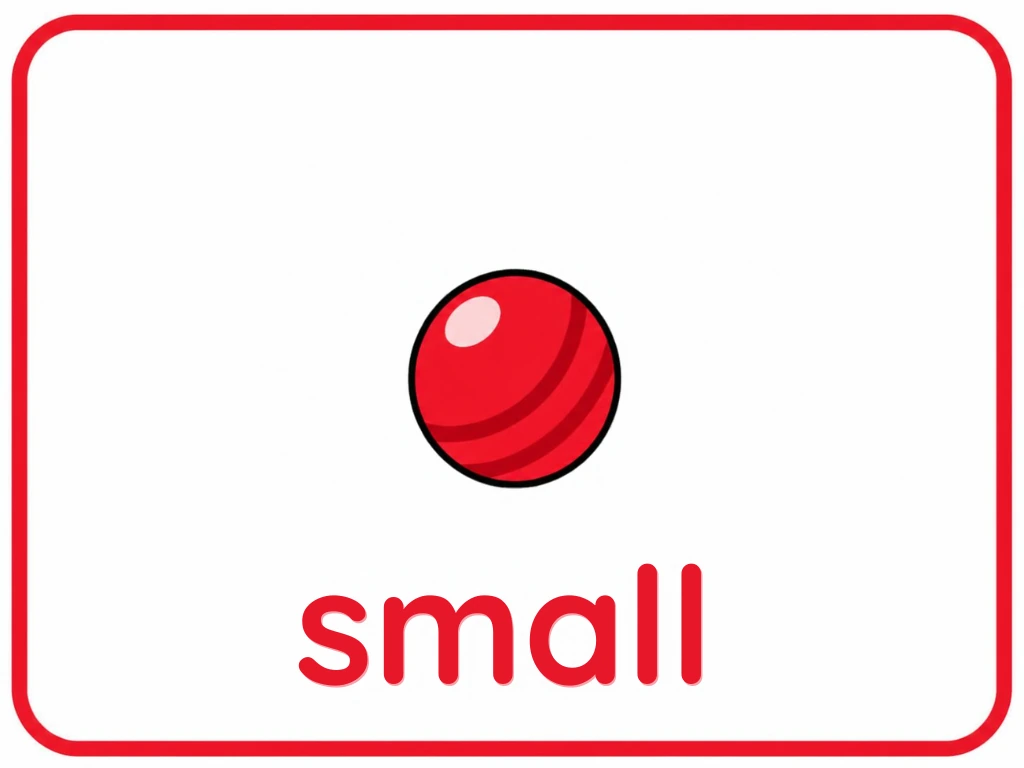
What is this?
Small means littler than the thing beside it. The small ball is small only because the big ball stands next to it — beside a marble, the very same ball would be the big one. Small is a partner word: the two of them only make sense together.
What does it mean?
Small is not a downgrade and not a fixed size — it is one side of a comparison, and which side depends on the company. That swap is a genuinely deep idea for a three-year-old: the same object can change its word when its neighbour changes. Playing with that swap is the whole lesson.
What does the child need to know?
Your child needs to know: small names the littler one of a pair, small things can hide where big things cannot, and the opposite word is big. Also, quietly for you: treasures small enough to swallow are a real hazard around babies — the safety note below folds that rule into the game.
Why this matters
Spotting small things is observation training. Bugs, buttons, seeds, coins and crumbs all live in the small world, and a child who practises finding them is building the careful looking that later finds letters inside words and details inside pictures.
What it teaches
Visual discrimination (finding small things in a busy room), comparison thinking, size words, careful reaching and pinching — genuine fine-motor work — plus the social delight of hiding games with rules.
Words to learn
smallbigtinyhidelittlefind
Say this to your child
“"This ball is small — tiny enough to disappear inside one fist! Small means littler than the other one. Watch: big ball, small ball. Now bring me something small from this room — something that could vanish in your hand!"”
Step by step
- Set the two ball cards next to each other and ask which one would fit in your hand — then close your fingers around the small one in the air to make the idea physical.
- Say the pair in one breath — big ball, small ball — and let your child point to each as you go.
- Run the hiding test: the small ball could hide under a cup; could the big one? Mime both and let your child discover why small is the hiding champion.
- Send the whole room on a small hunt: find three small things — a spoon, a sock, a bottle cap — and bring each one back to the card.
- Swap roles: your child hides a small object in a fist and you guess which hand, then trade turns until the guessing gets too good.
Look closer at the picture
Look at the picture together: how tiny is the ball — how much of the card does it take up? What is it sitting beside? Do the words small ball take more room on the card than the ball itself does?
Ask your child
"Which ball is smaller?" "Could the big ball hide under this cup — why not?" "What is the smallest thing you can see right now?" "Can something small still be heavy?"
What your child can say or do
Your child might announce "tiny ball, tiny hands!" while holding it in the air, parade small finds through the house, or correct you warmly when you hide the big card under a cup that obviously cannot fit it.
Out in the real world
The small world is everywhere: buttons on shirts, blueberries in the bowl, the littlest shoe on the mat. Name small things as you meet them, and let your child be the one who spots the tiniest berry, the smallest leaf, the littlest stone on the walk home.
Try it together
Hide-and-seek small: one small object — a ball, a spoon, a toy car — gets hidden in the room while your child covers their eyes. Warm warms and cold cools guide the hunt. Small things hide brilliantly, which is exactly what makes the game work, and finding them is the practice.
Understanding check
Ask: "Show me small. Which ball would hide under the cup? Find me something smaller than your hand." The curl of the fingers, the right card and a quick find — that is the word landed.
Parent tips
Follow the fascination: most children adore the small world, so let the hunt run longer than the lesson planned. Sit down together for small-object play — a floor seat keeps treasures in hands and out of mouths, and turns the safety rule into part of the game.
Staying safe
Things small enough to slip through a toilet-paper tube are choking hazards for babies and young toddlers. Keep the small-hunt treasures away from little siblings, and play small-object games sitting down, where nothing wanders off unwatched.
This lesson pairs with the Small ball flashcard in the library — print it, show it, keep it on the fridge. Back to Opposites & Comparing (Preschool).