
Big ball — a step-by-step lesson for grown-up and child
This lesson hands your child the grandest word in the whole set — and the secret hiding inside it: big is never big alone. It is only bigger than something, which is why the two ball cards always travel together.
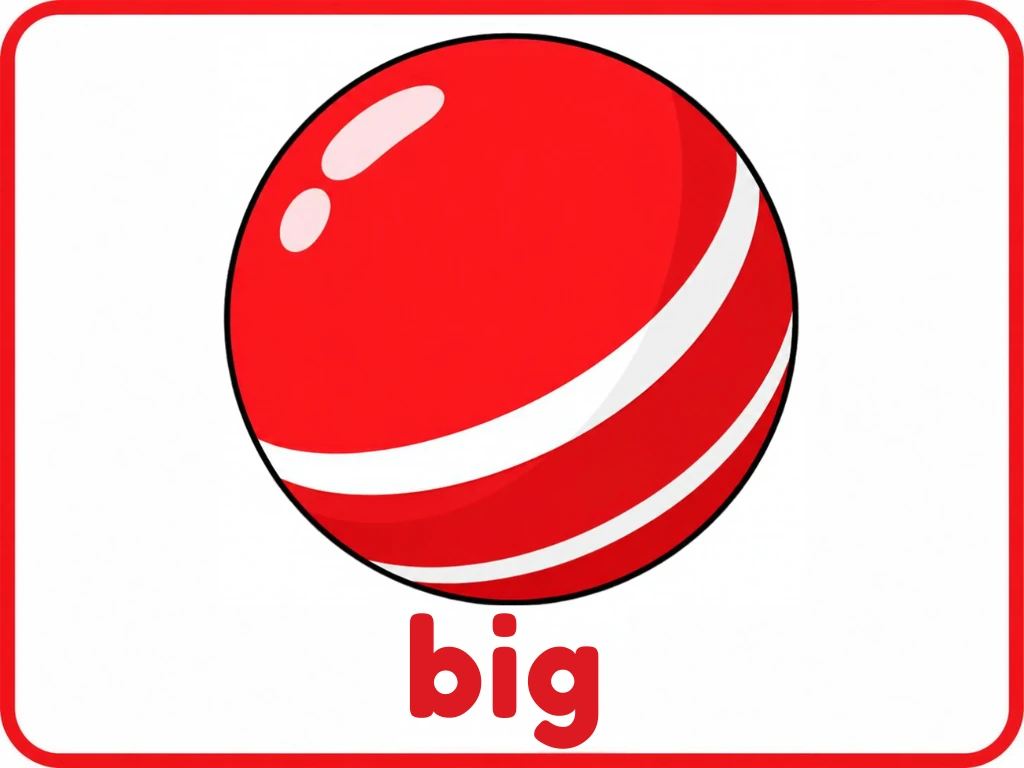
What is this?
Big means larger than the thing beside it. It is not a size a ball owns forever: the same ball is big next to a marble and small next to a beach ball. Big is a comparing word — it needs two things, and it names the winner.
What does it mean?
A three-year-old meets big with the whole body first and the word second. Arms stretch wide, steps turn giant, voices go enormous — and once the feeling is there, the word attaches to it and stays. The comparison is the meaning; the card simply shows the contest with a clear winner.
What does the child need to know?
Your child needs three things: big describes the larger one of a pair, the matching word for the other side is small, and every big thing around the house can be found and named. The bigger the hunt, the better the learning.
Why this matters
Comparing by size is the front door to early maths: it is measuring without numbers and ordering without worksheets. A child who can say which ball is bigger is already sorting, ranking and reasoning — the same thinking that later handles more and less, taller and shorter, first and last.
What it teaches
Comparison and ordering, size vocabulary, observation (working out what is bigger than what), body awareness through acting sizes out, and the confidence of owning a word that applies to nearly everything in the house.
Words to learn
bigsmallbiggersizecomparepair
Say this to your child
“"This ball is BIG — fling your arms out wide, THIS wide! Big means it wins the size contest. Now look at its partner card: that one is small. Big and small, big and small — say them together, then tell me which ball you would bounce higher."”
Step by step
- Lay the two ball cards side by side and let the pictures do the first teaching — one ball fills almost all of its card, the other sits tiny beside its big word card.
- Say both words in one breath: big ball, small ball. Then flip the order. The rhythm is the lesson — your child should hear the pair before pointing at it.
- Act the sizes out: wide arms for big, tucked-in arms for small, switching whenever you call the other word.
- Hunt the room together for big things — the sofa, the door, the bed — naming each one big with a big voice.
- Hand the cards over and let your child quiz you. Get one wrong on purpose — call the small card big — and enjoy being corrected, because teaching the word back is the strongest proof of learning there is.
Look closer at the picture
Look at the picture together: how much of the card does the striped ball fill? Can you see the stripes running across it? Where does the card end and the ball not reach? Which words sit with the ball?
Ask your child
"Which ball is bigger — this one or the small one?" "Can you find something in this room bigger than the ball?" "Is the sofa big? Bigger than what?"
What your child can say or do
Your child might throw both arms wide and bellow "BIIIIG ball!", line the two cards up and announce the winner, or start ranking everyone at the table by size — a very correct piece of comparing work.
Out in the real world
Big happens everywhere once you name it: big buses gliding past small cars, the big spoon that serves and the small spoons that eat, big shoes and little shoes lined up by the door. Each pair you notice out loud is one more repetition — and repetitions, not lessons, are what make comparing words stick.
Try it together
Opposite jumps: when you shout big, your child jumps as wide and tall as a body can go; when you shout small, they curl up into the tiniest ball on the rug. Alternate the calls slowly at first, then faster and faster until the words and the giggles arrive together.
Understanding check
Ask: "Show me big with your arms. Show me small. Which ball won the size contest?" Wide arms, a tight curl and the right card pointed at — that is the lesson landed.
Parent tips
Act first, talk second: at this age the body teaches the word. When your child decides every ball is big, skip the correction — set the small card beside it and ask "bigger than which one?" The question does the teaching, and your child gets to be the one who figures it out.
This lesson pairs with the Big ball flashcard in the library — print it, show it, keep it on the fridge. Back to Opposites & Comparing (Preschool).