
Ball — a step-by-step lesson for grown-up and child
This lesson teaches Bb and its lip-pop sound with the ball card: your child traces the letter, blows up an imaginary balloon one b-word at a time, and learns that b is a sound they can feel on their own lips.
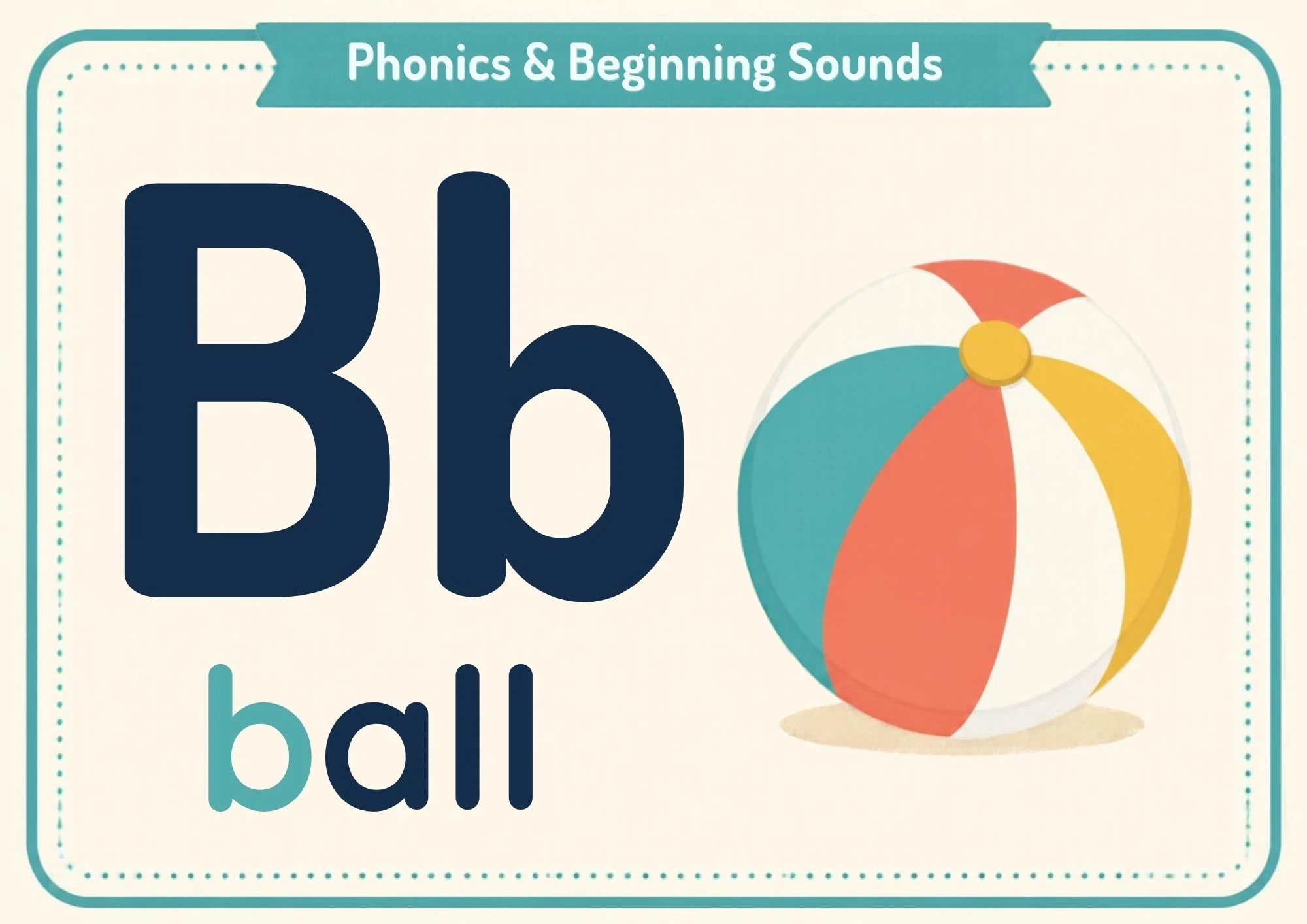
What is this?
Bb is the letter that stands for the first sound in ball — a quick pop made with two lips and a buzzing voice.
What does it mean?
B teaches that sounds live in the body, not just in the ear: /b/ happens on the lips, so your child can watch themselves say it in a mirror — a sound you can see is a sound you remember.
What does the child need to know?
Your child needs to feel the lips press together before the pop, hear the voice buzzing behind the pop, and carry the sound onto other words — ball, bat, bubble — not just the picture word.
Why this matters
/b/ opens dozens of everyday words — ball, bath, book, breakfast, bus. It is also the twin of /p/, and children who feel the buzz-versus-puff difference early never mix the two spellings later.
What it teaches
Lip strength and control, voice awareness (feeling the throat buzz), and mirror self-checking — the first step toward fixing sounds without being told.
Words to learn
bballbatbubblebathbig
Say this to your child
“"Press your lips together like this — now hum until they pop open: buh. That is b! B says buh, like ball. Bounce the sound: buh, buh, ball."”
Step by step
- Show the card: "Bb. Press your lips together — b! It says the ball sound."
- Finger-trace the tall Bb on the canvas while humming "b-b-b" — the tracing finger and the buzzing lips work together.
- Play the balloon game below so the sound gets a body to live in.
- Hunt b-things: a book, a bottle, a bear. Say each one with the same lip pop.
- End with the mirror check: lips together, voice on — "that is a real b!"
How to say it
Lips sealed, then released with the voice already running: "buh". The throat buzzes the whole time — a hand on the throat proves it. Keep the pop short; no "buh-uh" drag.
Look closer at the picture
On this card the big navy pair Bb sits beside a smiling beach ball in yellow, red and blue, with the word "ball" printed below — the toy most children already own, wearing its first letter.
Ask your child
"Where do your lips go for b?" "Does your throat buzz when you say it?" "What b-word should we bounce next?"
What your child can say or do
Your child might say: "B! buh-buh-ball!" or — halfway through the balloon game — the classic complaint: "My lips are tired." Tired lips are learning lips.
Out in the real world
Ball games, bath time and bubble mix are three b-factories you already own. On walks, every bus, bench and bird is a b-spot waiting to be claimed out loud.
Try it together
The balloon game: mime blowing up a balloon — one b-word per breath, and the balloon grows bigger each time: ball… ball-bat… ball-bat-bubble. On the biggest word, let go: the balloon flies around the room with a long "bbbbbb" until it lands.
Understanding check
Ask for the sound, never the letter: "what sound does B make?" — a clean "buh" with lips visibly pressed is the goal. Then swap in a picture of a dog: if they say "nope, that is d", the sounds are sorted.
Parent tips
If b comes out as p, slow everything down and add the throat hand: b buzzes, p does not. Never drill longer than five minutes — the lips learn fast and sulk when tired.
This lesson pairs with the Ball flashcard in the library — print it, show it, keep it on the fridge. Back to Phonics & Beginning Sounds (Class 28).