
Dog — a step-by-step lesson for grown-up and child
This lesson teaches Dd and its tongue-tap sound with the dog card: your child traces the letter, plays doorbell with an imaginary front door, and feels exactly where the tongue lands for every d-word.
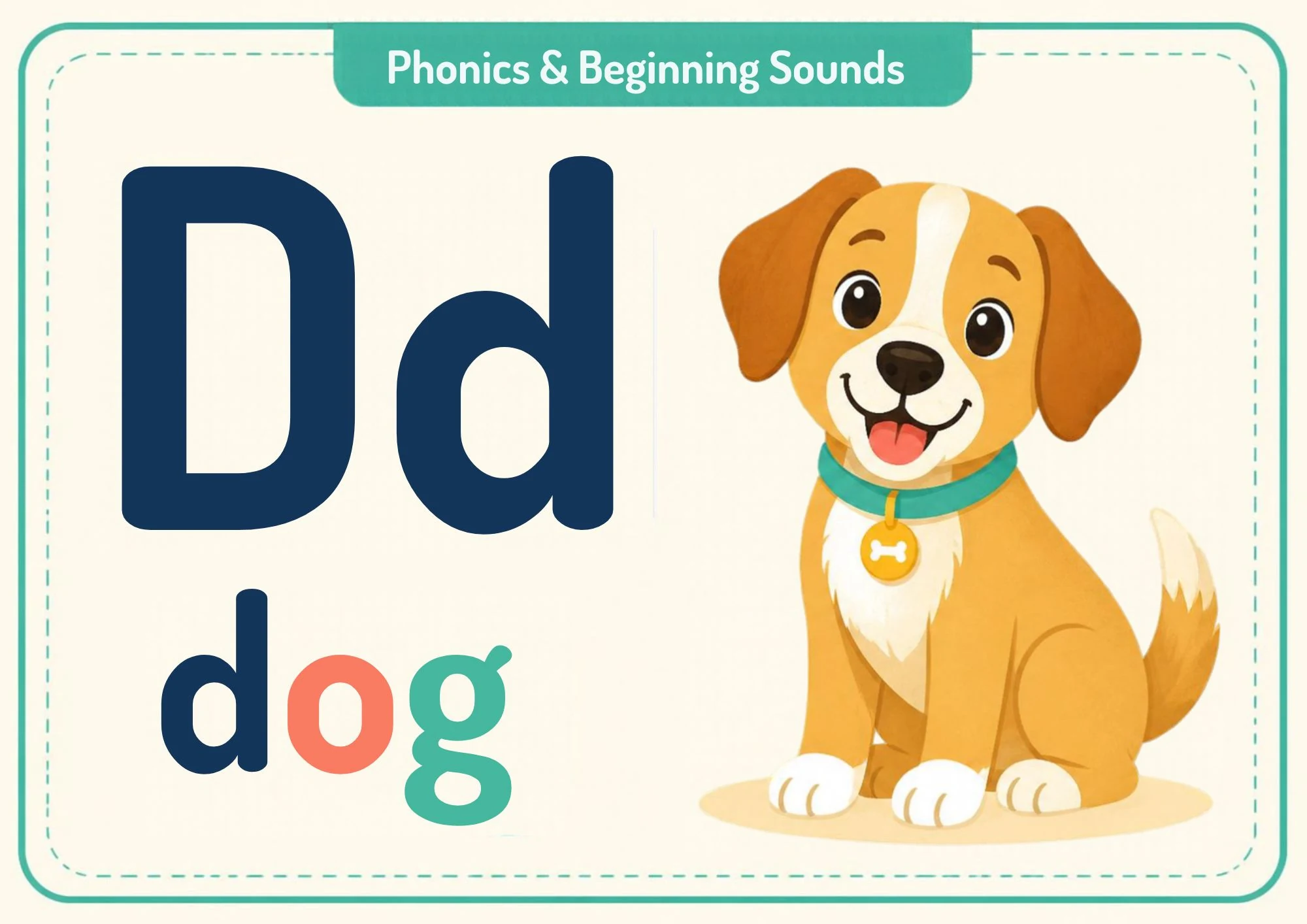
What is this?
Dd is the letter that stands for the first sound in dog — a quick tap of the tongue tip just behind the top teeth, with the voice switched on.
What does it mean?
D teaches that some sounds have an address: the tongue taps one exact spot, every time. Finding that spot is body knowledge — and body knowledge never fades.
What does the child need to know?
Your child needs to feel the tap behind the teeth, keep the voice buzzing through it, and let d start a whole visitor list of words — dog, dad, duck, door.
Why this matters
/d/ starts the words that run a family’s day: dad, dinner, door, done. It is the voiced twin of /t/, and feeling the buzz difference now is cheaper than fixing the spelling confusion later.
What it teaches
Tongue-tip precision, voice-on/voice-off awareness, and the rhythm habit — one tap, one sound, one word.
Words to learn
ddogdadduckdoordrum
Say this to your child
“"Put your tongue behind your teeth and let it bounce once — duh. That is d! D says duh, like dog. Knock the sound: d, d, dog."”
Step by step
- Show the card: "Dd. The tongue taps — d! It says the dog sound."
- Finger-trace the Dd on the canvas while tapping: one curve of the letter, one tap of the tongue.
- Play the doorbell game below — every visitor brings a d-word.
- Tap out three d-things you can see or pretend: dog, doll, doughnut.
- Finish with the drum finale: four fast taps, one loud "d-d-d-dog!"
How to say it
Tongue tip up to the ridge behind the top teeth, then release with the voice on: "duh". Quick and light — the tap is one frame long, not a held sound.
Look closer at the picture
On this card the big navy pair Dd sits beside a smiling golden puppy wearing a green collar, with the word "dog" printed below — the animal most children name first, now wearing its letter.
Ask your child
"Where does your tongue go for d?" "Does your voice buzz?" "Who should come to our door next — a duck or a doll?"
What your child can say or do
Your child might say: "d-d-d-dog!" like a drumroll, or — best case — start answering every "knock knock" at home with a new d-word.
Out in the real world
Every front door in your life is a d-game now: knock, say a d-word, enter. Walks supply dogs (real ones bark along), dads, and delivery vans that go ding-dong.
Try it together
Doorbell game: draw a door on paper or use a real door. Each "ding-dong" means a visitor arrives — and the visitor must be a d-word: dog, duck, dad, dragon. Open the door, greet the visitor by name, close the door, ring again. Ten rings, ten visitors, zero boredom.
Understanding check
Tomorrow, ask "what sound does D make?" and watch the tongue: a visible tap behind the teeth with a buzzing throat is a pass. Then try "t" — if the tap stays but the buzz stops, both twins are learned.
Parent tips
If dog comes out as "tog", the voice switch is off — hand on the throat, exaggerate the buzz. Keep sessions short: the tongue is a muscle and learns best in little bursts.
This lesson pairs with the Dog flashcard in the library — print it, show it, keep it on the fridge. Back to Phonics & Beginning Sounds (Class 28).