
Elephant — a step-by-step lesson for grown-up and child
This lesson teaches Ee and its short "eh" sound with the elephant card: your child traces the letter, cracks imaginary eggs that hatch e-words, and learns the relaxed middle-mouth vowel the whole alphabet leans on.
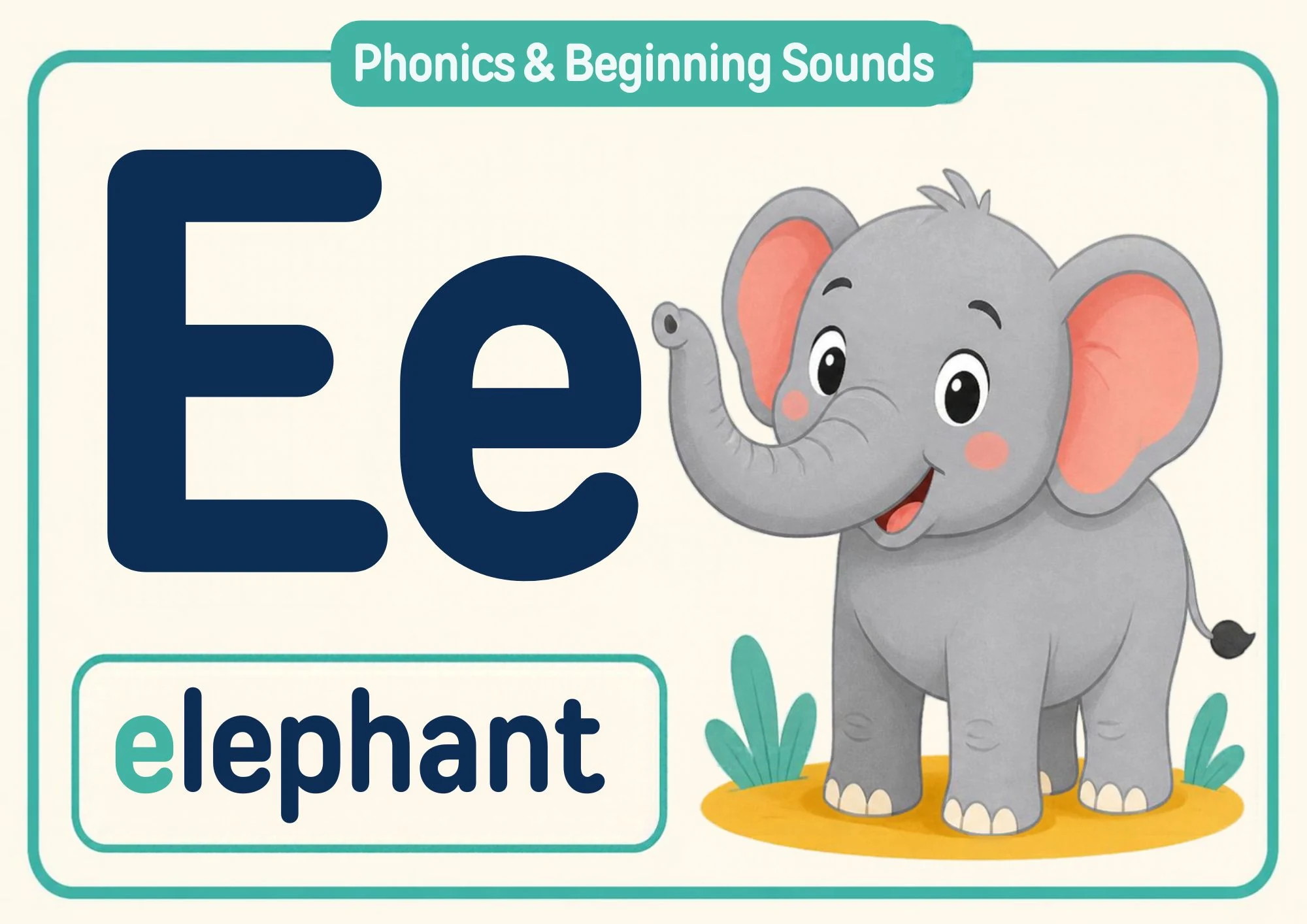
What is this?
Ee is the letter that stands for the first sound in elephant — a short, relaxed "eh" made with the mouth half open and the tongue resting flat.
What does it mean?
E is the alphabet’s hardest worker: it appears in more words than almost any other letter. Meeting it as a sound (not just a letter name "ee") saves years of reading guesswork.
What does the child need to know?
Your child needs to hear the short "eh" as its own sound — different from "ee" in tree and from "eye" — and say it in a handful of words: elephant, egg, elf.
Why this matters
Short /e/ sits inside bed, red, ten, get — words a four-year-old uses daily. It is also the vowel children confuse with short /i/ most often, so an early, well-modelled "eh" pays off for years.
What it teaches
Mid-mouth vowel control, sound isolation in long words (eh-le-phant), and the patience to let a long word start slowly.
Words to learn
eelephanteggelfelfelbow
Say this to your child
“"Relax your mouth — halfway open, nothing stretched: eh. That is E’s sound, the elephant one. Say it like a tiny echo: eh, eh, elephant."”
Step by step
- Show the card: "Ee. It says eh — the elephant sound. Say it softly: eh."
- Finger-trace the Ee on the canvas — three straight arms, like the letter itself.
- Play the egg-crack game below: every crack hatches an e-word.
- Stretch the long word together: "eh — eh — eh-le-phant". The sound lives at the front.
- Finish with three soft "eh"s and one elephant stomp.
How to say it
Mouth half open, tongue flat and forward, voice on: "eh". The sound is short and dry — no glide into "ee". If it slides, bite an imaginary lemon and try again.
Look closer at the picture
On this card the big navy pair Ee sits beside a smiling grey elephant with the word "elephant" printed below in its own rounded box — a long, friendly word that starts with the shortest of sounds.
Ask your child
"What sound starts elephant?" "Is your mouth big open, half open or closed for eh?" "What hatches from an egg?"
What your child can say or do
Your child might say: "eh-eh-elephant!" like a trumpet warming up, or announce breakfast facts: "eggs start with eh!" — which is exactly the point.
Out in the real world
Breakfast is an e-lesson: eggs, elbows on the table. Every elephant in every picture book gets one more "eh". And elbows, escalators and elevators all start with the same relaxed sound.
Try it together
Egg-crack game: tap an imaginary egg on the edge of an imaginary bowl — "eh, eh, CRACK!" — and something e-shaped hatches out: an elf, an elephant, an empty cup. Name the hatchling, crack the next egg. Whoever cracks the most eggs names the most e-things.
Understanding check
A day later, show the card and ask for the sound. "Eh!" is the goal; "ee" means the letter name crept in — replay the egg game, and keep your own "eh" short and flat so there is one model only.
Parent tips
Short /e/ and short /i/ mix up for years — that is normal, not failure. Model clearly, accept close attempts, and let many e-words do the sorting rather than corrections.
This lesson pairs with the Elephant flashcard in the library — print it, show it, keep it on the fridge. Back to Phonics & Beginning Sounds (Class 28).