
Fish — a step-by-step lesson for grown-up and child
This lesson teaches Ff and its windy sound with the fish card: your child traces the letter, powers a paper fan with f-breaths, and learns the one sound they can watch move a real object across a table.
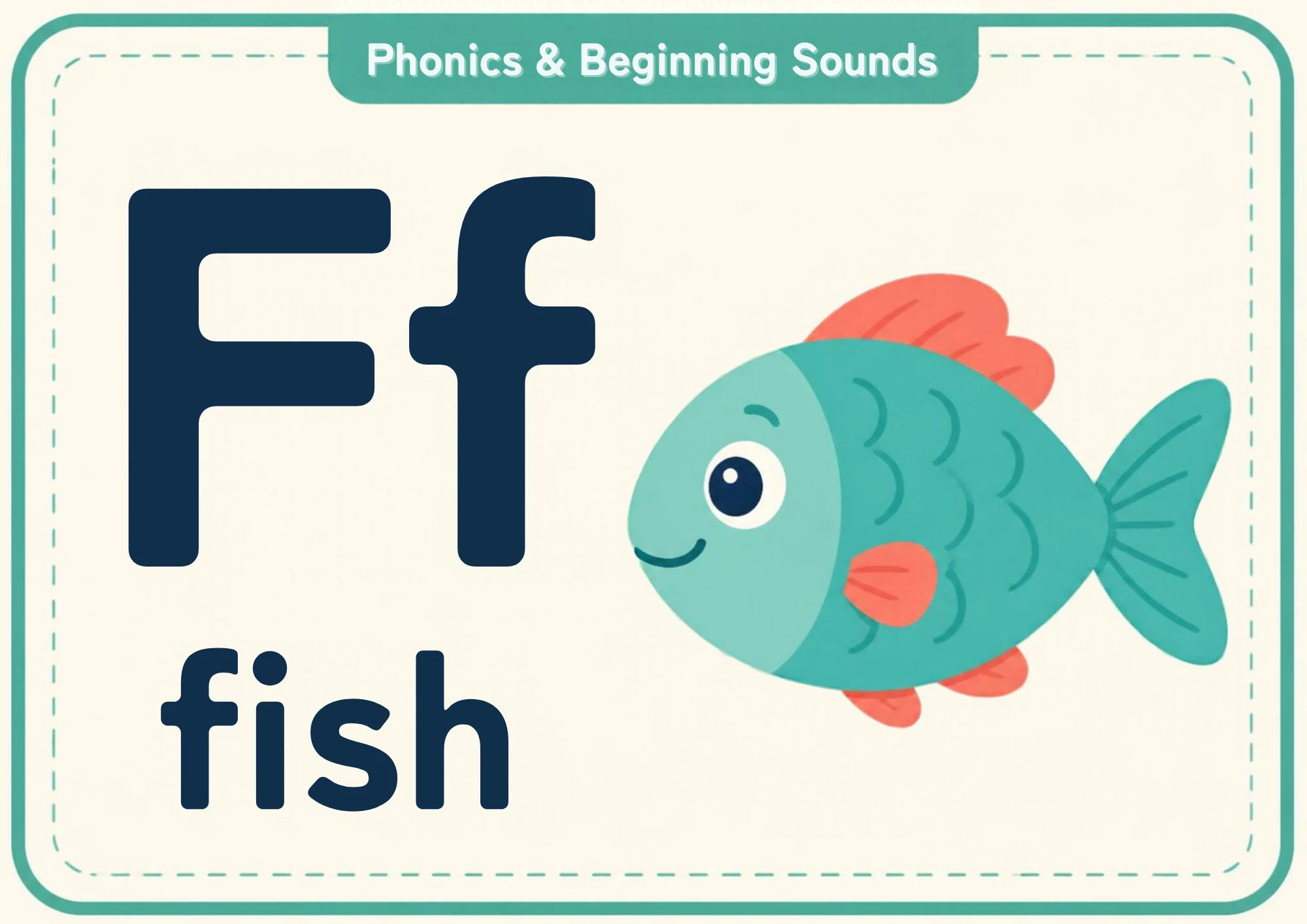
What is this?
Ff is the letter that stands for the first sound in fish — air hissing gently between top teeth and bottom lip, with no voice at all.
What does it mean?
F is the first "quiet" sound in the set: the throat stays silent while the mouth makes wind. That contrast — voiced versus breath — is a listening skill the whole alphabet will reuse.
What does the child need to know?
Your child needs the teeth-on-lip shape, the feel of moving air (not voice), and a small fleet of f-words — fish, frog, fork, fan — so the sound travels beyond one picture.
Why this matters
/f/ starts four, five, fish, family — words that organise a child’s whole day. It is also the whisper twin of /v/, and the hand-on-throat check learned here sorts both letters forever.
What it teaches
Lip-and-teeth coordination, air control (blowing gently on purpose), and voice-off awareness — noticing that some sounds run on breath alone.
Words to learn
ffishfrogforkfanfour
Say this to your child
“"Bite your bottom lip softly with your top teeth — now blow: fff. That is f! F says fff, like fish. Blow the sound: fff, fff, fish."”
Step by step
- Show the card: "Ff. Top teeth kiss the bottom lip and blow — f! The fish sound."
- Finger-trace the Ff on the canvas: two arms and a leg, while the lips hold the wind.
- Play the paper-fan game below — the breath becomes visible and useful.
- Collect f-things: a fork, a feather, a picture of a frog. Say each with one soft gust.
- Finish with the mirror check: teeth visible on the lip means a true f.
How to say it
Top teeth rest lightly on the bottom lip, air pushes through, voice off: "fff". It can stretch as long as the breath lasts — the only limit is air.
Look closer at the picture
On this card the big navy pair Ff sits beside a smiling teal fish with the word "fish" printed below — a swims-along animal for a swims-along sound.
Ask your child
"Can you feel the wind on your lip?" "Is your throat quiet or buzzing?" "How long can your f last — three seconds? Five?"
What your child can say or do
Your child might say: "fffish!" with a proper gust, or discover the party trick: f-ing at a candle flame and watching it bow.
Out in the real world
Fans, fridges and family dinners are f-territory. Feathers, falling leaves and foxes in storybooks all arrive pre-labelled with the sound — just say their names slowly.
Try it together
Paper-fan game: fold a paper fan (or use a real one), then power it with f-breaths only. Each gust must carry an f-word across the room: fish, frog, four. Race the fan against a feather — the breath that moves things is the right one.
Understanding check
Ask for the sound and watch the mouth: teeth on lip, moving air, silent throat. Then say v — if the buzz arrives and the shape stays, both twins are understood.
Parent tips
If fish becomes "vish", the voice snuck in — hand on the throat, no buzz on f. And keep the teeth soft: a gentle bite makes wind, a hard bite makes nothing.
This lesson pairs with the Fish flashcard in the library — print it, show it, keep it on the fridge. Back to Phonics & Beginning Sounds (Class 28).