
Goat — a step-by-step lesson for grown-up and child
This lesson teaches Gg and its growly sound with the goat card: your child traces the letter, plays the giggle game where laughing IS the sound, and feels /g/ buzzing right in the throat.
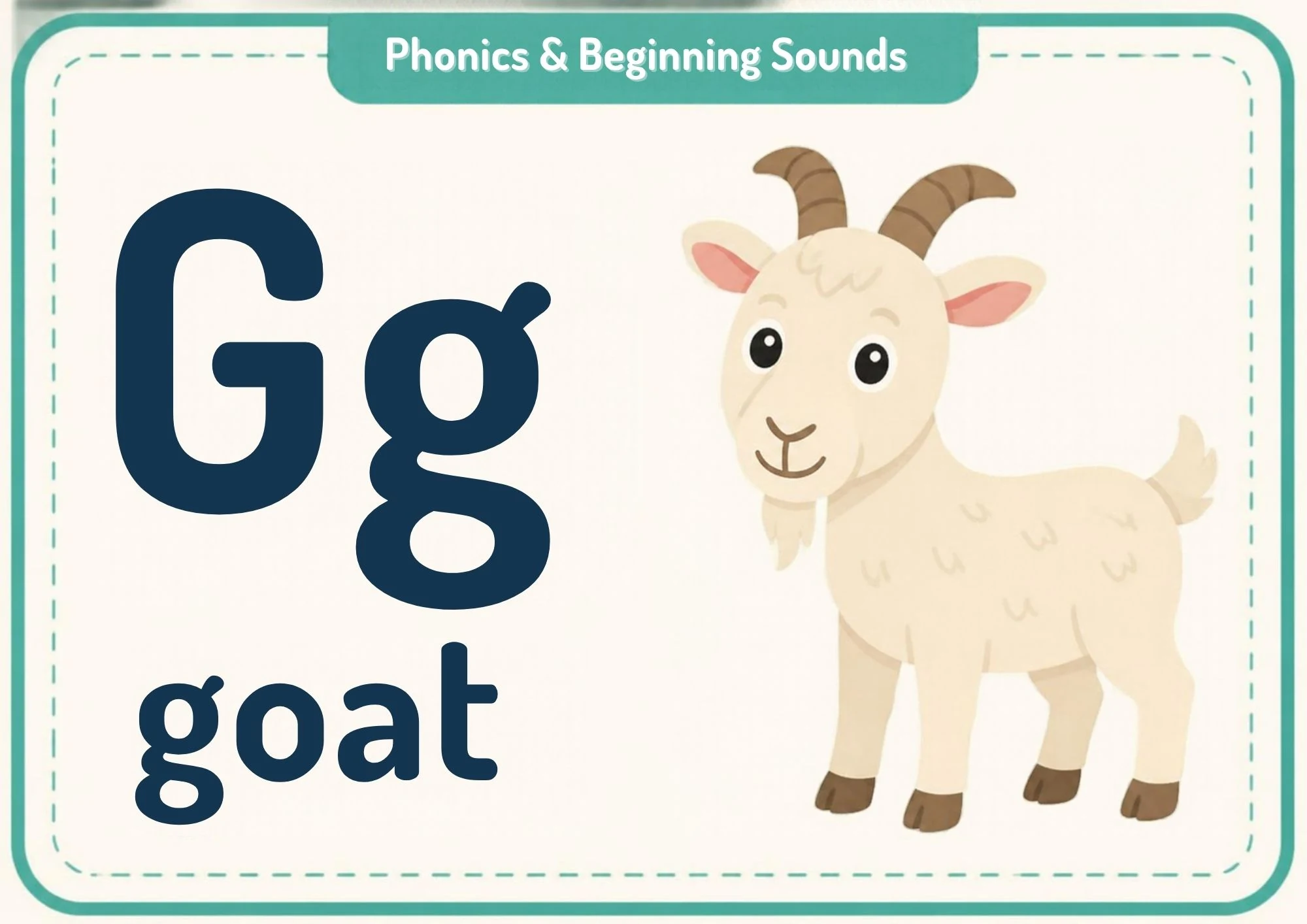
What is this?
Gg is the letter that stands for the first sound in goat — the back of the tongue lifts deep in the mouth and lets go with the voice growling.
What does it mean?
G teaches that sounds have homes: /g/ lives at the very back, the deepest spot in the mouth. Children feel it in the throat, and body-deep sounds stick for good.
What does the child need to know?
Your child needs the throat-growl feel, a clean "guh" (no stretched "guh-uh"), and a few g-words beyond goat — go, gum, giggle — to prove the sound is theirs.
Why this matters
/g/ drives go, get, game, giggle — the action words of a four-year-old. It is also the twin of /k/ (same spot, g buzzes, k does not) and grows up into a second soft job later; the hard growl comes first.
What it teaches
Back-of-tongue control (the same spot as k, now with voice), throat awareness, and playful volume control — growls can be big or tiny.
Words to learn
ggoatgogumgigglegarden
Say this to your child
“"Put your hand on your throat. Now growl like a tiny goat: guh, guh. Feel it shake? That is g! G says guh, like goat."”
Step by step
- Show the card: "Gg. It says g — a growl from way down: guh. The goat sound!"
- Finger-trace the Gg on the canvas — the circle and the hook — while growling softly.
- Play the giggle game below; laughing is rehearsal for g.
- Growl three g-things: goat, gum, gate. Hand on the throat to feel the buzz.
- Finish with one enormous silly goat growl — noise allowed.
How to say it
Back of the tongue lifts high and deep, then drops with the voice on: "guh". One drop, one sound — if it drags into "guh-uh", snap it shorter.
Look closer at the picture
On this card the big navy pair Gg sits beside a smiling white goat with little horns, and the word "goat" is printed below — the set’s comedians, wearing the growliest letter.
Ask your child
"Where do you feel g — lips, tongue or throat?" "Does it buzz?" "Growl me a g-word."
What your child can say or do
Your child might say: "g-g-g-goat!" like a machine starting, or go straight for the joke: "giggle starts with g — g-g-giggle!" while collapsing into one.
Out in the real world
Gardens, gates and gum all grow g-words on demand. A farm visit or a goat video supplies the animal itself; giggling supplies the sound — free, unlimited, and already loved.
Try it together
Giggle game: the grown-up tries — really tries — NOT to laugh while saying g-words: goat, gum, gate. The child’s job is to make it impossible: silly faces, goat noises, fake sneezes. Every giggle that escapes must be named: "that was a g-giggle!"
Understanding check
Ask "what sound does G make?" and listen for the growl, not "jee". Then try k — same spot, no buzz. If the throat sorts them apart, both letters are learning-proof.
Parent tips
If g and k swap, the throat hand is the referee: g buzzes, k stays quiet. And skip soft g (giraffe) for now — the goat owns this card; giraffes can visit another year.
This lesson pairs with the Goat flashcard in the library — print it, show it, keep it on the fridge. Back to Phonics & Beginning Sounds (Class 28).