
Igloo — a step-by-step lesson for grown-up and child
This lesson teaches Ii and its quick "ih" sound with the igloo card: your child traces the letter, plays the itch game that pulls the sound out naturally, and meets the smallest, quickest vowel in the alphabet.
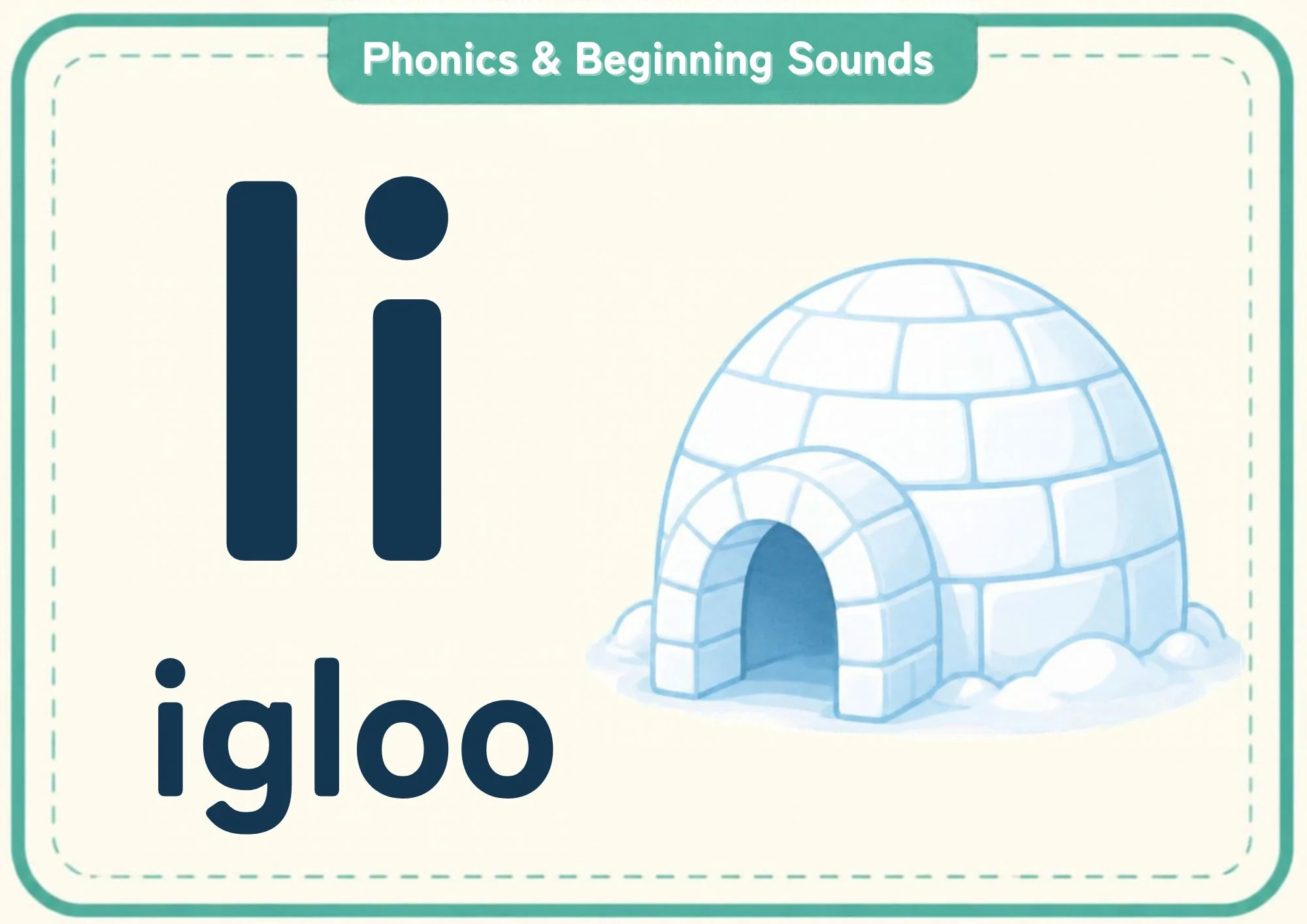
What is this?
Ii is the letter that stands for the first sound in igloo — a short, tight "ih" made with the mouth barely open and the tongue high and forward.
What does it mean?
I proves that vowels come in sizes: /a/ is a wide-open house, /i/ is a tiny snow hut. The mouth barely moves, the sound barely lasts — and it is still a whole letter.
What does the child need to know?
Your child needs to hear the quick "ih" as different from "eye" (the letter name) and from "ee", and to say it inside little words: igloo, in, insect, it.
Why this matters
Short /i/ runs the small words that hold sentences together — it, in, is, big, him. A child who owns "ih" can soon read the glue-words that make sentences stick.
What it teaches
Tiny-movement vowel control (the opposite skill of wide-open a), quick sound production, and listening for small differences between close vowels.
Words to learn
iiglooininsectitinch
Say this to your child
“"Make your mouth tiny — barely open: ih. That is I’s sound, the igloo one. Say it quick like a tickle: ih, ih, igloo."”
Step by step
- Show the card: "Ii. It says ih — quick and small, like the start of igloo."
- Finger-trace the Ii on the canvas: one tall stick and a dot — the shortest letter-shape, the shortest sound.
- Play the itch game below; "ih" arrives with the scratching.
- Say three tiny i-words together: in, it, insect. Keep the sound quick.
- Finish with the inch test: move one small inch across the floor per i-word.
How to say it
Mouth barely open, tongue high and forward, one quick beat: "ih". It is the shortest vowel — over and fast. If it stretches into "ee", tighten everything and try again.
Look closer at the picture
On this card the big navy pair Ii sits beside a snowy ice igloo with a round doorway, and the word "igloo" is printed below — a house built from the same stuff as the sound: small, quick, cool.
Ask your child
"Is your mouth big or tiny for ih?" "What is the picture on the card?" "Can you say three little i-words?"
What your child can say or do
Your child might say: "ih-ih-igloo!" with tiny nibbling mouth moves, or report honestly: "insect starts with ih — I have one in my tummy." Both count.
Out in the real world
Insects in the garden, ink on fingertips, itchy jumpers — "ih" hides in daily life. Inside-and-on top of that: every "in", "it" and "is" your child hears all day is a secret i-drill.
Try it together
Itch game: pretend something is itchy — an arm, a nose, a knee. Scratch and announce: "ih — itchy!" Then scratch-itch other things and name them: an itchy insect, an itchy igloo, an itchy inchworm. Whoever scratches the silliest body part wins the round.
Understanding check
Show the card the next day and ask for the sound: a quick "ih" (not "eye", not "ee") is the pass. Then hide the card and say "igloo" — if the first sound arrives tight and fast, the vowel is owned.
Parent tips
Short /i/ and long /i/ (ice, eye) are different jobs — keep this card’s sound tiny and quick. If "eegloo" keeps coming, whisper it: quiet forces the mouth small.
This lesson pairs with the Igloo flashcard in the library — print it, show it, keep it on the fridge. Back to Phonics & Beginning Sounds (Class 28).