
Jam — a step-by-step lesson for grown-up and child
This lesson teaches Jj and its jumping sound with the jam card: your child traces the letter, wobbles like jelly through a j-word game, and feels the tongue jump that every j-word starts with.
What is this?
Jj is the letter that stands for the first sound in jam — the tongue starts behind the teeth and jumps forward with the voice buzzing: j-j-jam.
What does it mean?
J is a movement sound: it does not sit still like m or s, it jumps. Children who learn j as motion — jump, jiggle, jog — are learning the sound and the action at once.
What does the child need to know?
Your child needs the quick tongue jump with voice on, a clean "juh", and a jar-full of j-words: jam, jump, juice, jog.
Why this matters
/j/ opens jump, joy, jam and jacket — the energy words of childhood. It is also the twin of /ch/ (same spot, j buzzes, ch puffs), a distinction worth feeling early.
What it teaches
Front-tongue jump control, voice awareness, and syllable play — j-words tend to be bouncy, and bouncy words are rhythm practice in disguise.
Words to learn
jjamjumpjuicejogjelly
Say this to your child
“"Put your tongue up, then let it jump out: juh. That is j! J says juh, like jam. Jump the sound: j, j, jam."”
Step by step
- Show the card: "Jj. The tongue jumps — j! It says the jam sound."
- Finger-trace the Jj on the canvas: the hook jumps down below the line, like the tongue jumping forward.
- Play the jelly-wobble game below — every j-word wobbles.
- Jump-say three j-things: jam, jump, juice. One small jump each.
- Finish with a whole-body jelly wobble and a loud "j-j-jam!"
How to say it
Tongue tip starts behind the top teeth and springs forward with the voice buzzing: "juh". Quick and springy — one jump, no slide into "zh".
Look closer at the picture
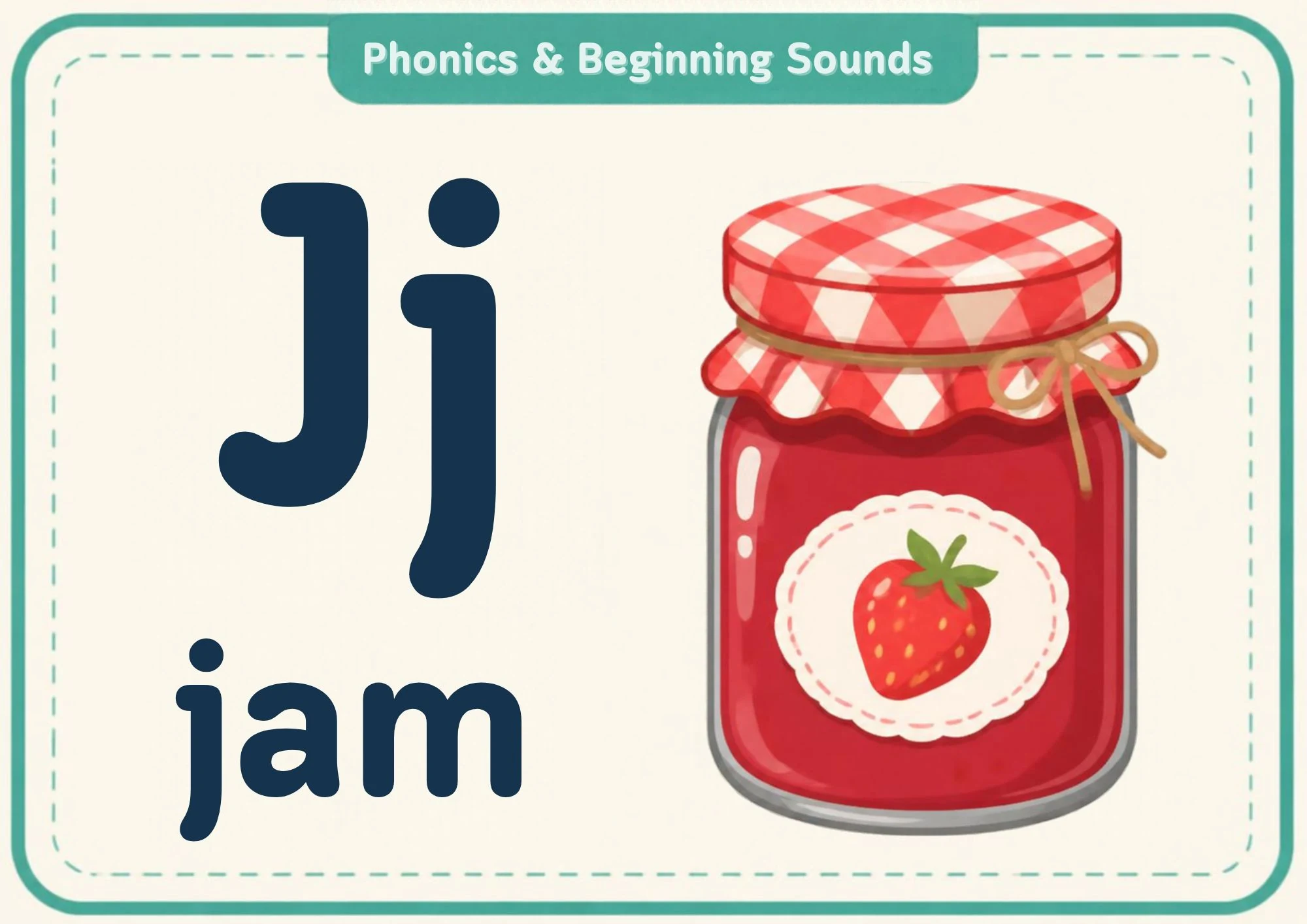
On this card the big navy pair Jj sits beside a strawberry jam jar with a red gingham lid, and the word "jam" is printed below — the stickiest card on the shelf, for the springiest sound.
Ask your child
"Does your tongue jump or sit still for j?" "Is your throat buzzing?" "What j-word makes you wobble best?"
What your child can say or do
Your child might say: "j-j-jam!" with real jumps, or make the breakfast connection unprompted: "juice starts with j — pour the j-sound!"
Out in the real world
Jam, juice and jelly live at the breakfast table; jumps and jiggles live everywhere. Jackets, jeans and jigsaws fill the rest of the day — every one a j-word asking to be said slowly.
Try it together
Jelly-wobble game: whenever anyone says a j-word, everyone wobbles like a plate of jelly — jam! wobble. jump! wobble. jog! wobble. The grown-up’s job is to say j-words fast; the child’s job is to keep wobbling without falling over. Falling over is, of course, a j too: j-just get back up.
Understanding check
Ask for the sound tomorrow: a springy "juh" with a buzzing throat is the pass. Then try ch — same spot in the mouth, puff instead of buzz. If the swap lands, the tongue has learned two letters for the price of one.
Parent tips
If j drifts to a y-sound, slow the jump down and exaggerate it. And keep it English-juh: in some languages j whispers differently — this card teaches the jumping English j.
This lesson pairs with the Jam flashcard in the library — print it, show it, keep it on the fridge. Back to Phonics & Beginning Sounds (Class 28).