
Kite — a step-by-step lesson for grown-up and child
This lesson teaches Kk and its click sound with the kite card: your child traces the letter, turns imaginary keys that unlock k-words, and learns the big spelling secret that two letters can share one sound.
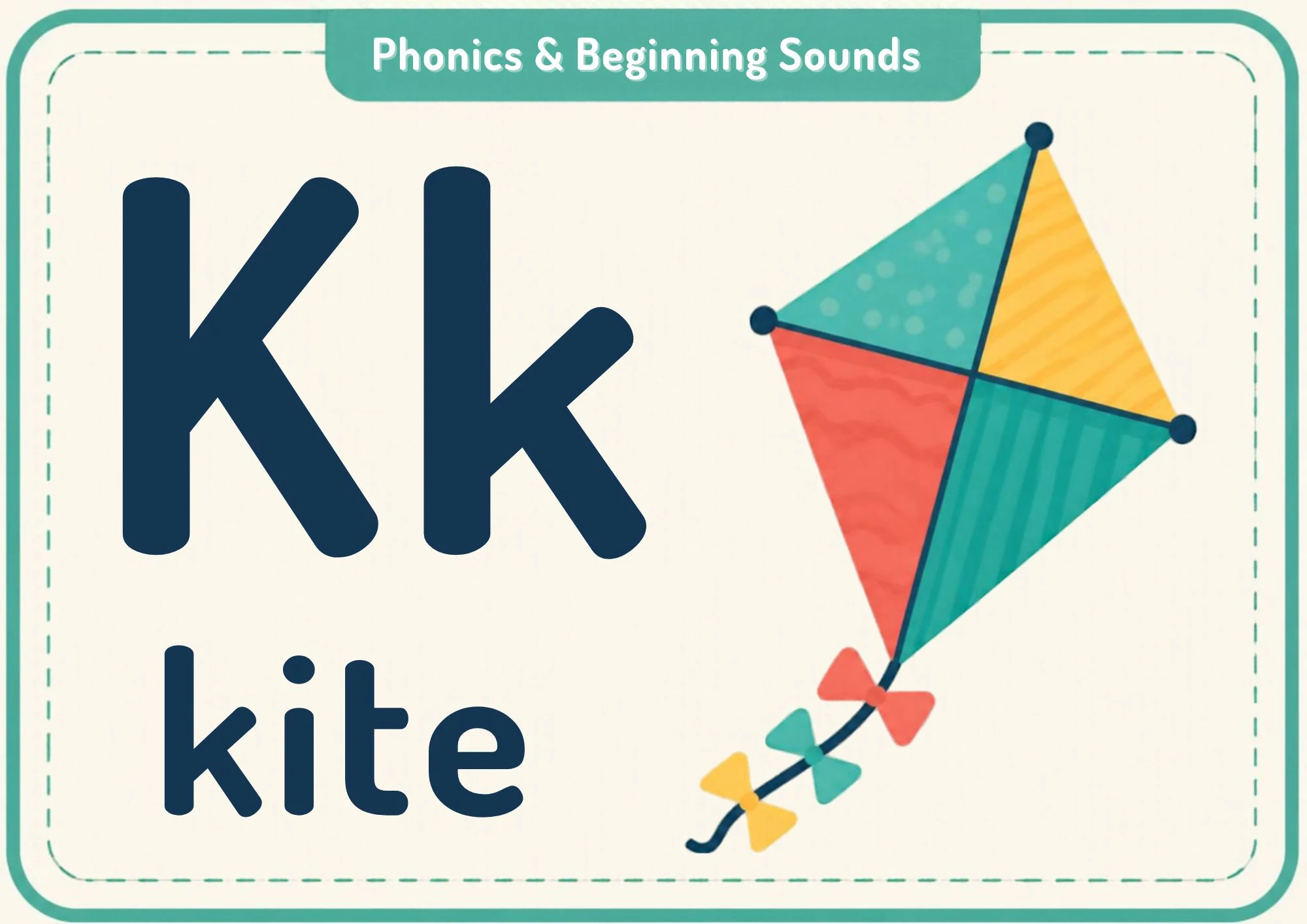
What is this?
Kk is the letter that stands for the first sound in kite — the very same back-of-the-mouth click that c makes in cat, here in its own shape.
What does it mean?
K is the alphabet’s spelling lesson in disguise: the click your child already owns now has a second written home. Meeting it as a fun fact — never a test — keeps both spellings friendly for life.
What does the child need to know?
Your child needs to recognise the click as the same one c makes, say it cleanly for k-words — kite, kick, key — and feel proud rather than confused about the two coats.
Why this matters
/k/ keeps kick, key, kitchen and kind running. Meeting it as "c’s twin" early prevents the classic later tear: "but why does cat start with c and kite with k?"
What it teaches
Back-click control (second visit), sound identity beyond letter shapes, and the flexible thinking that lets one sound belong to two letters.
Words to learn
kkitekickkeykingkiss
Say this to your child
“"Here is a secret: K and C make the very same click. K just wears its own coat. Say it: k, k, kite — the wind sound!"”
Step by step
- Show the card: "Kk. It says k — the same click as cat, in a new coat: kite!"
- Finger-trace the Kk on the canvas: one tall post, one arm and one leg — a letter built like a little person.
- Play the key-turn game below; every turn unlocks a k-word.
- Click three k-things: kite, king, keys. Listen for the same click as cat.
- Finish by saying cat, then kite — and announcing: "same sound, two letters!"
How to say it
Identical to hard c: back of the tongue lifts and releases, voice off: "k". One dry click, no vowel trailing.
Look closer at the picture
On this card the big navy pair Kk sits beside a colourful diamond kite with two bows on its tail, and the word "kite" is printed below — the flying toy that owns the second click-spelling.
Ask your child
"What sound does K make?" "Is it the same sound as cat?" "What k-word should we unlock next?"
What your child can say or do
Your child might say: "k-k-k-kite!" with three tugs, or deliver the lesson better than any adult: "c and k are twins!" — a fact they will repeat to everyone.
Out in the real world
Keys at every door, kicks in every garden, kings in every storybook. Windy days are kite days; windy days are also k-practice days.
Try it together
Key-turn game: mime holding a giant ring of keys. Each turn — click! — must unlock a k-word before the imaginary door opens: kite, king, kiss, kitchen. Open the door, peek inside, close it, pick the next key. Ten keys, ten words, one very heavy ring.
Understanding check
Ask "what sound does K make?" — the goal is the click AND the twin-fact: "same as c!" Then hide the card and ask for kite, kick, key in a row; three clean clicks mean the second coat fits.
Parent tips
Do not make the c/k difference a problem — it is a fun fact, not a quiz. Say "twins with two coats" once, play the keys, and let the spelling sort itself out years later.
This lesson pairs with the Kite flashcard in the library — print it, show it, keep it on the fridge. Back to Phonics & Beginning Sounds (Class 28).