
Lion — a step-by-step lesson for grown-up and child
This lesson teaches Ll and its singing sound with the lion card: your child traces the letter, climbs an imaginary ladder one l-word per rung, and keeps the tongue tip up — the whole secret of l.
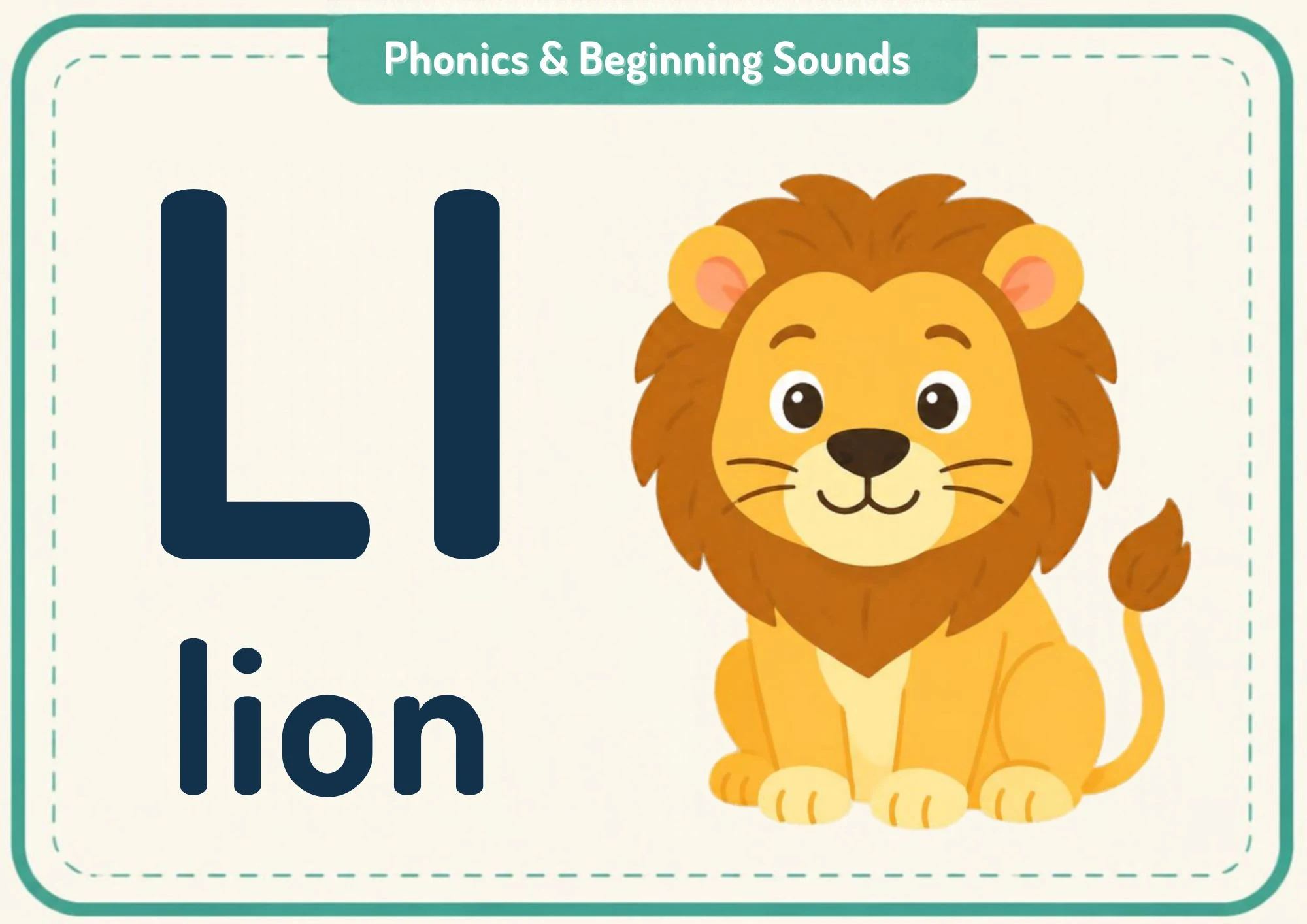
What is this?
Ll is the letter that stands for the first sound in lion — the tongue tip lifts behind the top teeth and the voice sings around its sides: l-l-lion.
What does it mean?
L shows that consonants can be vowels’ warm-up acts: the voice flows AROUND the sides of the lifted tongue instead of stopping. That side-flow is why l blends so smoothly into the vowels that follow it.
What does the child need to know?
Your child needs the tongue-tip-up feel, the singing hold, and a pride of l-words — lion, leg, love, lullaby — spoken with the tip visibly lifting.
Why this matters
/l/ starts look, love, like and lunch — the warmest words in a small child’s day. It is also one of the last sounds to mature, so gentle games now beat corrections later.
What it teaches
Tongue-tip lift and hold, sustained voicing (singing a consonant), and mirror self-checking — with l, the tongue tip is visible when done right.
Words to learn
llionlegliplovelullaby
Say this to your child
“"Put your tongue tip up behind your teeth and let it sing: llll. That is l! L says lll, like lion. Climb the sound: l, l, lion."”
Step by step
- Show the card: "Ll. The tongue tip goes up and sings — l! The lion sound."
- Finger-trace the Ll on the canvas: one tall post and one foot — the same shape as a tongue tip lifting, say it while you draw it.
- Play the ladder-climb game below — one rung, one l-word.
- Sing three l-things: lion, leg, love. Hold each l as long as breath allows.
- Finish with the mirror check: tongue tip visible at the top teeth means a true l.
How to say it
Tongue tip pressed lightly behind the top teeth, voice on, air flowing around the sides: "lll". It holds — sing it long. If it turns into "w" ("yion"), the tip is not lifting.
Look closer at the picture
On this card the big navy pair Ll sits beside a golden lion with a great dark mane, and the word "lion" is printed below — and the mane curls exactly like a lowercase l, a shape-lesson hiding in the picture.
Ask your child
"Can you see your tongue tip?" "How long can your l sing?" "What l-word should we climb to next?"
What your child can say or do
Your child might say: "lllllion!" with a five-second hold, or point at the mane and shout the shape-fact: "the lion has little l’s all over his head!"
Out in the real world
Ladders, lifts and legs; lips, lamps and love. The zoo lion roars once and the lullaby sings it again at bedtime — the sound is everywhere a child is.
Try it together
Ladder-climb game: stand tall and climb an invisible ladder, one rung per l-word — leg, lip, log, lift. Each climb ends on a shelf where an l-thing waits to be named. Climb high enough and the top shelf holds the grand prize: a lion (soft toy recommended, roaring optional).
Understanding check
Ask for the sound and watch the mirror: a visible tongue tip with a singing hold is the pass. If l arrives as w, slow down, exaggerate the tip lift, and let the mirror do the correcting — no words needed.
Parent tips
/l/ is a late bloomer — "yion" is a stage, not a fault. Keep the games silly, keep the tip visible, and never practice longer than the giggles last.
This lesson pairs with the Lion flashcard in the library — print it, show it, keep it on the fridge. Back to Phonics & Beginning Sounds (Class 28).