
Moon — a step-by-step lesson for grown-up and child
This lesson teaches Mm and its humming sound with the moon card: your child traces the letter, hums the tasty hum before every pretend snack, and meets the sound their mouth has known since babyhood.
What is this?
Mm is the letter that stands for the first sound in moon — lips pressed together, voice humming straight through them: mmm.
What does it mean?
M is the sound children make before words: "mmm" for tasty, for thinking, for calling mum. Learning m is not learning something new — it is naming something already owned.
What does the child need to know?
Your child needs the closed-lip hum, the feel of the buzz on the lips, and a moonful of m-words — moon, mum, milk, more — hummed into full words.
Why this matters
/m/ opens mum, milk, mine and more — the first-word family of almost every child. It is also the twin of /n/ (lips versus tongue tip), a difference the pinch-test makes loud and funny.
What it teaches
Closed-lip humming, voice awareness through the nose-versus-lips contrast, and connecting an owned sound to its written letter.
Words to learn
mmoonmummilkmoremmm
Say this to your child
“"Close your lips and sing through them: mmmm. That is m! M says mmm, like moon — and like the sound you make when dinner is delicious."”
Step by step
- Show the card: "Mm. Close your lips and hum — mmm. The moon sound!"
- Finger-trace the Mm on the canvas: four little mountain legs, humming the whole way across.
- Play the tasty-hum game below — the hum becomes a meal.
- Hum-say three m-things: moon, milk, muffin. Lips closed until the vowel.
- Finish with the longest hum of the day, landed softly on "moon".
How to say it
Lips fully closed, voice humming through the nose and lips: "mmm". Hold it long, then open into the word — mmm-moon. If the lips part early, the m disappears; keep them sealed.
Look closer at the picture
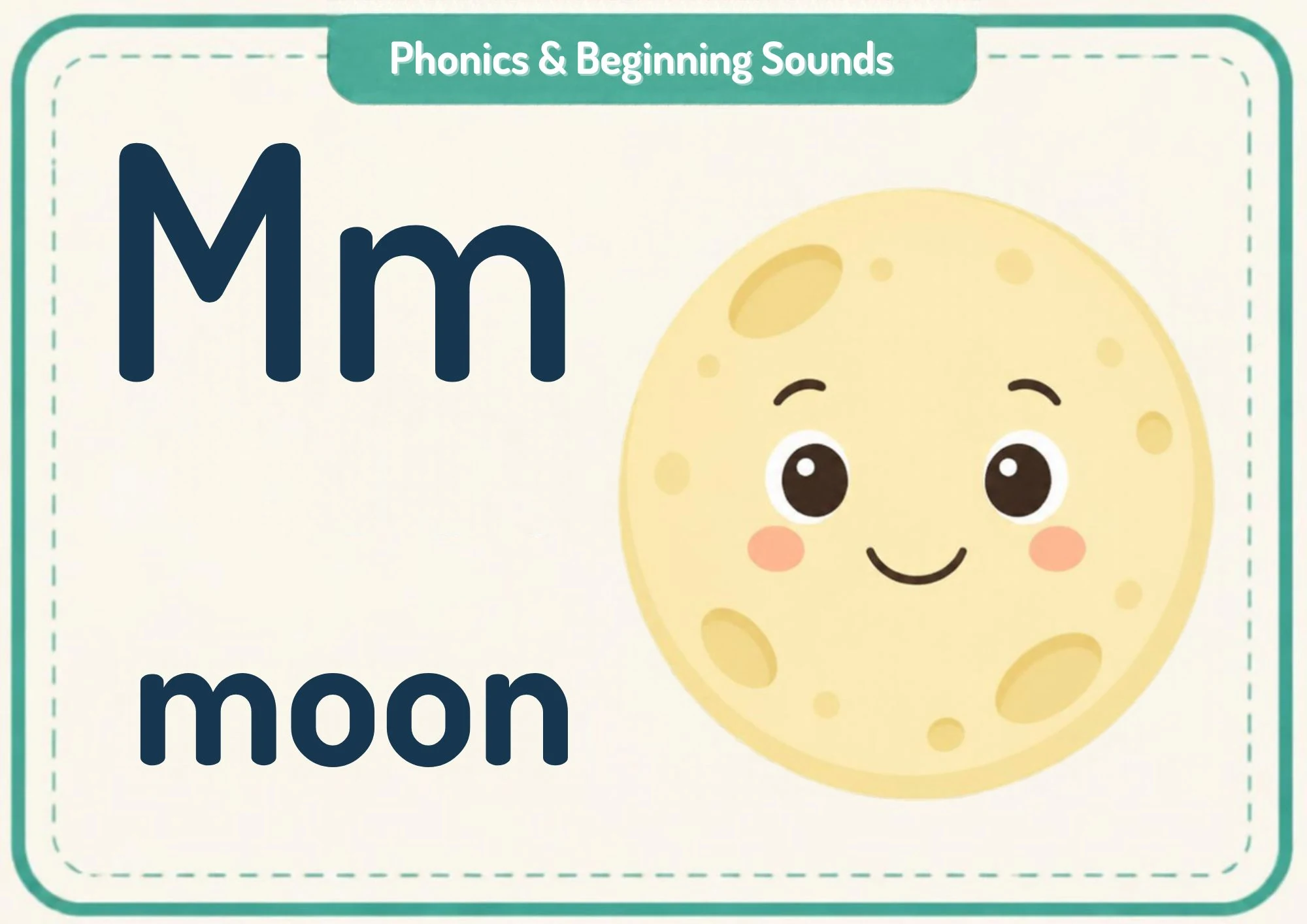
On this card the big navy pair Mm sits beside a smiling full moon with soft craters, and the word "moon" is printed below — the night-sky friend for the sound children hum at bedtime anyway.
Ask your child
"Are your lips open or closed for m?" "Can you hum with your mouth shut?" "What m-word would you eat right now?"
What your child can say or do
Your child might say: "mmmmoon!" with closed lips then a big open finish, or rate your cooking honestly: "mmm! that means m-words are coming."
Out in the real world
Mealtimes are m-festivals: mmm before every bite of mash, melon, muffin. Bedtime adds the moon itself, plus lullabies hummed on m — the sound already lives in your child’s favourite moments.
Try it together
Tasty-hum game: lay out pretend snacks (real ones work too). Before tasting each one, the eater must hum approval — "mmm!" — then name it with the hum attached: mmm-melon, mmm-muffin. Swap chef and critic roles. The tastiest-sounding m-word wins the last bite.
Understanding check
Show the card tomorrow and ask for the sound: a closed-lip hum is an instant pass — it is the hardest sound to get wrong. Then try n, and pinch the nose mid-hum: the buzz stops. M and n, sorted by nose.
Parent tips
If m-words start losing their front sound ("oon" for moon), hum the m and keep the lips closed until the last possible moment. The lips re-learn in one game.
This lesson pairs with the Moon flashcard in the library — print it, show it, keep it on the fridge. Back to Phonics & Beginning Sounds (Class 28).