
Nest — a step-by-step lesson for grown-up and child
This lesson teaches Nn and its nose-hum sound with the nest card: your child traces the letter, switches on pretend stars one n-word at a time, and learns how the nose joins the alphabet.
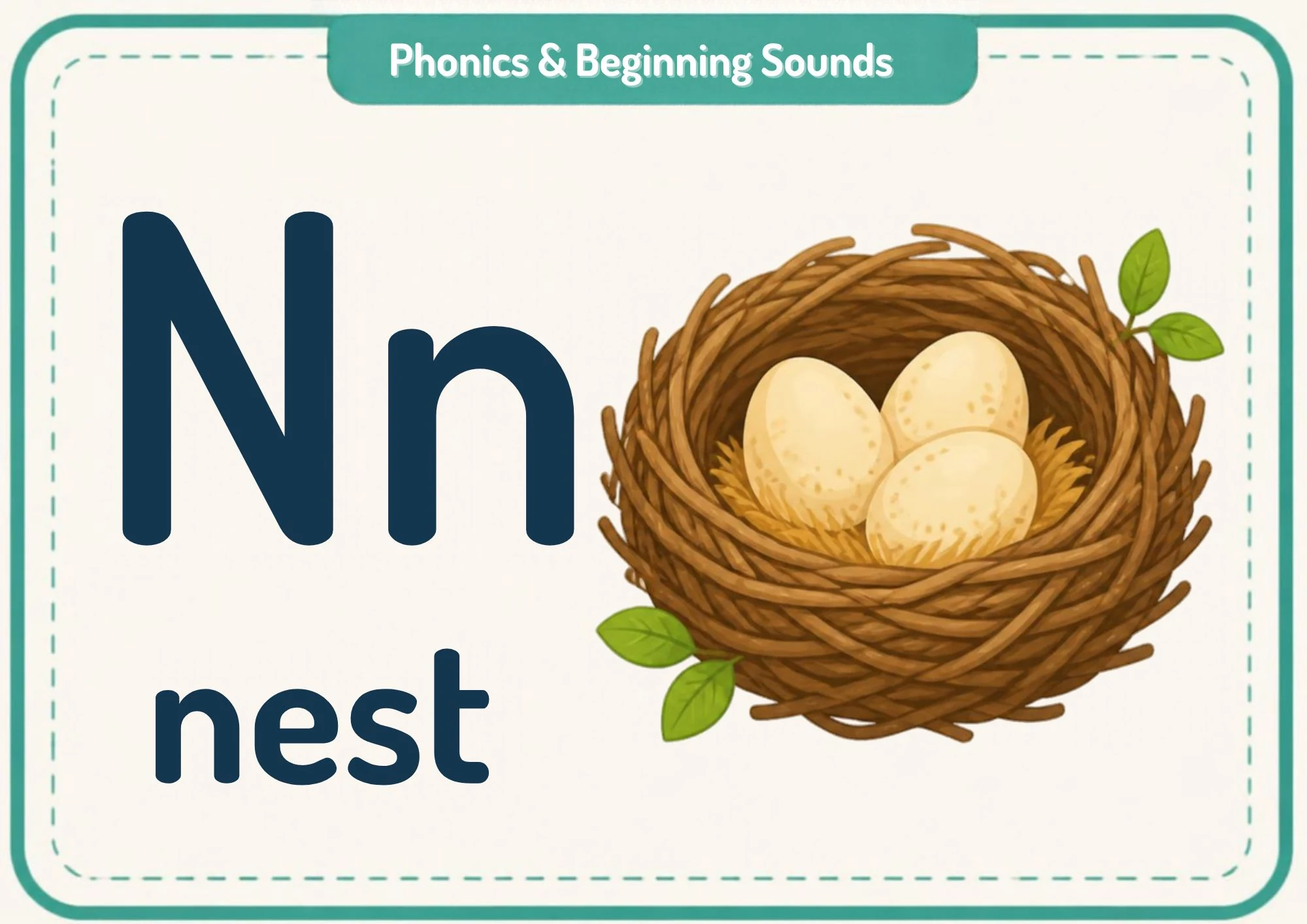
What is this?
Nn is the letter that stands for the first sound in nest — a quick tap of the tongue that turns into a hum, the sound a bottle makes as it empties: nnn.
What does it mean?
N shares one doorway with m: the nose. The only thing that changes is the tongue — resting at the lips for m, lifted behind the teeth for n. One body, two sounds, one fingertip apart.
What does the child need to know?
Your child needs the tongue-tip-up hum, the nose-buzz feel (pinch test!), and a nest-full of n-words: nest, nose, night, nine.
Why this matters
/n/ carries no, night, nine and napkin — words with real power in a child’s day. It is also m’s twin, and sorting the two by tongue spot now prevents years of m/n spelling swaps.
What it teaches
Tongue-tip precision while humming, nose-versus-lips discrimination, and the fine mouth-awareness that separates close twin sounds.
Words to learn
nnestnosenightninenap
Say this to your child
“"Tap your tongue behind your teeth and hum — nnn. That is n! N says nnn, like nest. Feel it buzzing in your nose? N, n, nest."”
Step by step
- Show the card: "Nn. Tongue tip up, hum through your nose — nnn. The nest sound!"
- Finger-trace the Nn on the canvas: two posts and a bridge, one nnn-hum per stroke.
- Play the night-stars game below — every n-word lights a star.
- Hum three n-things: nest, nose, night. Tongue tip stays high.
- Finish with the pinch test: hum n, pinch the nose, feel the buzz stop. Magic.
How to say it
Tongue tip pressed behind the top teeth, voice humming through the nose, mouth lightly closed or open: "nnn". The lips stay apart — if they close, you made an m.
Look closer at the picture
On this card the big navy pair Nn sits beside a brown nest holding three pale eggs, and the word "nest" is printed below — three eggs, free counting practice, riding on the sound.
Ask your child
"Where is your tongue for n?" "What happens if I pinch your nose while you hum?" "Name an n-word in this room."
What your child can say or do
Your child might say: "nnnest!" with the nose-scrunch of a proper hum, or demand the pinch test on repeat — the buzz-stop is preschool comedy gold.
Out in the real world
Night-time is n-time: night, no, nose-wipe, nine bedtime hugs. Birds’ nests on walks, napkins at dinner, and the word no (said by both parties) keep the sound in rotation.
Try it together
Night-stars game: the room goes to night-time (lights can stay on; pretend dark is better). Each n-word said switches on one imaginary star: night… nose… nine… nest. Fill the whole ceiling, then count the stars — nine is, naturally, the best answer.
Understanding check
Ask for the sound and watch the tongue: tip up, nose buzzing. Then the referee game: m and n back to back — lips for m, tongue for n. If your child can show both, the twins are sorted.
Parent tips
Swap hunts work better than corrections here: say nest, nose and name in a row and let your child point to their nose or their lips each time they hear where the hum sits. The pointing finger learns faster than the correcting mouth — and no inside the nest stays the best n-word of all.
This lesson pairs with the Nest flashcard in the library — print it, show it, keep it on the fridge. Back to Phonics & Beginning Sounds (Class 28).