
Octopus — a step-by-step lesson for grown-up and child
This lesson teaches Oo and its round sound with the octopus card: your child traces the letter, plays the surprise-box game where every opening is an "O!", and learns the one letter that is also a perfect mouth shape.
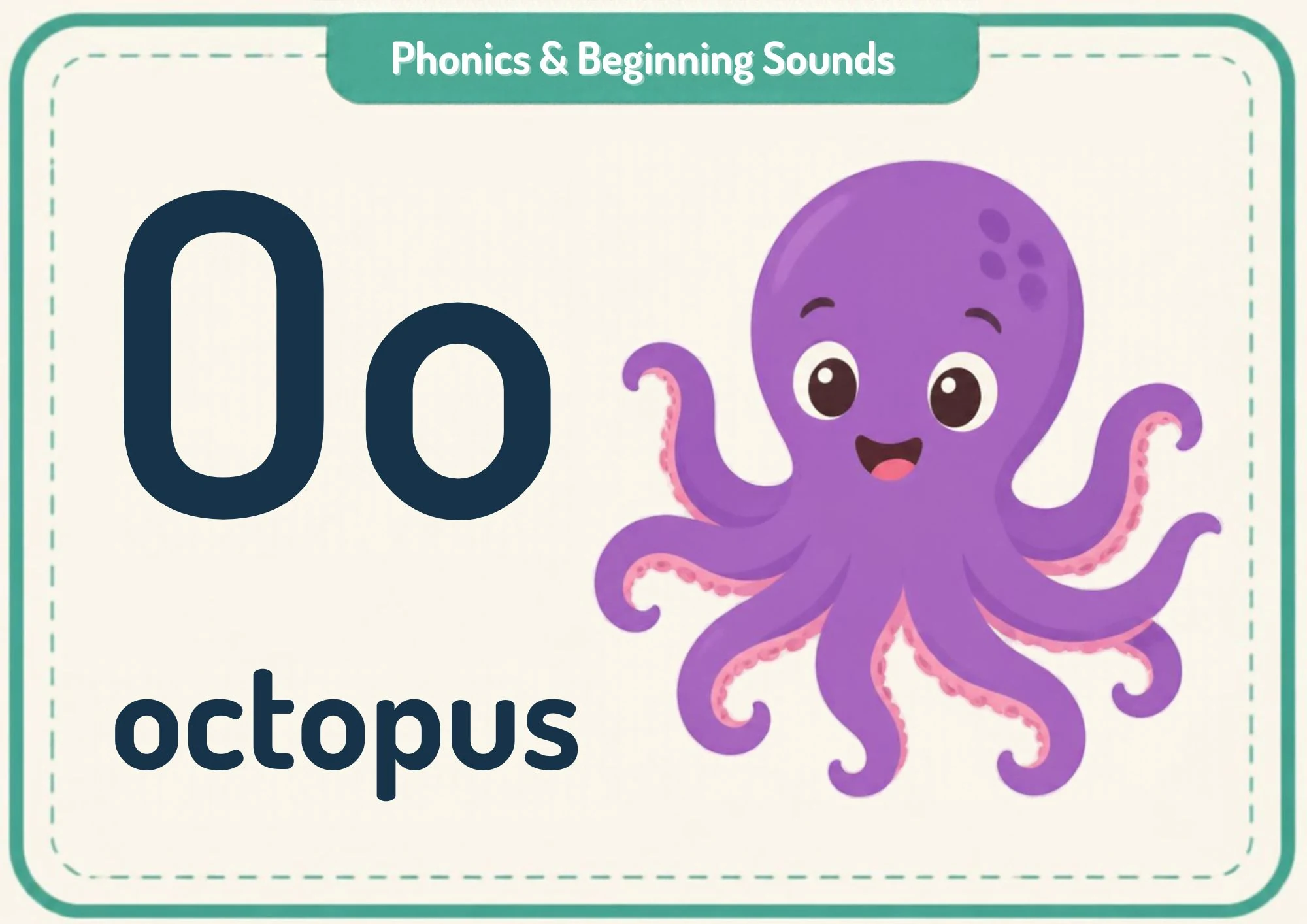
What is this?
Oo is the letter that stands for the first sound in octopus — a short, round "oh" made with the lips curled into a little circle.
What does it mean?
O is the alphabet’s self-portrait: the letter looks like the mouth shape it needs. Show the letter, make the mouth — the shape teaches itself, which is why o is a favourite first vowel.
What does the child need to know?
Your child needs the round-lip "oh", kept short (this is octopus /o/, not open /oh/), and a basket of o-words: octopus, on, off, ox.
Why this matters
/o/ powers on, off, hot, not, stop — the words that run a four-year-old’s day, including the most powerful one: stop. Short and round, and sentences start working.
What it teaches
Lip rounding control, letter-shape to mouth-shape mapping, and keeping a vowel short when the letter name wants to stretch it.
Words to learn
ooctopusonoffoxhot
Say this to your child
“"Make your lips into a little circle — oh! That is O’s sound, the octopus one. Say it round: oh, oh, octopus."”
Step by step
- Show the card: "Oo. Round your mouth like this letter: oh! The octopus sound."
- Finger-trace the Oo on the canvas — a perfect circle, drawn while the lips hold their own perfect circle.
- Play the surprise-box game below; every lid-lift is a natural O.
- Round-say three o-things: on, off, octopus. Keep the sound short and round.
- Finish with eight arm-wiggles — one per arm, one per o-word.
How to say it
Lips rounded into a small circle, voice on, sound kept short: "oh". No glide up into "oh-uh" — clip it clean. The letter draws the mouth; the mouth draws the sound.
Look closer at the picture
On this card the big navy pair Oo sits beside a smiling purple octopus with curling arms, and the word "octopus" is printed below — eight arms for eight practice rounds, all starting with the same round sound.
Ask your child
"Is your mouth round or flat for o?" "What does the letter look like?" "Say on — now off. Both start with...?"
What your child can say or do
Your child might say: "o-o-o-octopus!" with lips like a goldfish, or connect the shape forever: "O looks like my mouth when I say it!"
Out in the real world
On-and-off switches are o-controllers disguised as furniture. Hot and not, stop and go, octopuses in the bath — the round sound runs the day’s biggest moments.
Try it together
Surprise-box game: fill an imaginary box (or a real one) with mystery objects. Open the lid — "O!" — then name what is inside, starting with the sound you just made: an octopus, an orange, an ox. Close, shake, reopen. The louder the O, the bigger the surprise.
Understanding check
Show the card tomorrow and ask for the sound: a short round "oh" is the pass; a stretched "oh-ohh" means the long O visited — clip it short and move on. The surprise-box reopen is the quickest repair.
Parent tips
Short /o/ (octopus, on) and long /o/ (open, over) are different jobs. Keep this one round and clipped — the long O has its own cards elsewhere on the path.
This lesson pairs with the Octopus flashcard in the library — print it, show it, keep it on the fridge. Back to Phonics & Beginning Sounds (Class 28).