
Pig — a step-by-step lesson for grown-up and child
This lesson teaches Pp and its puff sound with the pig card: your child traces the letter, pops like corn on every p-word, and catches the invisible puff of air that separates p from its loud twin b.
What is this?
Pp is the letter that stands for the first sound in pig — lips pressed together, then a little burst of air with no voice: p-p-pig.
What does it mean?
P is invisible — nothing wiggles in the mouth to show it happened. So this lesson teaches the tissue trick and the mirror check: children learn to catch sounds they cannot see.
What does the child need to know?
Your child needs the soft lip burst, the silent throat (p does not buzz), and a pen of p-words: pig, pop, park, pink.
Why this matters
/p/ runs please, play, park and popcorn — the polite-and-playful heart of a child’s day. It is also b’s twin, and the puff test learned here keeps the two spellings apart forever.
What it teaches
Lip-burst control, voice-off awareness (the b/p contrast), and instrument-based self-checking — tissue and mirror as the child’s own measuring tools.
Words to learn
ppigpopparkpinkpopcorn
Say this to your child
“"Press your lips together and let a tiny puff out: p! That is P’s sound, the pig one. Pop the sound: p, p, pig."”
Step by step
- Show the card: "Pp. Lips together, little puff — p! The pig sound."
- Finger-trace the Pp on the canvas: one tall post and one round belly, puffing with each curve.
- Play the popcorn game below — every pop is a p-word.
- Puff-say three p-things: pig, pink, park. Throat silent, lips busy.
- Finish with the tissue test: p moves the tissue, b does not. Science!
How to say it
Lips sealed, then opened with a small air burst and no voice: "puh". Keep the puff small and quick — a big dramatic blast is fine for learning, quiet for talking.
Look closer at the picture
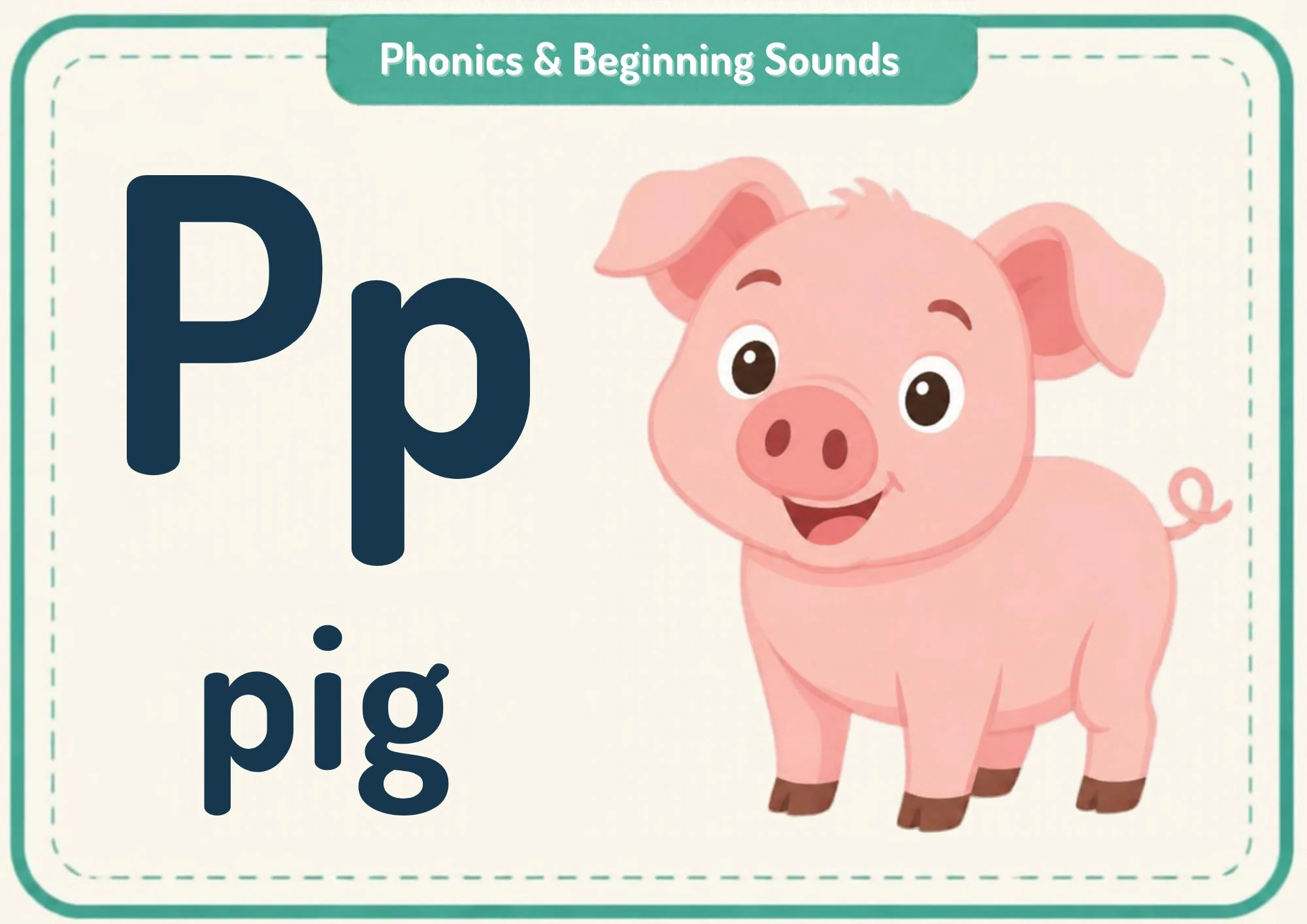
On this card the big navy pair Pp sits beside a smiling pink pig, and the word "pig" is printed below — the snout-nosed teacher for the sound with no voice and plenty of puff.
Ask your child
"Does your throat buzz for p?" "What happens to a tissue when you say p?" "What p-word would you plant in the garden?"
What your child can say or do
Your child might say: "p-p-p-pig!" with popcorn jumps, or run the tissue experiment on the whole family — p, b, f, everything gets tested.
Out in the real world
Parks, picnics and puddles; pigs at the farm, penguins at the zoo. Popcorn nights put the sound right in the bowl — pop is the best p-word ever invented.
Try it together
Popcorn game: everyone crouches low like a seed in the pan. The grown-up pretends to pour oil, shake the pan and turn up the heat — and when the heat is HOT, each child pops up with a p-word: pop! pink! pig! park! Pop, say the word, sink back down, wait for the next shake. The biggest pop wins the pan.
Understanding check
Ask for the sound and hold the tissue: a visible jump with a silent throat is the pass. Then say b — same lips, buzzing, tissue still. If your child can feel both twins, p is fully learned.
Parent tips
If pig comes out as big, the voice switched on — hand on the throat proves p stays quiet. Exaggerate the puff while learning; the small everyday p arrives on its own.
This lesson pairs with the Pig flashcard in the library — print it, show it, keep it on the fridge. Back to Phonics & Beginning Sounds (Class 28).