
Bones — a step-by-step lesson for grown-up and child
This lesson makes the invisible inside visible: your child presses, bends and wiggles their way to discovering the frame under their skin — and learns that the same quiet scaffolding is busy making blood all day long.
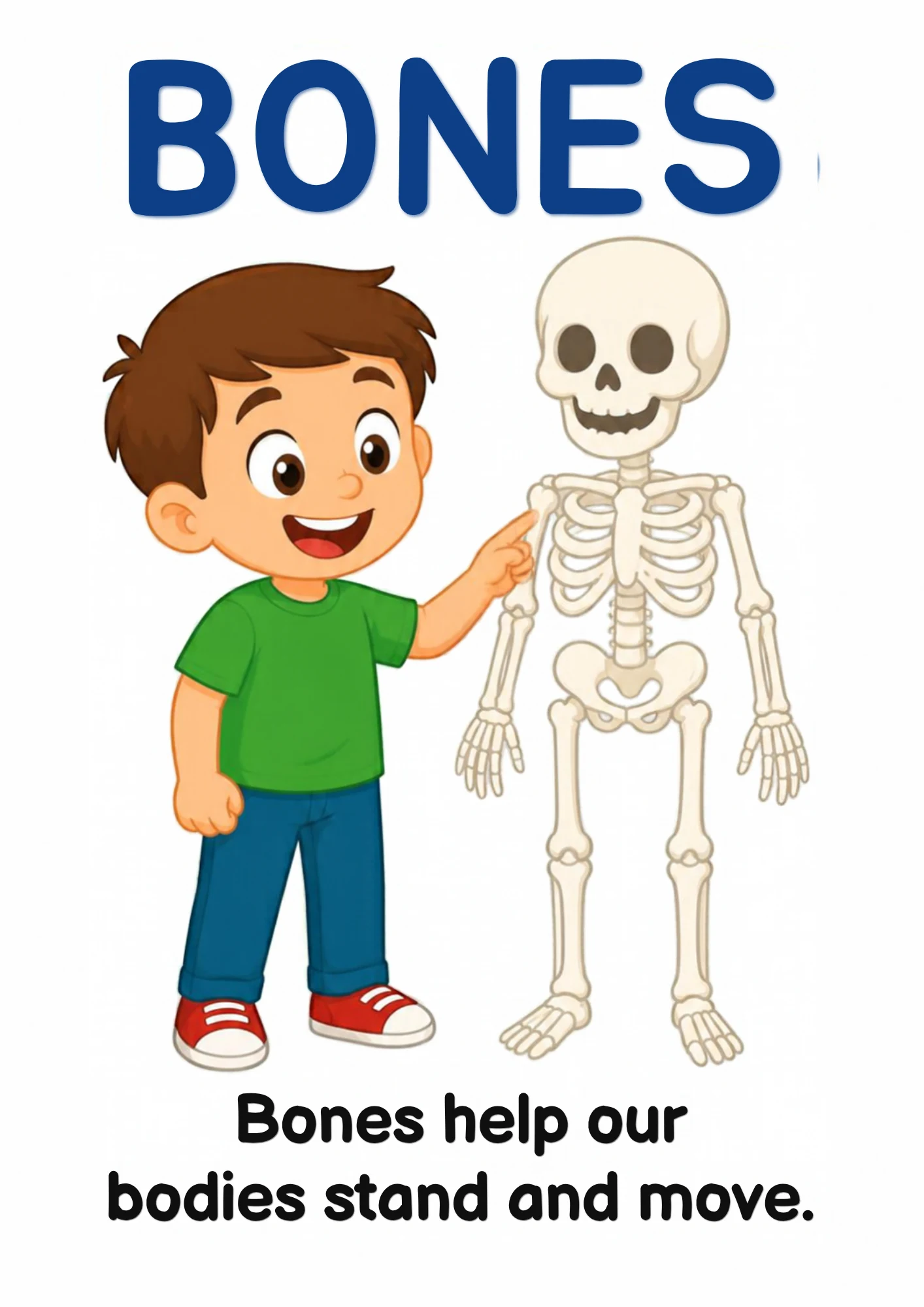
What is this?
Bones are the hard parts inside your body: 206 of them in a grown-up, joined at joints. The skeleton holds you upright, guards the soft organs, gives muscles something to pull on — and the biggest bones are blood factories.
What does it mean?
A body without bones would be a puddle: bones are why you stand, sit, jump and carry. Joints are where the design gets clever — the elbow bends one way, the shoulder swings a circle, and every bend has a limit that keeps it safe.
What does the child need to know?
A baby starts with about 300 soft bones; as you grow, some join together, leaving 206. Bones grow with you — the skeleton of a four-year-old is halfway to its final size. Blood cells are made deep inside the biggest bones, like a factory under the floor.
Why this matters
Feeling your own skeleton turns "bones" from a Halloween word into a body fact. It builds self-knowledge, safety sense (helmets and elbows exist because bones can break), and the habit of asking what is inside things.
What it teaches
Body awareness and self-care vocabulary, sorting (bendy joints versus straight bones), counting to five on the touch hunt, and early engineering thinking: frames, supports and joints, just like a crane or a doll’s stand.
Words to learn
bonesskeletonjointsbendribsskull
Say this to your child
“"Under your skin there is a whole frame, like the poles inside a tent. Bones hold you up, protect the soft parts, and make your blood inside the big ones. Feel that hard ridge in your shin — that is your skeleton, saying hello from inside."”
Step by step
- Show the card: who is standing beside the child, and does the skeleton look friendly? Wave to the skeleton together.
- Start the feel-hunt: press gently on the shin — that hard bit is a bone saying hello. Find the ribs, the elbow, the knee, the skull.
- Bend test: wiggle fingers, bend the elbow, swing a shoulder — bones are straight but joints are the bendy hinges between them.
- Tell the factory secret: inside the biggest bones, blood is being made all day, every day, without a break.
- Count up: a baby starts with about 300 bones, and some join together as you grow — a grown-up has 206. Your child is a building site, in the best way.
Look closer at the picture
Ask your child: who is standing next to the child in the picture? Does the skeleton look friendly or grumpy? Can you find the skeleton’s ribs? Where are your own ribs right now?
Ask your child
"What do bones do for your body?" "Where do two bones meet?" "What is made inside your biggest bones?" "Why does a baby have more bones than you?"
What your child can say or do
"I can feel my skeleton — it is everywhere!" "Bones make my blood!" Your child may press knuckles to find hard bits all day, count the bones in one hand, or explain that babies have "more bones but smaller ones, and some zip together".
Out in the real world
Skeletons are hiding in every meal and playtime: chicken bones on a plate, the hard knobs of your ankles on stairs, X-ray pictures at the doctor. Once your child can find five bones, every bump and bend becomes a map of the frame inside.
Try it together
Skeleton dance: call out a bone — "ribs!", "skull!", "shin!" — and your child pats it fast, then freezes like a statue. Slow-mo round next: every move in slow motion, feeling which parts bend at joints and which stay straight.
Understanding check
Ask: "What holds your body up? Where do bones bend? What is made inside big bones?" Skeleton, joints, blood = landed.
Parent tips
Keep the touch hunt gentle — bones to find, not bones to bang. If a cast or an X-ray shows up in your family or a friend, bring it out: a real broken-bone story teaches more about why bones matter than any diagram.
This lesson pairs with the Bones flashcard in the library — print it, show it, keep it on the fridge. Back to Science, Nature & Discovery (Class 31).