
Fish — a step-by-step lesson for grown-up and child
This lesson answers the question every child asks at the fish tank — how on earth does it breathe down there? — and turns a goldfish bowl into a breathing laboratory your child can count, compare and imitate.
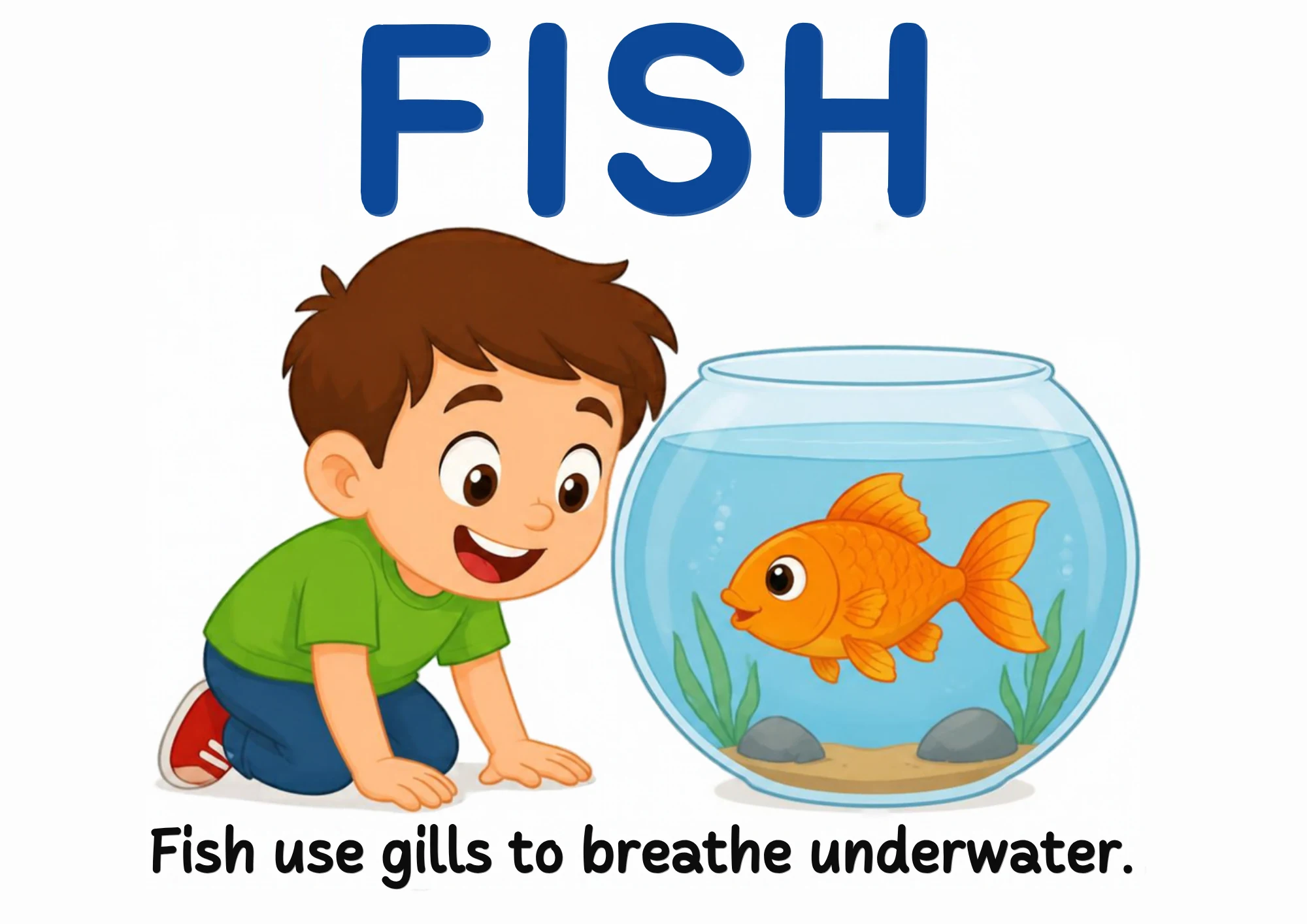
What is this?
A fish breathes with gills: water goes in the mouth, pours over the gills hidden behind the gill covers, and the gills snatch the oxygen out of the water — so a fish never has to surface for air the way we do.
What does it mean?
We solve the breathing problem with lungs that take air from the sky; fish solve it with gills that take air from the water. Same job, different tools — comparing solutions is what scientists do all their lives.
What does the child need to know?
Fish never stop pumping: the gill covers flap open and shut like tiny doors, all day and night. Fins steer and brake, the flat tail is the engine, and most fish rest without ever closing their eyes — they have no eyelids to close.
Why this matters
Gills open up the compare-and-contrast habit: fish, frogs and people all need oxygen, but each body finds it somewhere different. Your child also learns to read animal bodies as equipment — every part has a job.
What it teaches
Observation of small repeated movements (gill beats), counting practice, comparison across animals (gills versus lungs), and the deep idea that bodies are built to match where they live.
Words to learn
fishgillswaterbreathefinstail
Say this to your child
“"A fish carries its own breathing gear inside its head. It takes a big sip of water, and while the water pours out over its gills, the gills grab the air out of it. Those flaps opening and closing are the fish breathing — it never has to come up for air."”
Step by step
- Show the card: what is the child peering at, and where does the goldfish live? Name the bowl and the fish.
- Ask the big question: our lungs grab air out of the sky — how does a fish grab air out of the water? Let guesses fly before you answer.
- Explain the gill doors: water swims in the mouth, washes over the gills, and the gills grab the air hidden in the water.
- Watch a real fish if you can — a bowl, a tank, an aquarium — and count gill beats together for ten seconds.
- Compare: you breathe about twenty times a minute at rest; was the fish faster or slower? Finish with fins for steering and the tail for pushing.
Look closer at the picture
Ask your child: what is the child peering at? Can you find the goldfish? Is the fish swimming in a bowl or the sea? What do you think the fish is looking at?
Ask your child
"What does a fish use to breathe?" "Do fish breathe air or water?" "What do fins do — and the tail?" "How long can you hold your breath under water?"
What your child can say or do
"Gills are doors that grab air!" Your child may puff cheeks and pretend to be a fish, flap hands by their neck like gills, or count the gill beats of every fish they ever meet — bowls, aquariums, and the fish counter at the market.
Out in the real world
Fish live in every patch of water bigger than a bucket: bowls, tanks, garden ponds, rivers, the sea. Once gills make sense, the aquarium becomes a breathing lesson on repeat — and your child knows why a fish out of water flops: its gear only works wet.
Try it together
Gill-breathing pretend: scoop "water" with big armfuls, clap hands to your neck and whisper "grab!" each time — once, twice, all day long. Then switch: you are the fish, your child counts your gill beats, and you race to twenty.
Understanding check
Ask: "What does a fish breathe with? What do gills grab from the water? What pushes a fish along?" Gills, oxygen, the tail = landed.
Parent tips
A home goldfish bowl is a live experiment: one quiet minute of sitting still, and the gill counting works best when nobody taps the glass. Feeding time is bonus science — fish rush the surface, then settle back into their gill rhythm.
This lesson pairs with the Fish flashcard in the library — print it, show it, keep it on the fridge. Back to Science, Nature & Discovery (Class 31).