
Karate — a step-by-step lesson for grown-up and child
This lesson teaches karate as the manners programme wearing a punch: the bow, the counted kata, the blocks before punches — and the control of stopping every punch in the air.
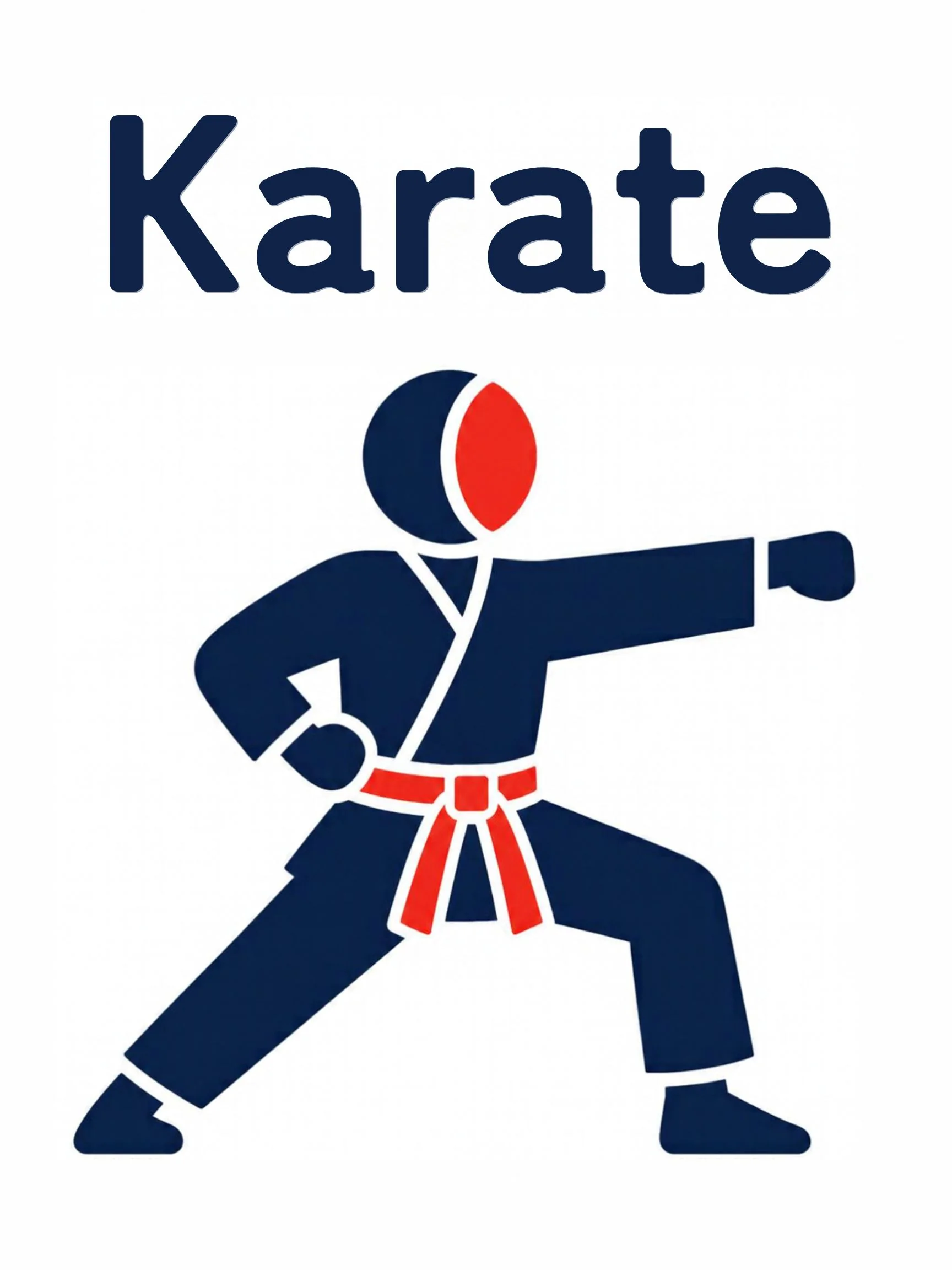
What is this?
Karate means "empty hand" — a Japanese art of blocks, punches and kicks done with no weapons: strong low blocks, straight punches that STOP in the air, and kata — patterns of moves counted out loud.
What does it mean?
The hidden curriculum of karate is control: every punch stops short, every partner is bowed to, every class starts and ends with respect. Children learn that power and manners arrive together or not at all.
What does the child need to know?
Your child needs three karate ideas: the bow opens and closes everything; blocks come BEFORE punches — low, middle, high; and the punch is straight and STOPPED — air control proves the discipline.
Why this matters
The counted kata — ichi, ni, san, shi — is focus training disguised as a drill: four moves in order, in Japanese, with a big voice. It is the wall’s best first lesson in doing things IN ORDER.
What it teaches
Sequencing (the kata is an ordered plan), blocking mechanics, air-stopping control (punch power with a brake), and the counting itself — Japanese one-to-four is a genuine first foreign-language souvenir.
Words to learn
karateempty handblockpunchkatabowichi ni san shi
Say this to your child
“"Karate means empty hand — no weapons, just your body! We bow first: oss! Blocks come before punches: low, middle, high. Then the straight punch — out from the hip and STOP in the air, because karate power comes with karate control. And we count in Japanese: ichi, ni, san, shi! Bow. Oss!"”
Step by step
- Show the card: "This is karate — empty hand, strong blocks, straight punches."
- The bow: fists to the palm, small bow — oss! Every kata begins and ends here.
- The three blocks: LOW (arms cross down), MIDDLE (forearm across the tummy), HIGH (forearm over the head). Blocks before punches — say it, mean it.
- The stopped punch: straight out from the hip, STOP in the air — no partner, no target, full control. Control IS the skill.
- Teach the kata below and close with the bow: "block, block, block, punch — ichi ni san shi!"
Look closer at the picture
On this card the word "karate" is printed large at the top with the dojo’s scene below — the child in the white suit mid-move exactly as a first kata looks.
Ask your child
"What does karate mean? What comes before punches? Where does the punch stop? What are the counting words?"
What your child can say or do
Your child might say: "Empty hand!" "Low, middle, high — blocks first!" or the counted kata: "Ichi, ni, san, SHI!"
Out in the real world
Karate lives in dojos on every street corner of the four countries this class calls home — the white suits and coloured belts are the world’s most visible children’s sport. Watch one kids’ class: the bowing is not decoration, it is half the lesson.
Try it together
The First Kata: bow, then four moves down an imaginary line — low block (ichi), middle block (ni), high block (san), straight stopped punch (shi) — counted in a BIG voice. Turn, repeat the other way. Three lines make a whole kata: bow, and oss! Belt ceremony: any coloured ribbon tied on, one thing praised about the manners, not the punches.
Understanding check
Ask: "What does karate mean? What comes before punches? What does the punch do in the air? Count the kata." Empty hand, blocks, stops, ichi-ni-san-shi — four answers and the dojo is open.
Parent tips
The air-stop is the discipline engine — a punch that can stop can be trusted, and children feel that trust immediately. And count in Japanese every single time: four words of a second language, worn like a belt.
This lesson pairs with the Karate flashcard in the library — print it, show it, keep it on the fridge. Back to Sports & Movement (Class 37).