
Odd One Out — a step-by-step lesson for grown-up and child
This lesson is the deck’s grand finale: three things that match and one that does not, and your toddler gets to find the stranger and say so.
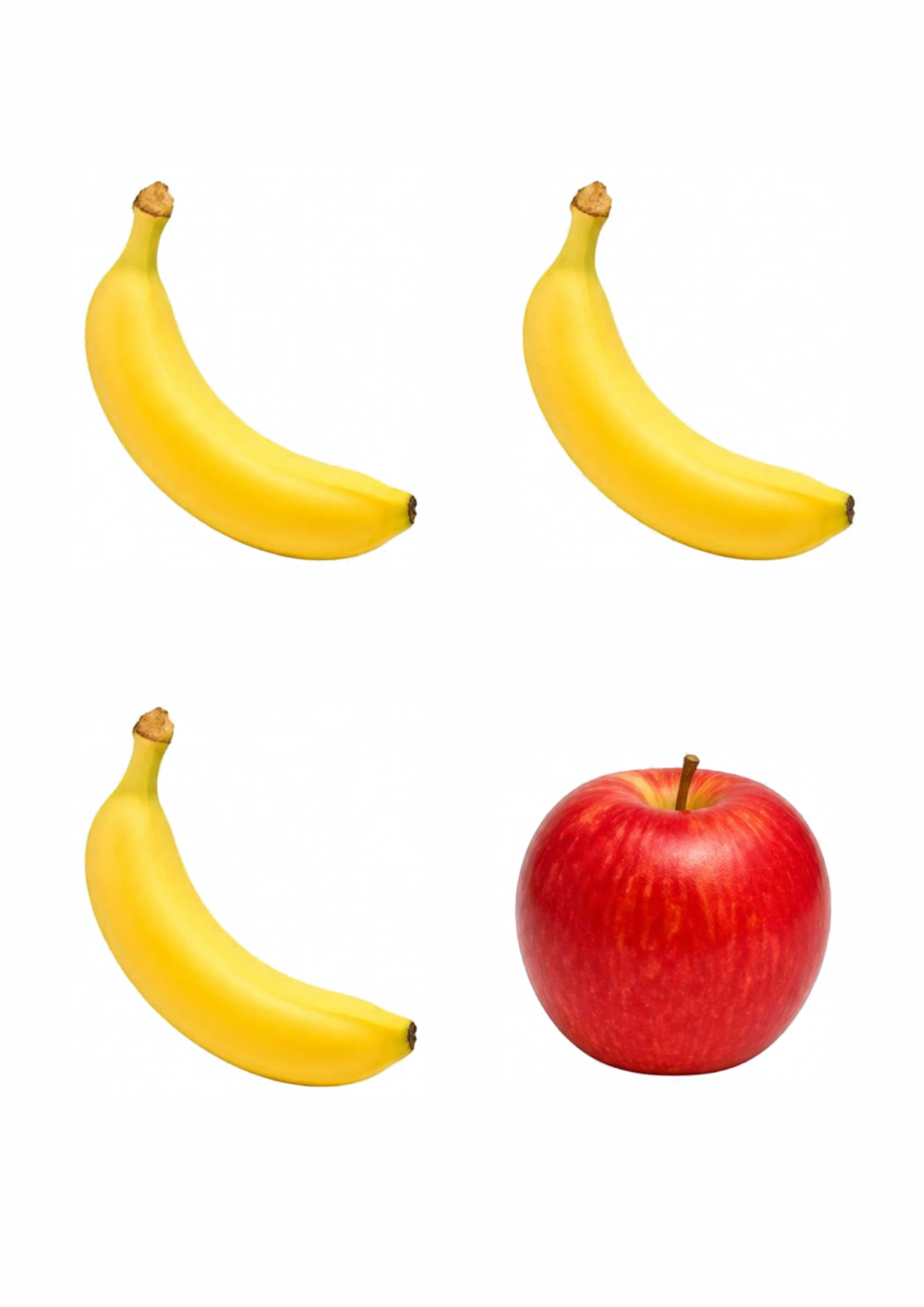
What is this?
The odd one out is the thing that breaks the pattern. Three bananas make a row; the apple does not belong — and spotting that break is a two-year-old thinking milestone.
What does it mean?
This puzzle stacks two skills: seeing what the group is, then testing each member against it. The stranger only looks strange once the pattern is held in mind — that holding is the growing part.
What does the child need to know?
Hard is honest: this is the trickiest card in the deck, and wrong grabs are part of the path. Shrink the game to real objects when the card stalls, and grow it back when the grin returns.
Why this matters
Odd-one-out is dinner-table gold: three spoons and one cup, three crackers and one apple. The pattern needs nothing but the table setting, rerun nightly for free.
What it teaches
Pattern spotting, holding a rule while checking members against it, and different used as a verdict — the fullest thinking workout the deck offers.
Words to learn
differentoddonebananasapplebelong
Say this to your child
“"Banana, banana, banana… apple! Wait — which one is different? Look again… the apple! Three bananas, one apple. The apple is the odd one out! Can you say different?"”
Step by step
- Show the card and name the row in order, one point each: banana, banana, banana… apple. Let the rhythm break all by itself at the end.
- Ask the question: which one is different? Then wait through the thinking — the pause is where the comparing happens.
- Confirm the find with the pattern said out loud: three bananas, and one apple — the apple is different! Trace from banana to banana, then stop at the apple.
- Celebrate the oddity, not a win: the apple is not wrong to be there — it is the interesting one. Different is a discovery, not a mistake.
- Rerun it small and real: three spoons and one cup at lunch, and let your toddler hand you the stranger. Tables make friendly versions of tricky cards.
Look closer at the picture
The card shows three bananas and one apple for an odd-one-out activity — three matching fruit and one that breaks the row. Ask your toddler to tap each banana in turn, then find the fruit that is not a banana.
Ask your child
"Which one is different?" "Are they all bananas?" "What is this one?" "Can you find the one that does not belong?"
What your child can say or do
A slow point that visits each fruit before landing, or a snatch of the apple held up like evidence — both are answers. Different said as diff-rent is the word of the month; keep saying it back.
Out in the real world
Table settings run this puzzle nightly: three spoons and one fork, three cups and one plate. Hand over the job of fetching the odd one and the thinking becomes a chore anyone would volunteer for.
Try it together
Stranger soup: line up four snacks, three the same and one odd, and let your toddler evict the stranger with a flourish. Then swap jobs — you close your eyes, they build the row, and you get to be wrong on cue.
Understanding check
Ask cold at the next tidy-up: line up three books and one bear and request the different one. A clean pick passes. A pick of the bear with reasons attached — bear is soft! — passes best of all.
Parent tips
If the card stalls, shrink it: two of one thing, one of another, on the table. Tricky cards grow back — the trick is ending every round before the wobble, never after.
Staying safe
Tableware versions use toddler-safe pieces — no knives in the sorting game, ever. Snack rows sit on the plate, not the floor, and stay bigger than a toilet-roll tube right up until they are eaten.
This lesson pairs with the Odd One Out flashcard in the library — print it, show it, keep it on the fridge. Back to Matching & Sorting (Toddler 4).