
Daisy — a step-by-step lesson for grown-up and child
This lesson turns every lawn into a hunt: your toddler learns the daisy — small, bright, everywhere — and gets the proudest find in the whole flower set, because they found it themselves.
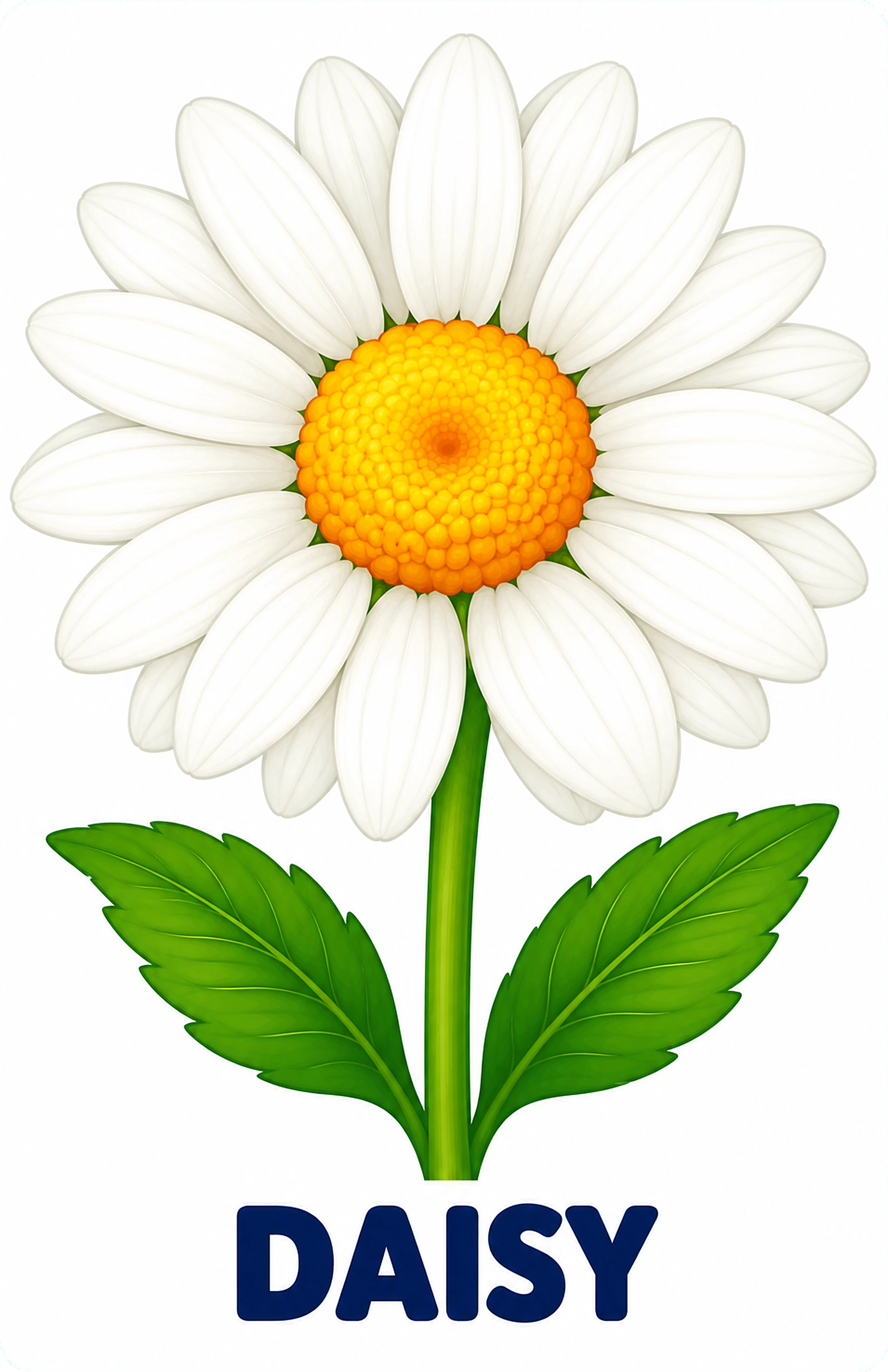
What is this?
A daisy is a small flower that grows low in grass, with a ring of narrow petals around a round gold middle. Daisies open in the morning and close again in the evening.
What does it mean?
The daisy is usually the first flower a child finds without help — small enough to be a discovery, common enough to be findable every single day. Independent discovery is the whole prize at two.
What does the child need to know?
Daisies are the little stars hiding in the grass, with a gold middle and petals like a collar. We find them with our eyes, we never pick the whole patch, and drawing one — circle, spokes — is daisy practice too.
Why this matters
A findable treasure builds watching skills better than any flashcard: eyes down, scanning, spotting. The daisy also opens and closes with the day, a first clock hiding in the grass.
What it teaches
Visual scanning and spotting, tiny-motor pointing at small targets, early drawing (a circle with petals around it), morning-evening rhythm words, and the confidence of a find announced.
Words to learn
daisysmallgrasspetalsgoldfind
Say this to your child
“"A daisy! Small and bright, hiding in the grass. See the gold middle and the white petals all around? Let us go daisy-hunting — eyes down, looking, looking... there! You found one! We look at them where they grow, and we can draw our own at home."”
Step by step
- Show the card, say daisy, and make a tiny circle with your finger and thumb — this flower is the small one in the set.
- Draw a daisy in the air: a little gold circle, then petal-strokes all around — your toddler can add the petals with a pointed finger.
- Take the hunt outside to any grass: how many daisies can we find? Count them loosely — one, two, lots — and celebrate every find.
- Kneel down at one daisy and look properly: the gold middle, the petal collar, the stem hiding in the grass.
- Close with the daisy’s secret: at night the petals close up like hands folded, and morning opens them again — check tomorrow if you can.
Look closer at the picture
Make a tiny circle with your fingers and say daisy. Ask your toddler to find the gold middle on the card, then the petals around it — small finds, carefully pointed at, are the whole game.
Ask your child
"Is the daisy big or little?" "Where does it hide — in the grass or in the trees?" "Can you find one outside?" "What is in the middle, gold or blue?" — answered with a finger-circle, a hunt and a proud stomp-to-spot.
What your child can say or do
"Daisy!" Expect lawn-hunting at every stop, daisies pointed out from car seats, and a first drawn flower — one gold circle, petals exploding around it. Daisies may be gifted to you by the fistful. Say thank you.
Out in the real world
Daisies grow in every park, lawn, verge and crack with grass — the most findable flower in the world. Each white-and-gold spot is a completed hunt, and no equipment was needed, ever.
Try it together
Daisy maths, gently: find one daisy, then another — "one daisy, two daisies!" — and stop while it is still a game. If a grown-up makes a daisy chain, your toddler does the quality control: holding, pointing, approving.
Understanding check
On the next lawn, watch before you prompt: eyes-down scanning means the hunt has stuck. A gold-middle point and the word daisy together — lesson fully bloomed.
Parent tips
Take the hunt at toddler pace — one daisy is a complete expedition. Keep picking to a single flower in your hand only, and let most daisies stay in the grass: the finding was always the treasure.
Staying safe
Lawns hold more than flowers — check the patch for bees, stones and dog mess before the crouching starts. Daisies are not for eating, and newly mown grass, with its sharp little clippings, is a look-only place.
This lesson pairs with the Daisy flashcard in the library — print it, show it, keep it on the fridge. Back to Garden Flowers (School Garden).