
Funnel — a step-by-step lesson for grown-up and child
This lesson teaches the funnel as engineering in one word: change a wide pour into a narrow stream — demonstrated with water, and with one glorious puddle where puddles are allowed.
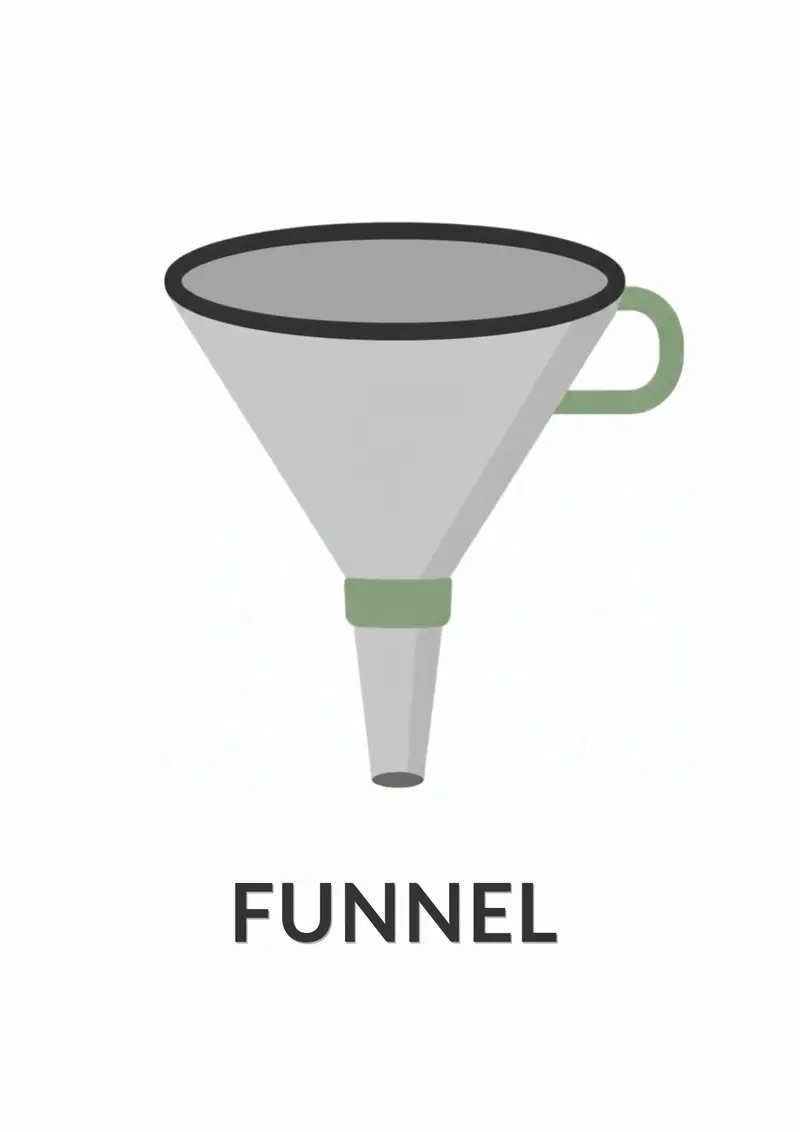
What is this?
A funnel is the little cone that guides a pour into a small opening — water, oil, juice, all delivered neatly into bottles that would otherwise splash.
What does it mean?
This is a name-and-try card: the concept — guiding flow — is the point more than the tool. A child who explains WHY the funnel works has discovered fluid dynamics at the sink.
What does the child need to know?
You need the funnel, an empty bottle, a jug of water — and outdoor permission for the control experiment (no funnel, full pour, one puddle).
Why this matters
Cause and effect is unforgettable when one version is neat and the other is a puddle. The funnel demo delivers both in under a minute.
What it teaches
Pouring control, guided-flow thinking, the wide-vs-narrow concept, and tidy-up reflexes (the puddle demo is outdoors for a reason).
Words to learn
funnelconepourstreambottleno spills
Say this to your child
“"Funnel! Stand it in the bottle… pour — the water runs down the cone, right into the bottle! No spills, no puddles. And with NO funnel? (Outside!) — SPLASH! Now you know: the funnel makes wide pours neat."”
Step by step
- Meet the cone: "funnel! Wide at the top, narrow at the bottom — watch what it does."
- The neat demo: funnel in the bottle mouth, child pours from the jug — "the water glides… right in! Zero puddles."
- The control experiment (outside): same jug, NO funnel, full tilt — "the puddle! That is why the funnel exists."
- The why, asked back: "what does the funnel do?" (makes the opening wide, the stream narrow)
- The encore: funnel a scoop of rice into a jar — solids work too. The tool has range.
Look closer at the picture
On this card the word "funnel" sits over a gray and green cone — wide mouth up, narrow stem down, the whole trick in its shape.
Ask your child
"What does the funnel do?" (guides the pour) "What happens with NO funnel?" (a puddle!) "What else could we funnel?" (rice! sand! juice!)
What your child can say or do
Your child might funnel everything pourable, narrate "wide in, narrow out!", or request the puddle demo weekly — flow, mastered.
Out in the real world
Funnels hide in garages (oil), petrol stations and craft drawers. Each sighting gets the nod: "a funnel — the pouring helper." The concept scales to hoses and funnels forever.
Try it together
Water Lab: funnels of different sizes, bottles of different necks — which pair pours fastest? Test, time, repeat. The lab is open; the floor is waterproof.
Understanding check
Ask: "What does the funnel do?" (guides pours) "Why is it wide at the top?" (to catch the pour) "What did we learn outside?" (no funnel = puddle!)
This lesson pairs with the Funnel flashcard in the library — print it, show it, keep it on the fridge. Back to Kitchen Things.