
Solo — a step-by-step lesson for grown-up and child
This lesson teaches the solo — the spotlight moment: the band steps back, the room goes quiet, and one player carries the music all by themselves.
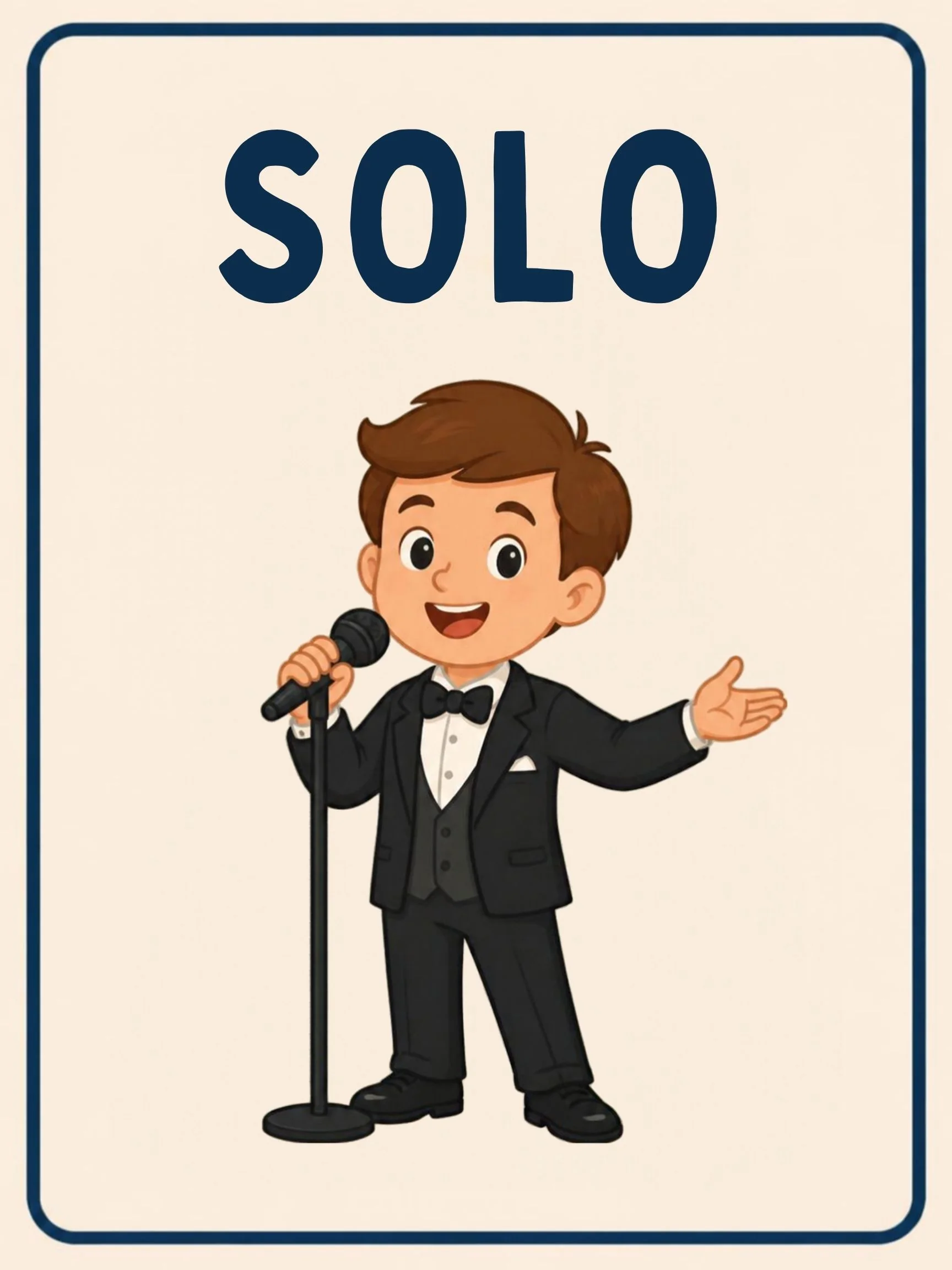
What is this?
A solo is one player performing alone: a guitar solo lifting out of a song, a singer’s unaccompanied verse, a cadenza where the orchestra stops and one violin soars. All eyes, one player.
What does it mean?
The solo is the room’s courage lesson: playing alone in front of people is a genuine bravery skill, and the solo’s structure makes it safe — the band returns, the spotlight is brief, the applause is certain.
What does the child need to know?
Your child needs three solo ideas: a solo is ONE player in the spotlight — the band steps back, not away; the solo is SHORT — eight shining beats can be a whole solo; and the audience is on your side — the quiet is attention, not judgement.
Why this matters
Standing alone and performing is one of childhood’s real mountains — the solo game climbs it in eight-beat steps, with the whole family as the kindest audience a soloist will ever have.
What it teaches
Solo performance courage, holding space alone (short but real), audience-relationship skills (bowing, thanking), and the return-to-the-band structure.
Words to learn
solospotlightalonebraveeight beatsbowapplause
Say this to your child
“"A solo is the spotlight moment — the band steps BACK, the room goes quiet, and one player carries it! And here are the secrets: a solo can be just EIGHT BEATS — short and shining is a real solo. The quiet audience is on your side — that silence is them leaning in. Play your eight beats, take your bow, and the band comes roaring back!"”
Step by step
- Show the card: "This is a solo — one player, one spotlight."
- The step-back: the band does not leave — it steps BACK and lowers to a hush, so the soloist floats on top. Hear it in any song: the sudden quiet around the solo.
- The short truth: a solo can be EIGHT BEATS — a little shine is a real solo. Long is not the point; brave is.
- The kind quiet: when the room goes quiet for a solo, that is ATTENTION, not judgement — the audience is leaning in.
- Play the spotlight game below and close: "one player, all ears."
Look closer at the picture
On this card the word "Solo" stands in big navy capitals inside the rounded frame, with a friendly spotlight illustration below — exactly as the one-player moment looks.
Ask your child
"How many players in a solo? What does the band do — leave or step back? What does the quiet audience mean?"
What your child can say or do
Your child might say: "One player in the spotlight!" "Eight shining beats!" or the soloist: "The quiet was them leaning in — I played my solo!"
Out in the real world
Solos lift out of every song: the guitar break, the drum fill, the a-cappella verse — listen for the step-back tonight and name the solo when it arrives. Eight beats of shine, everywhere.
Try it together
The Spotlight: the family band plays a steady groove (pot, shaker, hum) — then the leader’s hand rises: the band steps to a hush, and the SOLOIST of the round plays eight shining beats alone — any instrument, any sounds. Hand falls: the band ROARS back. Every player gets a solo, every solo gets the full applause, every soloist bows. One player, all ears — courage, in eight-beat servings.
Understanding check
Ask: "How many players in a solo? How long must it be? What is the quiet audience doing?" One, eight beats is plenty, leaning in — three answers and the spotlight is yours.
Parent tips
Eight beats, exactly — the limit is what makes it brave instead of scary. And the band’s ROAR back is essential: the solo always ends in reunion, which is why children ask to solo again.
This lesson pairs with the Solo flashcard in the library — print it, show it, keep it on the fridge. Back to Music Room (Class 23).