
Dig — a step-by-step lesson for grown-up and child
This lesson teaches digging as slow archaeology: the scoop, the pry, the pile — and the patience of going DEEPER instead of starting new holes everywhere.
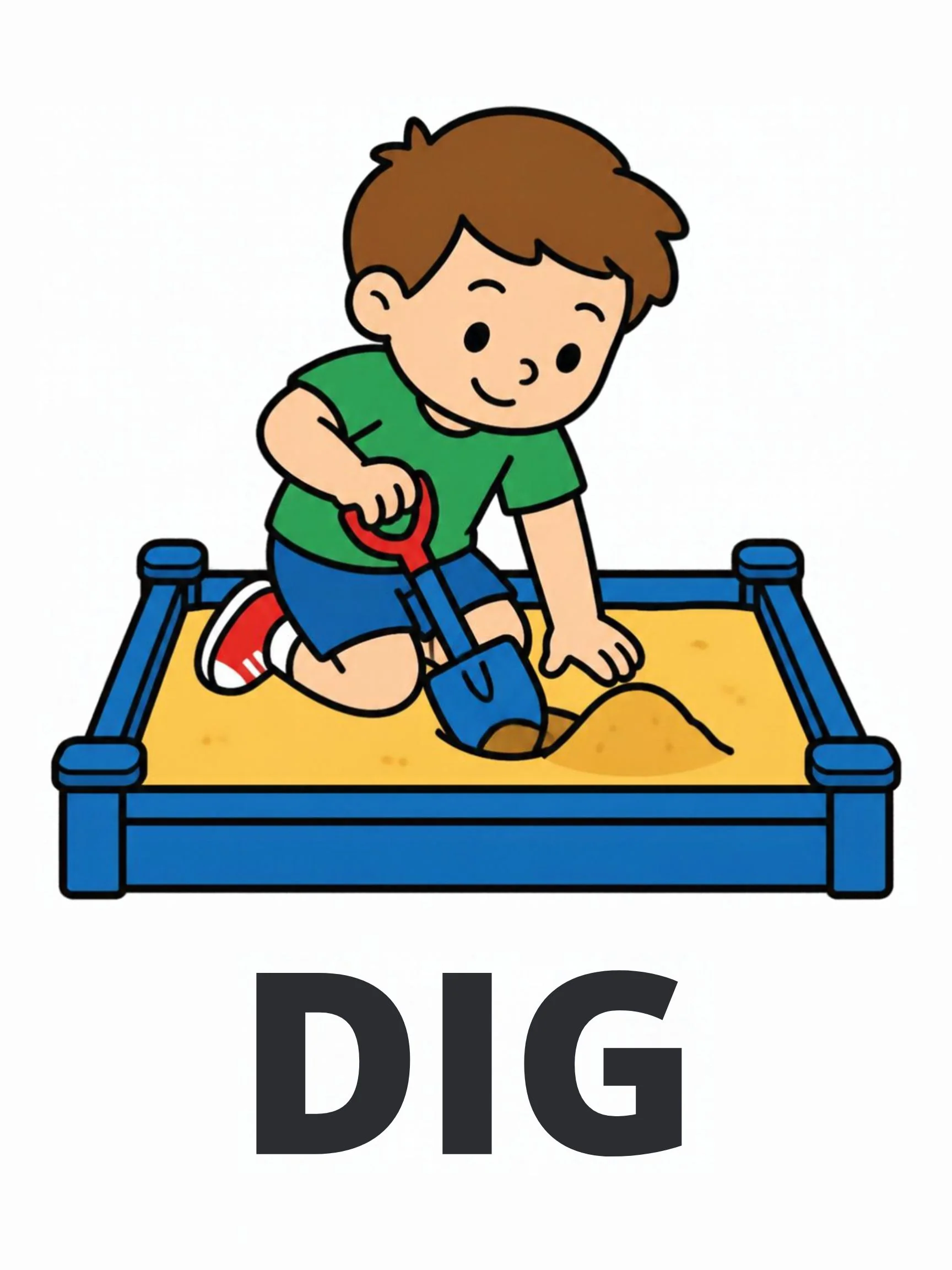
What is this?
Dig is pulling the ground apart with hands or tools: scoop the sand, pry the gravel, pile it up, and keep going — down toward the treasure, the water table, or just the interesting dark layer.
What does it mean?
Digging is whole-body strength work disguised as treasure hunting: wrists scoop, arms pry, trunk stabilises. And its virtue is patience — one hole, going deeper, beats twelve holes, one inch each.
What does the child need to know?
Your child needs three dig ideas: the scoop is a wrist turn — fingers curl, wrist rolls the load out; the pry is a lever — wiggle the stick DOWN then lift; and deep beats wide — one hole with a mission beats a garden of scratches.
Why this matters
Digging builds grip, wrist rotation and trunk strength — the lifting muscles — while teaching the one-sitting virtue of sticking with a job that starts slow.
Words to learn
digscooppryspadepiledeeptreasure
Say this to your child
“"Digging is going DOWN — scoop the sand, pry the stones, pile it up, and keep going deeper! Curl your fingers and turn your wrist for the scoop. Push the stick down to pry the stone up — levers are magic. And the digger’s law: one deep hole beats twelve shallow ones. Deeper, deeper, treasure!"”
Step by step
- Show the card: "This is dig — down to the treasure, one scoop at a time."
- The scoop: hands or spade — fingers curl under, wrist turns, load lifts, pile grows. Practise the wrist turn in the air first.
- The pry: a stick or spade tip under a stone — push DOWN on the handle, the stone lifts. Levers are magic with rules.
- The mission: pick ONE hole and dig it deeper each day — mark the depth with a stick. Deep beats wide!
- Play the dig games below and close: "scoop, pry, deeper."
Look closer at the picture
On this card the word "Dig" stands in big navy capitals inside the rounded frame, with a friendly digging illustration below — exactly as the spadeful looks.
Ask your child
"What does the wrist do in a scoop? How does the pry lift the stone? One deep hole or twelve shallow ones?"
What your child can say or do
Your child might say: "Wrist turn — scoop!" "The stone flew up — lever magic!" or the archaeologist: "My hole is deeper than yesterday!"
Out in the real world
Sandpits, gardens, the beach at low tide — digging jobs are everywhere, and so are the treasures: worms, shells, old coins of the playground. The pry is how real archaeologists lift every stone.
Try it together
Treasure Dig: bury three "treasures" (a bottle-cap coin, a marble, a shell) in a sandpit or a rice bin — one shallow, one middle, one DEEP. The mission: recover all three from ONE hole, using scoops and prys, marking depth with a stick. Finish with the museum: treasures displayed on a bench, hole solemnly refilled. Scoop, pry, deeper — the archaeologist’s whole day.
Understanding check
Ask: "What does the wrist do? What lifts the stone? Deep or wide?" Turns, the pry, deep — three answers and the hole is going down.
Parent tips
Wet sand holds walls and teaches deep digging; dry sand teaches patience with collapse — both are honest teachers. And the refill is part of the game: diggers leave the ground as they found it.
This lesson pairs with the Dig flashcard in the library — print it, show it, keep it on the fridge. Back to Playground.