
Jump — a step-by-step lesson for grown-up and child
This lesson teaches jumping in its four honest beats — bend the knees, swing the arms, fly on two feet, land soft as a frog — the pattern every puddle, line and podium jump shares.
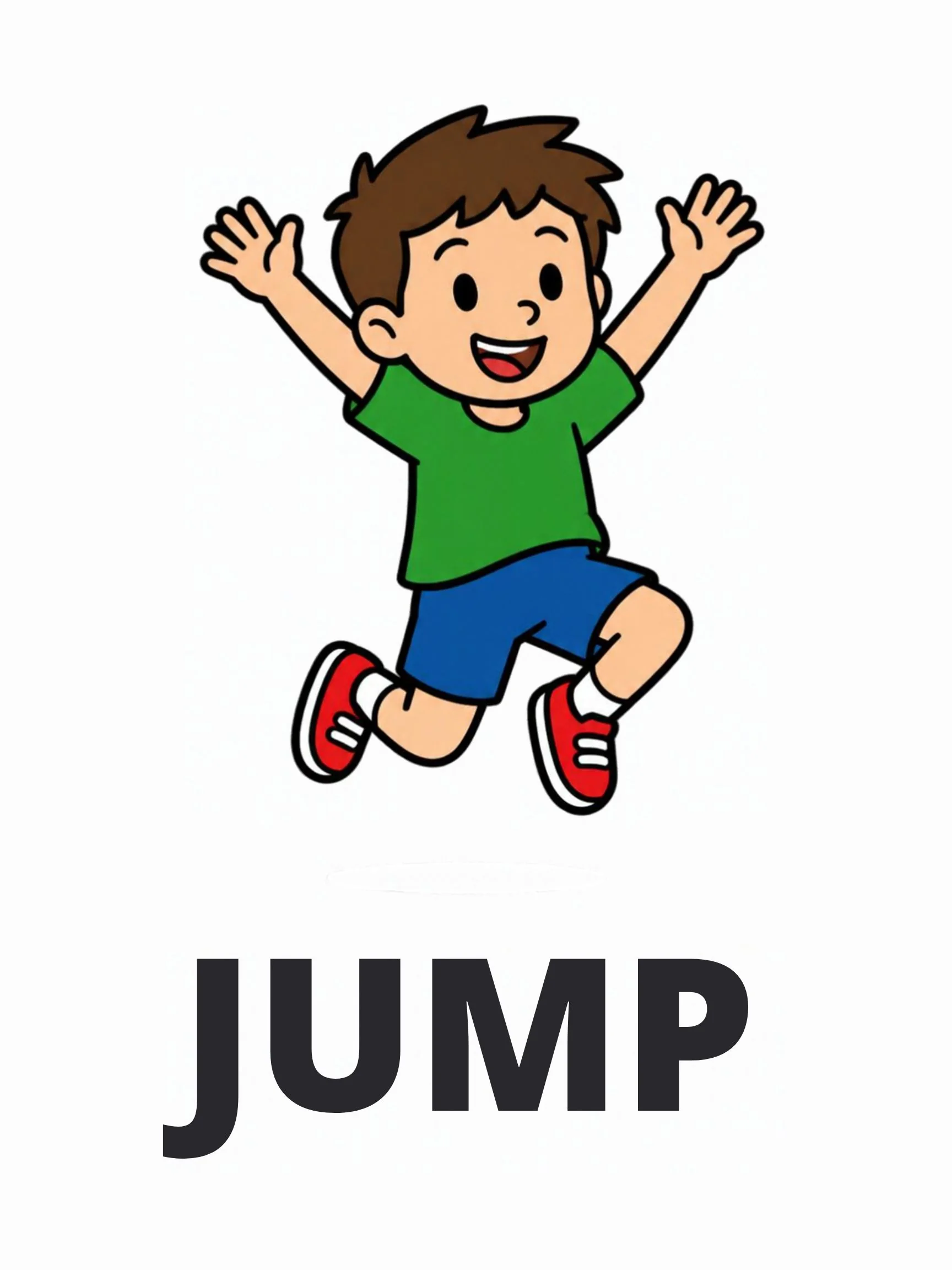
What is this?
Jump is leaving the ground with both feet and landing again: knees bend to load, arms swing to lift, the body flies, and the landing bends the knees again to catch the fall softly.
What does it mean?
The jump’s secret is that landing is half the skill: a jump that ends stiff is a stomp that hurts. Bend-swing-fly-BEND gives children the whole arc — and soft landings are the habit that keeps jumping joyful for years.
What does the child need to know?
Your child needs three jump ideas: the knees are springs — they bend BEFORE the jump to load and AFTER to land; the arms swing UP with the jump — free lift from the wings; and two feet leave together, frog-style.
Why this matters
Jumping is the wall’s most-repeated power move — hops, skips, vaults and dance all borrow its bend-swing-land — and soft landings protect every joint that will ever leap.
What it teaches
Two-foot take-off and landing, arm-leg coordination, force loading (the pre-bend), and the frog-soft landing that makes repetition safe.
Words to learn
jumpbendswingtwo feetlandsoftfrog
Say this to your child
“"Jumping has four beats! BEND the knees — load the springs. SWING the arms up — wings give free lift. FLY on two feet — frog on a lily pad! And land BENT — soft as a frog, quiet as a leaf. Bend, swing, fly, land: every puddle-jump in the world uses the same four beats!"”
Step by step
- Show the card: "This is jump — bend, swing, fly, land soft!"
- The springs: bend the knees — feel the spring load. Jump straight up and BEND on landing — boing! The bend catches you.
- The wings: arms swing UP as the feet leave — try a jump with arms glued down (small!), then with the swing (big!). The arms are free lift.
- The frog landing: land on two feet, knees bent, like a frog on a lily pad — silent as a frog is the goal.
- Play the jump games below and close: "bend, swing, frog-land."
Look closer at the picture
On this card the word "Jump" stands in big navy capitals inside the rounded frame, with a friendly jumping illustration below — exactly as the airborne frog pose looks.
Ask your child
"When do the knees bend — twice or never? What do the arms do? What lands quietly?"
What your child can say or do
Your child might say: "Bend, swing, fly, land!" "My arms gave me free lift!" or the frog report: "Frog-landing — silent as a leaf!"
Out in the real world
Puddle-jumps, chalk lines, the last stair-hope — jumps wait everywhere. The four beats transfer to every one, and the frog-landing is the habit that keeps them all painless.
Try it together
Puddle Line: chalk puddles on the ground — small, middle, wide. Jump each with the four beats: bend… swing… fly… frog-land. Score the landings by SOUND: a quiet frog-land earns a croak of approval, a stompy land earns "again — softer!" Then the lily-pad course: five puddles in a row, frog-hopped with springs and wings. Bend, swing, fly, land — the puddle line is a gym.
Understanding check
Ask: "Name the four beats. What lifts for free? How does a frog land?" Bend-swing-fly-land, the arms, soft and bent — three answers and the puddles are jumped.
Parent tips
"Land like a frog" works better than "land softly" — the animal picture does the coaching. And hold the arms-glued comparison once: feeling the free lift sells the swing forever.
This lesson pairs with the Jump flashcard in the library — print it, show it, keep it on the fridge. Back to Playground.