
Legs — a step-by-step lesson for grown-up and child
This lesson marches in the biggest movers of all. Legs do the going — walking, running, hopping, kicking, climbing — and the games that name them are the kind your child will want to keep playing long after the lesson ends.
What is this?
Legs are the two long parts between the hips and the feet. They stand, walk, run, jump, hop, kick and climb — every place your child gets to, the legs get them there. At the bottom of each leg is a foot, the part that meets the ground.
What does it mean?
Legs are the body’s engines, and feet are their wheels: the legs make the power, the feet steer and land it. Together they carry the whole body through the day — and they are also the strongest muscles your child owns, which is why running feels so good.
What does the child need to know?
Your child needs to know: legs walk, run, jump, hop and kick, each leg ends in a foot, one-leg standing is the legs’ balance trick and it takes practice, and legs get care too — trousers on, shoes tied, rest when they are tired.
Why this matters
Leg vocabulary and leg strength grow together. The marching, hopping and one-leg games build the coordination that playgrounds demand, and naming the legs means a child can say what hurts, what is tired and what just did something brilliant.
What it teaches
Gross-motor power and coordination, single-leg balance (a genuine milestone skill), movement vocabulary, body-part naming below the waist — often the last to be learned — and the stamina pride of a body that goes and goes.
Words to learn
legswalkrunhopkickclimb
Say this to your child
“"These are your legs — the strongest engines you own! They walk, they run, they jump, they kick, they climb. In the middle is your knee, the hinge that folds. Can you march like a soldier? Hop like a bunny? Stand on one leg like a flamingo? Your legs just did the whole circus!"”
Step by step
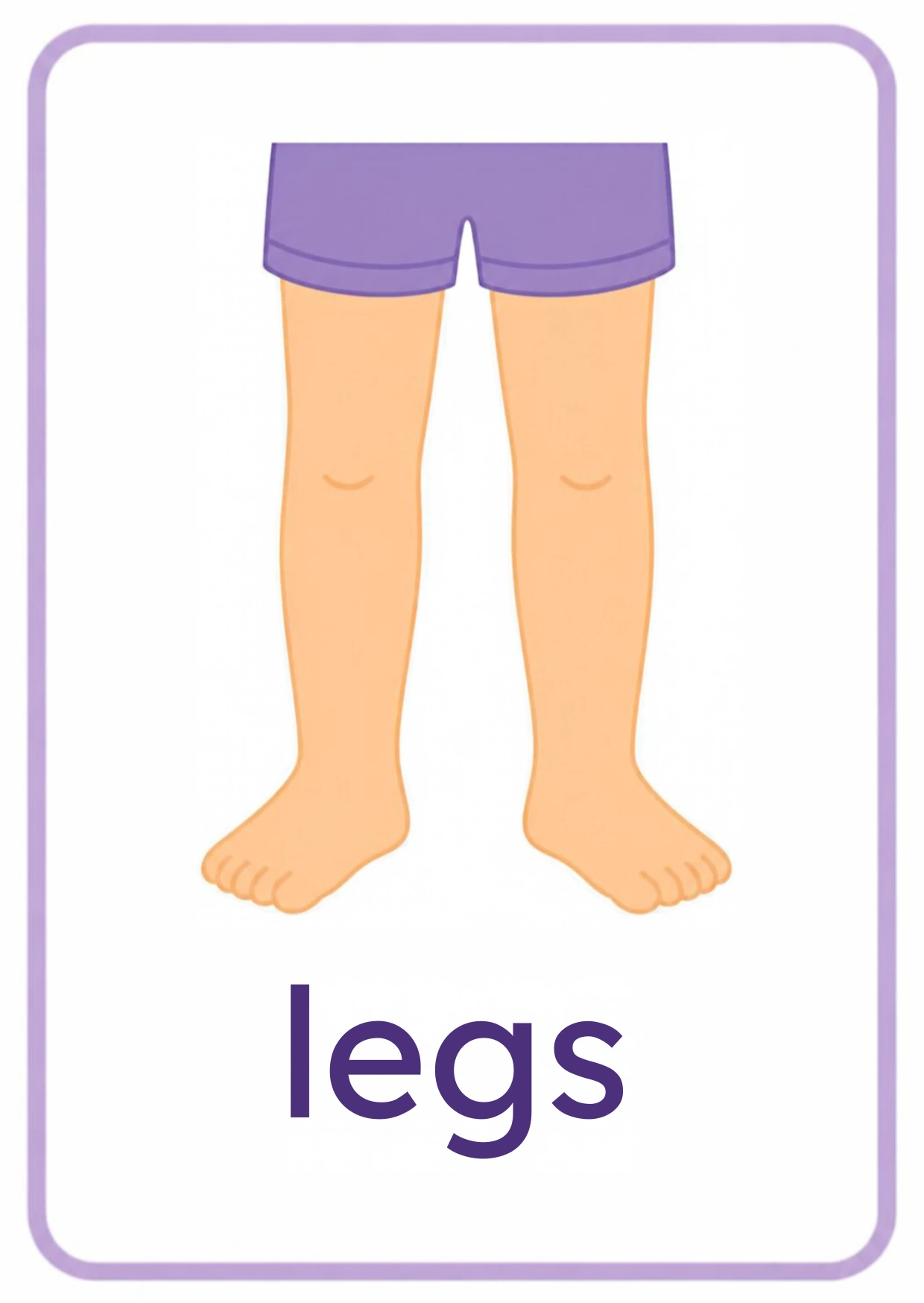
- Show the card: two legs in purple shorts, standing ready. Ask what they are for, then name them: legs — the body’s engines.
- Find your child’s legs: trace from hip to foot. Bend a knee together and feel how the leg folds — the knee is the hinge in the middle.
- Play the engine games: march around the room with high knees, then run on the spot, then a big two-foot jump. The legs are warming up.
- Hold the balance challenge: stand on one leg like a flamingo — count how long, try the other leg, then hold a teddy for difficulty. Flamingos are allowed to wobble.
- Finish with the carrying idea: everything your child reaches — the park, the slide, the top of the stairs — the legs carried them there. Thank the engines out loud.
Look closer at the picture
Look at the picture together: how many legs are in the picture? What are they wearing — purple shorts? What word sits with the legs? Are they standing still or moving?
Ask your child
"What do your legs do all day?" "Where is your knee — show me the hinge!" "Can you hop on one leg — how many hops?" "What did your legs carry you to today?"
What your child can say or do
Your child may march through every doorway for a week, demand flamingo-timing contests with the whole family, or report that legs are the strongest muscles and offer to prove it — engines named, pride installed.
Out in the real world
Legs are named all day: legs up for the trousers, run to the gate, kick the ball, climb the slide, walk to the bus. The playground is the field trip — every apparatus there is a legs lesson already running.
Try it together
Legs circuit: four stations — march ten steps, five two-foot jumps, three hops on each leg, one long balance on one foot with arms out like wings. Run the circuit twice, then let your child design a station for you. Designing is the highest level of knowing.
Understanding check
Ask: "What do legs do? Where is the knee? Show me one-leg balance." The verbs, the hinge and a wobbly flamingo — that is the lesson landed.
Parent tips
Count hops and balance-seconds out loud — the numbers give the game a target and sneak in counting. And expect the flamingo to beat some adults in the family; letting your child win the balance contest is a small price for a body part this loved.
Staying safe
Legs run fast — indoor running lives on rugs, not tiles, and climbing happens with a grown-up in sight. Knees take the falls: patches and plasters are part of the engine’s maintenance, and tired legs are allowed to say so.
This lesson pairs with the Legs flashcard in the library — print it, show it, keep it on the fridge. Back to Body Parts & Five Senses Flashcards.