
Pull — a step-by-step lesson for grown-up and child
This lesson teaches pulling — force that comes TOWARD you: knees bent, body leaning back, grip tight — the wagon, the rope, the door, all one pattern.
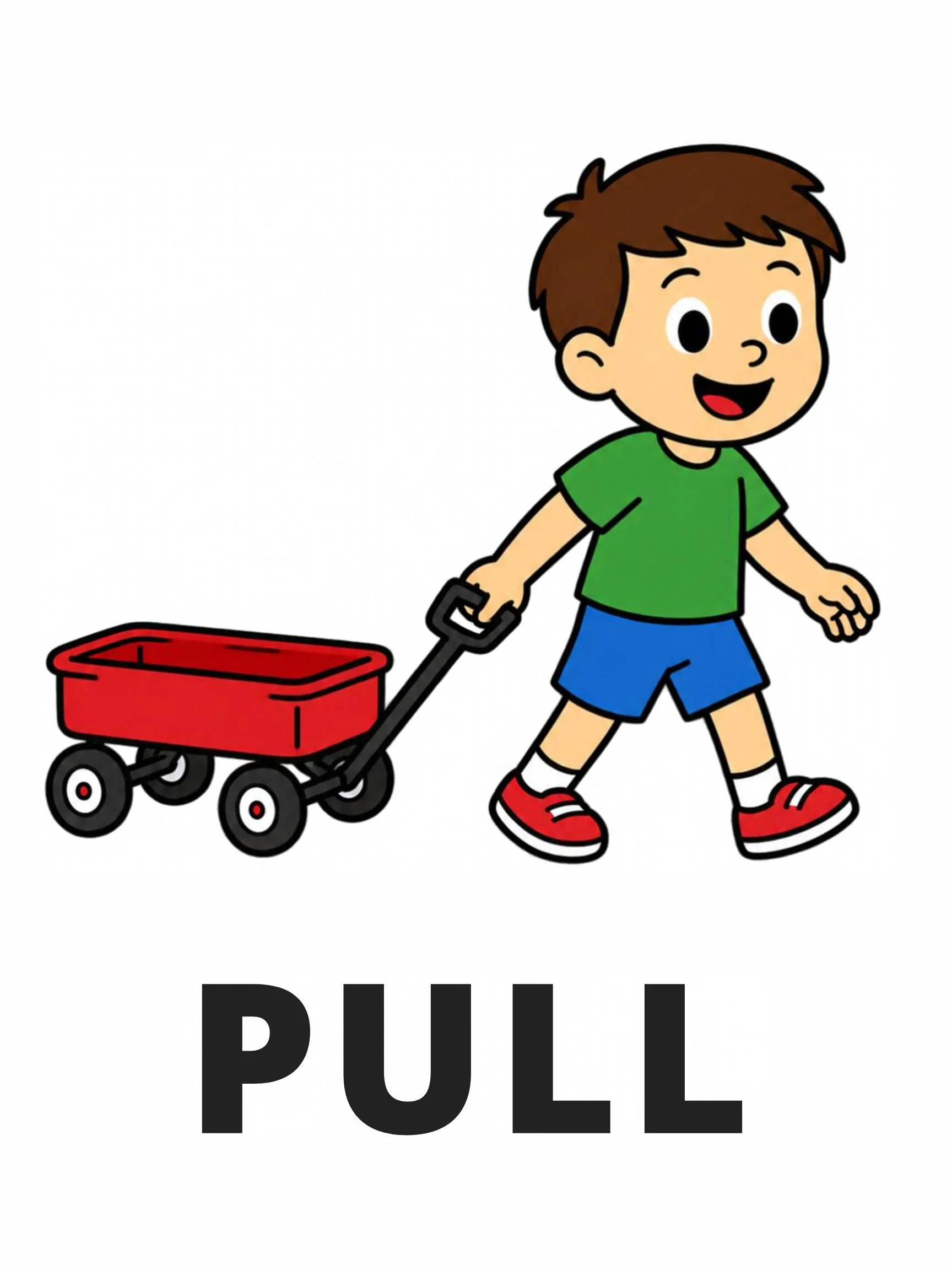
What is this?
Pull is drawing something toward your body: the wagon handle, the tug-of-war rope, the heavy door. Strong pulling leans the body BACK and lets the legs take the strain.
What does it mean?
Pulling is the mirror twin of pushing — and the posture is its whole secret: pulling with a tall straight body strains the back; pulling with bent knees and a lean-back turns the legs into the engine.
What does the child need to know?
Your child needs three pull ideas: pull comes TOWARD the body — the target is your own chest; the body leans BACK and the knees BEND — the legs are the engine; and the grip holds tight — thumbs wrapped, knuckles working.
Why this matters
Tug-of-war is the purest strength game in childhood — and its stance (bent, leaning, gripped) is the same one that will safely pull wagons, ropes and doors for life.
What it teaches
Pulling force with leg drive, grip strength, body-lean coordination, and the partnership game — pulling WITH rules (no letting go!).
Words to learn
pullropelean backkneesgriptugtoward
Say this to your child
“"Pulling comes TOWARD you! The secret is the lean-back: knees bent, body leaning away from the rope, and your LEGS walking backward — the legs are the engine, the hands just hold on tight. Thumbs wrapped! Tug-of-war, wagons, heavy doors — every pull is lean-back and leg-power."”
Step by step
- Show the card: "This is pull — bringing it toward you!"
- The lean-back: hold hands with a partner and pull — feel how leaning BACK makes you strong? Tall-and-forward is weak; bent-and-back is the engine.
- The grip: thumbs wrapped around the rope — no fingertip holds. Grip like you mean it.
- The legs pull: pull a loaded laundry basket (the wagon) — knees bent, lean back, LEGS walk backward. The legs are the muscle.
- Play the tug games below and close: "lean back, legs pull, grip tight."
Look closer at the picture
On this card the word "Pull" stands in big navy capitals inside the rounded frame, with a friendly pulling illustration below — exactly as the lean-back looks.
Ask your child
"Which way does a pull go — away or toward? Where does the engine live — arms or legs? What do the thumbs do?"
What your child can say or do
Your child might say: "Lean back — pull toward me!" "My legs are the engine!" or the grip check: "Thumbs wrapped, rope won’t slip!"
Out in the real world
Pulls wait in every wagon handle, garden gate and pet lead — and the lean-back stance transfers to all of them. Even getting dressed pulls: sleeves toward the body, lean back, legs strong.
Try it together
Tug-of-War Rules: a soft rope or towel, feet planted, knees bent, lean back — pull the marker (a ribbon on the rope) across your line. Rules: never LET GO (the fall rule), stop on the call, lean back not down. Then the wagon pull: load a laundry basket with two toys, pull it across the room — lean-back legs, tight grip. Two pulls, one stance, real strength.
Understanding check
Ask: "Toward or away? What is the engine? What do the thumbs do?" Toward, the legs, wrap — three answers and the pull is strong.
Parent tips
Never-let-go is the safety spine of every tug game — say it before, during, after. And softer is better early: a towel rope teaches the stance without rope burns.
This lesson pairs with the Pull flashcard in the library — print it, show it, keep it on the fridge. Back to Playground.